


Expected Value Formula: How to Calculate EV With Examples

The expected value formula multiplies each possible outcome by its probability, then adds the results. For a discrete random variable, write it as E(X) = Σ pᵢ × xᵢ. In plain English: expected value is a probability-weighted average.
If the outcomes are profits and losses, the answer is expected profit. If the outcomes are numbers on a die, the answer is an expected die score. Defining what you are measuring comes before doing the arithmetic.
This guide covers the formula, worked examples and its use in prediction markets. All financial examples are hypothetical. The prices, probabilities and fees below are teaching assumptions, not live quotes or Macro Markets charges.
What Does the Expected Value Formula Mean?
There are three parts to the formula:
- xᵢ: one possible value of the outcome you are measuring.
- pᵢ: the probability of that outcome, written as a decimal.
- Σ: add the products for all possible outcomes.
For example, 25% becomes 0.25. If an outcome is a loss, keep its minus sign. If two outcomes are the only possibilities, their probabilities must add to 1, or 100%.
The formula gives more weight to outcomes that are more likely. It does not give every outcome an equal vote unless their probabilities are equal.
The result uses the same units as the outcomes. Dollar profits produce a dollar expected profit. A count of items produces an expected count. Do not turn a dollar result into a percentage without defining the amount of capital used.
OpenStax explains expected value as the mean of a probability distribution. That mean need not be one of the outcomes available in a single trial. It summarizes the distribution as a whole.
How to Calculate Expected Value Step by Step
Use this process for a finite set of outcomes:
- Define the quantity. Decide whether you want a payout, net profit, score or another measure.
- List all possible outcomes. Include losing outcomes and any relevant refund or cancellation case.
- Assign probabilities. Use decimals and check that the probabilities total 1.
- Multiply each outcome by its probability. Keep units and minus signs consistent.
- Add the weighted outcomes. Interpret the answer in the units you started with.
Suppose an exercise has two possible net results: a $10 profit with a 25% chance, or a $2 loss with a 75% chance. Those are already net results; no further entry cost needs to be deducted.
| Outcome | Weighted profit |
|---|---|
| +$10 at 25% | +$2.50 |
| −$2 at 75% | −$1.50 |
| Total | +$1.00 |
Weight the profit: 0.25 × $10 = $2.50. Weight the loss: 0.75 × (−$2) = −$1.50. Then add them: EV = $2.50 − $1.50 = $1.00.
That is an expected profit of $1 per trial under the stated model. One trial still ends with a $10 profit or a $2 loss. It does not pay a $1 profit simply because the average is $1.
There is also a 75% chance of losing in this example. Positive expected value and a high chance of winning answer different questions.
Expected Value Examples Beyond a Single Bet
A Fair Die Has an Expected Score of 3.5
A fair six-sided die has possible scores of 1, 2, 3, 4, 5 and 6. Each has a probability of 1/6. Its expected score is:
E(X) = (1 + 2 + 3 + 4 + 5 + 6) ÷ 6 = 3.5.
You cannot roll a 3.5. The number describes the average score across the distribution. It is not a forecast of the next roll.
Using a simple average works here because the six faces are equally likely. If the die were biased, you would need the probability of each face. Adding the face values and dividing by six would no longer be enough.
A Business Scenario Can Use the Same Formula
Suppose a hypothetical project has a 30% chance of a $20,000 net profit and a 70% chance of a $5,000 net loss. These are the only outcomes in this simplified model.
EV = 0.30 × $20,000 + 0.70 × (−$5,000) = $2,500.
The expected profit is $2,500, while the most likely individual outcome is a $5,000 loss. The formula does not decide whether that risk is affordable. It also does not account for the time to receive the money unless the outcomes have been adjusted for time.
These examples show why the quantity matters. An expected die score, a project profit and a contract payout can use the same mathematics while measuring different things.
Expected Value in Prediction Markets
In a prediction market, separate the event's estimated chance from the price paid for a contract. Then define the actual payments in each settlement outcome.
Consider a hypothetical Yes contract that pays $1 if an event occurs and $0 otherwise. Assume it is held until normal settlement, with no refund or cancellation. Let:
- p be your estimated probability that Yes wins.
- c be the purchase price per contract.
- f be a fixed extra cost per contract, identical in both outcomes.
The net profit is $1 − c − f if Yes wins, and −c − f if it loses. Applying the general formula gives:
EV = p × ($1 − c − f) + (1 − p) × (−c − f).
After simplifying, EV = p × $1 − c − f. This is a dollar amount per contract. The shortcut depends on the $1-or-$0 payout and the fixed cost assumption.
For a different winning payout, multiply the probability by that payout. For fees that vary by outcome, build each outcome's net profit separately. If a contract can be canceled or refunded, include that possibility instead of forcing every outcome into Yes or No.
A Worked Contract Example After Costs
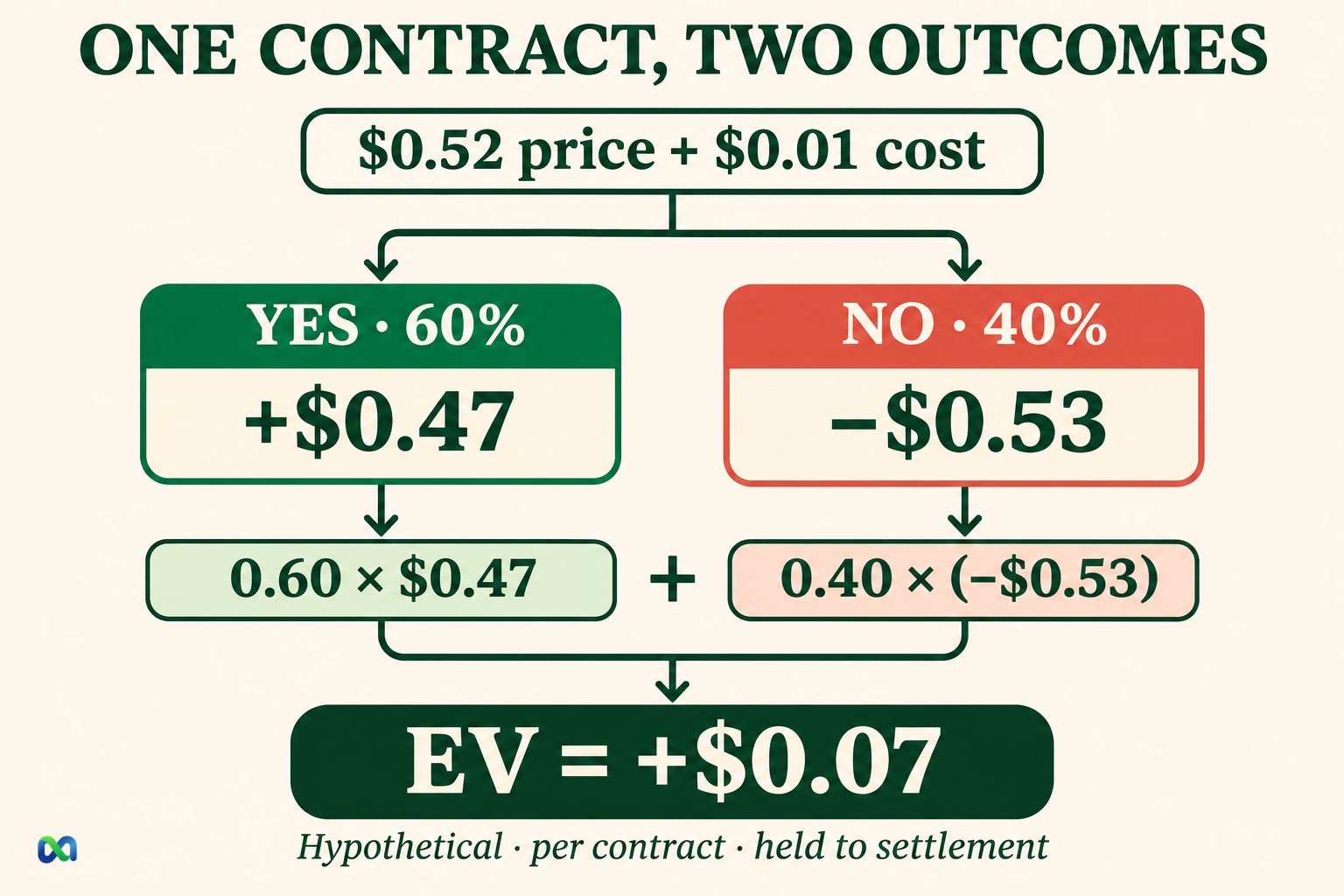
Assume a 60% estimated chance of Yes, a $0.52 entry price and a $0.01 fixed extra cost per contract. The total amount paid is $0.53.
If Yes wins, the net profit is $1 − $0.53 = $0.47. If it loses, the net loss is $0.53. The two-outcome calculation is:
EV = 0.60 × $0.47 + 0.40 × (−$0.53) = $0.07.
The shortcut gives the same result: 0.60 × $1 − $0.52 − $0.01 = $0.07.
For 100 contracts on that same event, the estimated EV is $7. The position could still finish with a $47 profit or a $53 loss. Buying 100 contracts does not create 100 independent event outcomes; they all depend on the same settlement.
You can change the assumptions in our prediction market expected value calculator. The calculator performs the arithmetic; it cannot establish whether your probability estimate is sound.
Test the Probability Assumption
Keep the same $0.53 total cost and change only the probability. The result can change sign:
| Estimated chance | EV per contract |
|---|---|
| 45% | −$0.08 |
| 50% | −$0.03 |
| 53% | $0.00 |
| 55% | +$0.02 |
| 60% | +$0.07 |
The break-even probability is 53% under these assumptions. If a plausible change in your estimate moves it below that level, the model's positive result is fragile.
A displayed price is a useful reference for implied probability. It is not proof of the event's true chance. Using the entry price itself as your probability estimate produces zero EV before costs in this simplified contract model.
What Positive Expected Value Does Not Tell You
Positive EV means the probability-weighted result is above zero under your assumptions. Negative EV means it is below zero. Neither label tells you what will happen next.
The University of California, Berkeley's explanation of the long run distinguishes an average tendency from a promise about a sequence of results. A losing streak does not make the next independent outcome owe you a win.
Prediction-market inputs bring another problem: the probability is usually estimated rather than known. Repeating a mistaken estimate does not turn it into a reliable one. Related positions may also lose together.
An EV figure does not, on its own, show the largest possible loss, the spread of outcomes, the time your money is committed or how much of your capital is exposed. Two positions with the same EV can have very different risks.
It also does not say that a high-probability outcome is worth its price. For a $1-or-$0 contract with no extra costs, an estimated 60% chance and a $0.70 price give EV = −$0.10. The event is the favorite in that model, but its price exceeds its expected payout.
Keep a record of the probabilities you assigned before events resolved. Our Brier score guide explains one way to evaluate those forecasts across completed events. That is a separate task from measuring the profit on the prices you paid.
Common Expected Value Calculation Mistakes
Using a payout where you need net profit. Receiving $1 after paying $0.53 is a $0.47 profit, not a $1 profit. Define the outcome before weighting it.
Removing the minus sign from losses. A 40% chance of losing $0.53 contributes −$0.212 to EV. Making it positive reverses the economic meaning.
Counting a cost twice. If each scenario already uses net profit after fees, do not subtract those fees again at the end. Likewise, an actual execution price already reflects the amount paid for the contract.
Ignoring how the order will execute. A last-traded price or midpoint may differ from the average price available for your quantity. Use a realistic execution price and include costs that remain outside it. Our prediction market fee calculator helps separate some of those assumptions.
Treating one result as a verdict on the estimate. A positive-EV position can lose, and a negative-EV position can win. Evaluate the probability model and the realized outcome separately.
Treating EV as a complete strategy. A dollar expectation does not choose position size, assess account eligibility or resolve unclear contract wording. For the practical process around a contract, use our guide to trading on prediction markets.
Expected Value Formula FAQ
What Is the Simplest Expected Value Formula?
For a finite set of outcomes, use EV = Σ probability × outcome. Multiply the value of each outcome by its probability, then add the products. For money, specify whether those values are gross payouts or net profits.
Can Expected Value Be Negative?
Yes. If the outcome variable includes losses, their weighted contributions can exceed the weighted gains. Negative expected profit is different from a negative probability: probabilities themselves cannot be negative.
Is Expected Value the Same as an Average?
It is a probability-weighted mean. The sample average summarizes outcomes you actually observed. They can differ, especially over a small sample or when the probability model is inaccurate.
What If All Outcomes Are Equally Likely?
For a finite set of equally likely outcomes, add their values and divide by the number of outcomes. That is why a fair six-sided die has an expected score of 3.5. Use probability weights when the outcomes are not equally likely.
Does Expected Value Guarantee a Profit Over Time?
No. An estimated EV depends on the model, probabilities and costs being appropriate. Even a sound model can produce losses over a finite period. Repetition does not remove model error, limited capital or exposure to related events.
AI-generated illustrations. All numerical scenarios are hypothetical; no image depicts a live market or a guaranteed return.
