


Sunk Cost Fallacy: Examples in Trading and Investing

The sunk cost fallacy is the mistake of letting an unrecoverable past investment determine whether you commit more resources today. Money, time, and effort already spent can make a position feel worth defending even when the remaining benefits no longer justify the remaining costs.
In investing, the useful question is what holding offers from this point compared with selling and using the proceeds elsewhere. Your purchase price explains your past result. It does not, by itself, establish the better choice now.
What Is the Sunk Cost Fallacy?
A sunk cost has already been incurred and cannot be recovered. The fallacy appears when that past cost becomes a reason to continue an activity, rather than evaluating the activity's future benefits and costs.
The St. Louis Fed distinguishes sunk costs from opportunity costs when explaining everyday decisions. The distinction applies to an abandoned project as well as a disappointing investment.
Imagine you paid for a research subscription. The payment is nonrefundable, and a particular report is no longer useful. Spending another evening reading it does not recover the fee. The relevant comparison is between the value of that evening's reading and the best available use of the same time.
Continuing can still be reasonable. A project might have strong future prospects despite earlier mistakes. What matters is whether those future prospects support the decision independently of the resources already spent.
That separates the fallacy from ordinary persistence. A sound decision can involve patience, repeated effort, and temporary losses. Those qualities become a problem when they replace a fresh assessment of the choice.
A Losing Position Is Not Entirely a Sunk Cost
An investment can contain both an irreversible past payment and an asset you can still sell. Ignoring the asset's present value would create a second mistake.
If you paid $70 for a position and can sell it for $40 today, the original payment cannot be changed. But the available $40 matters. Keeping the position means declining that cash and retaining exposure to the future outcome.
Do not automatically describe the entire $70 as money that is now unavailable in every form. You still own something with a possible exit value. Likewise, do not assume the $40 is available if the displayed price cannot be executed for your position size.
Use the net proceeds you could actually obtain after exit costs. A last-traded price, an indicative quote, and a firm executable bid can imply different choices. Where no early exit exists, the decision may instead concern whether to add more exposure or allocate new money elsewhere.
Worked Example: Hold or Sell a Contract
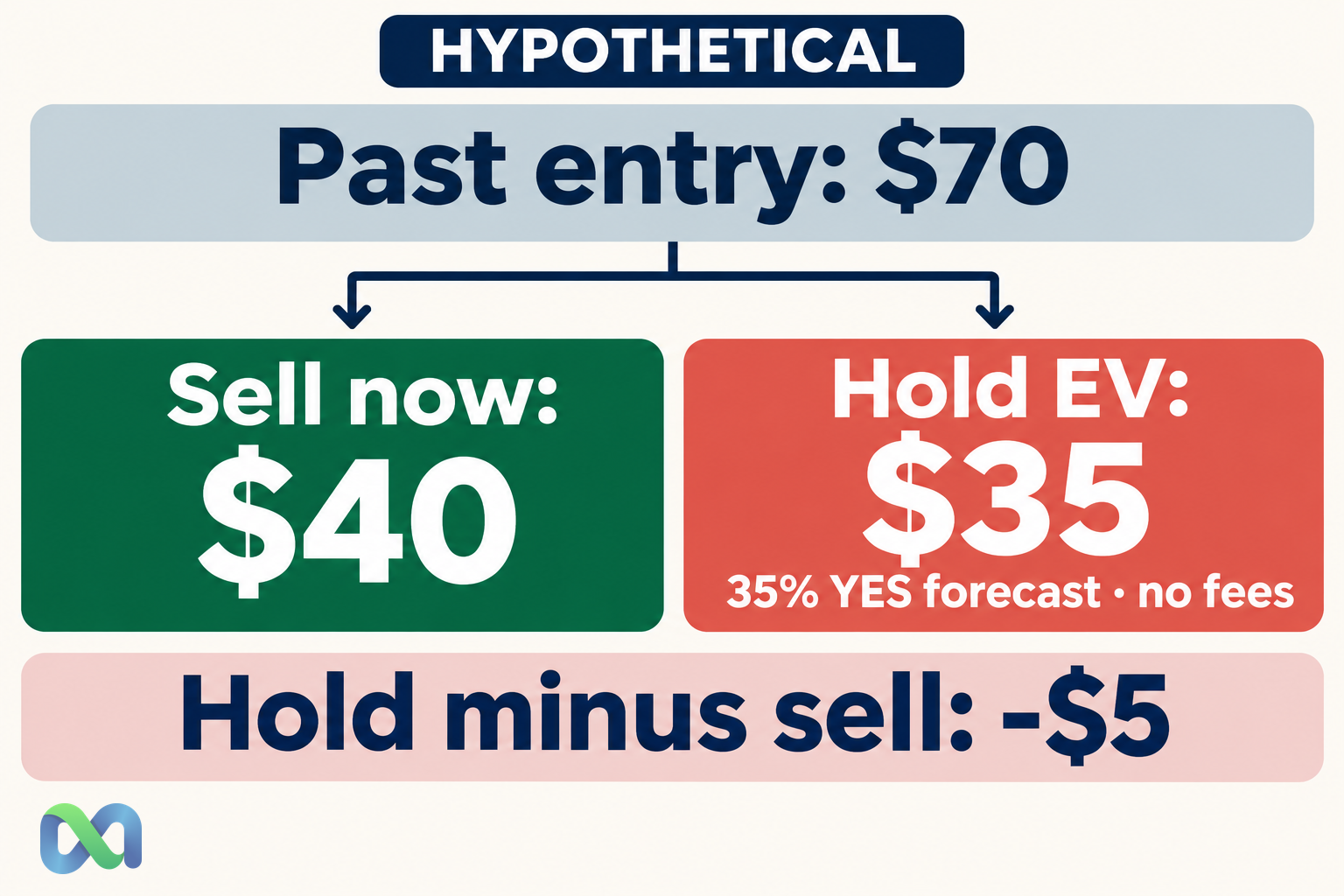
Consider a hypothetical position in 100 binary event contracts. Each pays $1 if YES occurs and $0 otherwise. You originally paid $0.70 per contract, for a $70 entry cost.
Assume you can now sell all 100 contracts for $0.40 each. There are no fees or taxes in this example, and holding cash earns zero over the remaining period. Your current estimate of YES is 35%.
| Measure | Amount |
|---|---|
| Original cost | $70 |
| Sale proceeds | $40 |
| Hold value | $35 |
The expected settlement value of holding is 100 × $1 × 0.35 = $35. Selling produces $40 now. Under these assumptions, holding offers $5 less in expected value than selling.
The original $70 cost appears in either historical profit calculation:
- Sell now: $40 − $70 = −$30.
- Hold: $35 − $70 = −$35 in expected profit.
The difference remains $5. The old cost does not reverse the ordering because it is the same past payment in both choices.
This does not guarantee that selling will look better after settlement. If YES occurs, holding pays $100. If NO occurs, it pays $0. The calculation compares today's estimated outcomes; it does not reveal which outcome will happen.
The scenario is an illustration, not a current quote or platform fee schedule. A real comparison must include executable prices, costs, settlement timing, and uncertainty in the probability estimate.
When Continuing Can Be the Better Choice
Change the forecast in the same example from 35% to 55%, while keeping the sale proceeds at $40. Expected settlement value becomes $55. Holding now offers a $15 expected advantage over selling, before any omitted costs or risk considerations.
The earlier loss has not disappeared. The future comparison has changed because the forecast has changed.
That is a reason to review the evidence behind the new forecast. If the estimate rose only because you wanted to justify the position, the calculation would merely express the original bias in numbers. A written forecast needs reasons that can be checked and challenged.
Our expected value guide explains how to compare possible payoffs. Expected value remains one input: a person who cannot bear a full loss may choose differently even when the average modeled payoff is higher.
The same reasoning works for a business project. Suppose $12,000 has already been spent and cannot be recovered. Completing the project requires another $4,000 and is expected to generate $3,000 in additional benefits. Continuing has a forward value of −$1,000; stopping avoids that additional loss under the stated assumptions.
If credible new evidence raises the expected benefits to $6,500, continuing instead has a $2,500 forward surplus. The decision changes because the remaining opportunity changes, not because the original $12,000 deserves repayment.
Sunk Cost, Opportunity Cost, and Loss Aversion
These ideas describe different parts of a decision.
| Concept | Focus |
|---|---|
| Sunk cost | Unrecoverable past |
| Opportunity cost | Forgone alternative |
| Loss aversion | Response to losses |
A sunk cost concerns something you cannot change. An opportunity cost concerns what you surrender by choosing one available path over another. Loss aversion concerns the importance a person places on losses relative to gains.
They can interact. Recognizing a loss might feel unpleasant, which can make a past purchase price seem more important than new evidence. That possibility does not establish that every investor holding a losing asset is biased.
Consider the investor's current alternatives, goal, time horizon, and ability to bear losses. Those are more useful than assigning a psychological label from a price chart alone.
A Practical Review for an Existing Position
Write the decision in terms of what can still change:
- State the choice. Hold, sell, reduce, add, or wait for a specified piece of information.
- List recoverable resources. Include realistic sale proceeds and refundable or avoidable costs.
- Separate past payments. Keep nonrefundable costs in the performance record, without using them to justify new spending.
- Estimate future consequences. Include downside outcomes, costs, timing, and the value of other available uses of capital.
- Name the evidence. Record what would make you revise the forecast or the chosen action.
One useful question is whether you would enter the same position today at its current executable price. An answer of no is a reason to investigate. It is not an automatic order to sell: taxes, costs, access restrictions, and portfolio effects can make a new purchase different from maintaining an existing holding.
Set the review rule before you become attached to a particular outcome. A scheduled review can make the process easier to follow, but the schedule itself does not ensure a correct forecast.
Keep the Performance Record Honest
Removing sunk costs from a forward decision does not mean removing them from your records. Original entry costs, failed projects, and research expenses still matter when evaluating what a strategy has achieved.
Keep two views. The performance view records what happened, including every relevant expense. The decision view compares the options available now. Mixing them can produce either excessive attachment or an unrealistically flattering track record.
Also distinguish a bad result from a bad process. A carefully evaluated decision can lose money, and a poorly justified one can profit. Review repeated decisions using records made before their outcomes, rather than explaining each result with a story invented afterward.
The risk aversion guide adds another part of that review: a forecast does not tell you how much uncertainty you can afford to accept.
Frequently Asked Questions
Is Holding a Losing Investment Always a Sunk Cost Fallacy?
No. Holding may be justified by current value, future prospects, costs of switching, or the investor's goal. The fallacy is using an unrecoverable past commitment as the reason for adding or maintaining exposure without a sufficient forward case.
Are All Previous Investment Costs Irrelevant?
They remain relevant to historical performance and may help explain taxes or contractual terms. For today's choice, distinguish past payments from future consequences that differ between holding and exiting.
Does Avoiding the Fallacy Require a Stop-Loss Order?
No. A stop-loss is one possible trading rule, with execution and market risks of its own. Avoiding the fallacy requires comparing present alternatives using current evidence. It does not prescribe a universal exit price.
