




USMNT World Cup 2026: Group D Guide
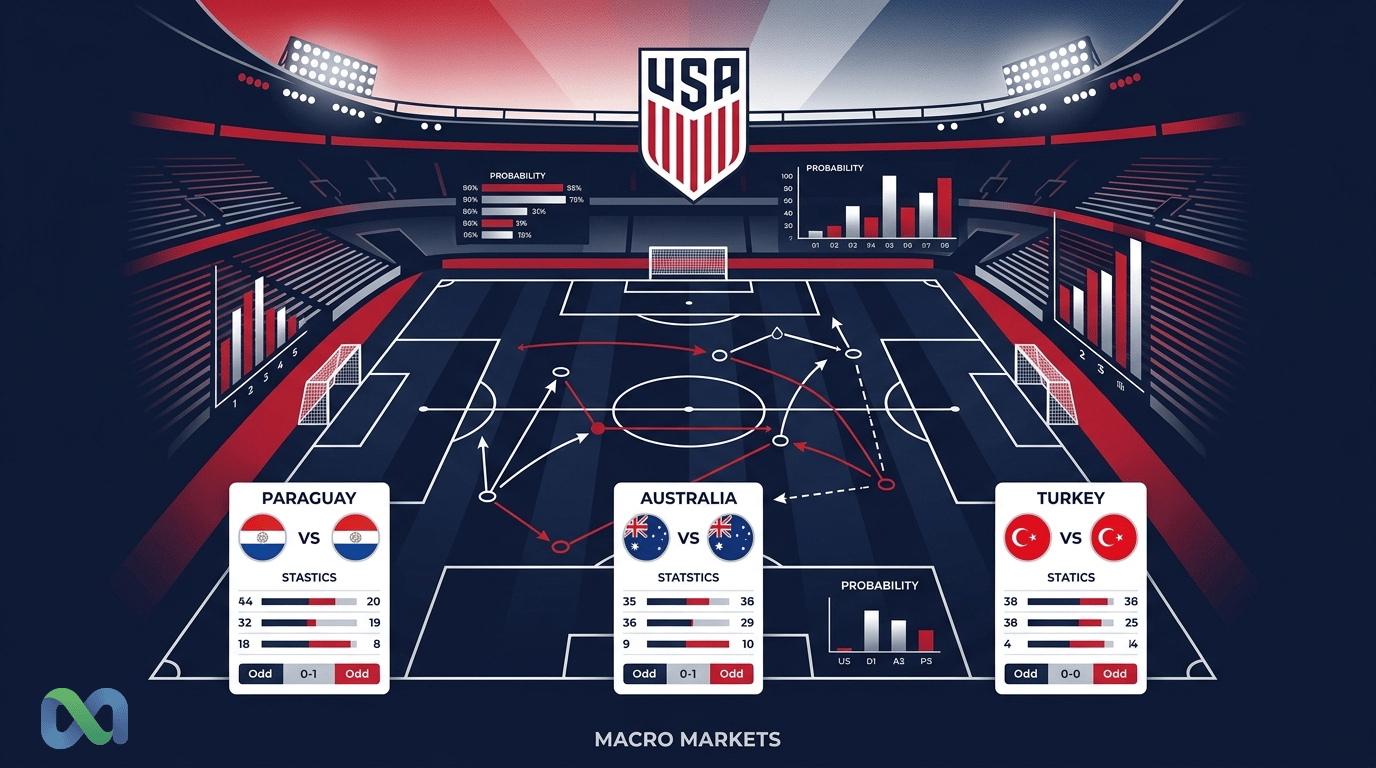
The USMNT World Cup 2026 campaign arrives in a rare position. The United States will play at home, enter as a co-host, and carry the pressure of turning the country's soccer growth into a tournament result. This is not only a sporting campaign. It is a public test for the generation of Christian Pulisic, Weston McKennie, Tyler Adams, Antonee Robinson, Folarin Balogun, Gio Reyna, Tim Weah, and Chris Richards.
The United States is in World Cup 2026 Group D with Paraguay, Australia, and Turkey, according to the research frame used in this guide. The team qualifies automatically as one of the host nations, alongside Canada and Mexico. Mauricio Pochettino leads the group, with a mandate to bring more intensity, high pressing, and competitive clarity to the squad.
This guide covers the group, fixtures, history, likely squad, playing style, key players, and market probabilities for the USMNT World Cup 2026. The goal is to separate confirmed facts from projections, without treating market prices as certainty. Probabilities move with squad news, injuries, friendlies, and trading volume.
Editorial update: May 2026. Final squad, kick-off times, and venues should be checked against the official FIFA World Cup 2026 page before final publication.
United States World Cup 2026 Summary
The United States World Cup 2026 team qualifies automatically because the country is co-hosting the tournament. The USMNT enters Group D, faces Paraguay, Australia, and Turkey, and should begin the competition with a strong home-environment advantage. The pressure, however, will be greater than in previous World Cups.
Quick summary:
- Country: United States.
- Status: automatically qualified as co-host.
- Group: Group D.
- Opponents: Paraguay, Australia, and Turkey.
- Head coach: Mauricio Pochettino.
- Main player: Christian Pulisic.
- Best World Cup finish: third place in 1930.
- Last World Cup: round of 16 in 2022.
- Strength: pace, physicality, transitions, and home advantage.
- Watch point: consistency against teams outside CONCACAF.
Group D and opponents
Group D is favorable, but it is not simple. Paraguay usually competes well in physical matches. Australia brings aerial strength, discipline, and World Cup experience. Turkey adds technical talent, quick transitions, and players used to European pressure.
That is why the USMNT 2026 World Cup outlook should not be analyzed only through the host-nation angle. The team has to control different types of games. Against Paraguay, the challenge is winning duels and avoiding transitions. Against Australia, set pieces and crosses matter. Against Turkey, the risk appears between the lines and after midfield turnovers.
How the United States qualified
The United States qualified automatically because it is hosting the 2026 World Cup. That advantage removes qualifying risk, but it creates a different problem. The team reaches the tournament without the same number of high-pressure official games it would have had in a qualifying campaign.
That detail matters for probabilities. Friendlies and regional competitions help, but they do not fully replicate a World Cup environment. Therefore, the market can react sharply to any poor test against higher-level opponents.
Squad status
The official squad still needs to be confirmed by the federation. Until then, any list should be treated as a projected squad, not a final roster. The core is clear: Pulisic leads the creative work, McKennie brings box runs and intensity, Adams protects the defense, Robinson drives the left side forward, and Balogun competes for the center-forward role.
That caution is essential for the USMNT World Cup 2026. An injury to Pulisic, Adams, or Robinson changes the reading of the team. The choice between Reyna, Weah, and other attacking pieces can also alter the tactical shape.
USMNT World Cup 2026 Schedule
The United States World Cup 2026 schedule will be one of the most searched topics before the tournament opens. The final match calendar should be validated with FIFA. Still, the Group D structure allows three types of games to be projected: an emotional opener, a second-round control test, and a final group game shaped by qualification pressure.
United States vs Paraguay
The opener against Paraguay should be the most emotional match in the group. The United States will be at home, with strong support and global attention. Paraguay, on the other hand, may accept less possession and look for direct duels.
For the USMNT World Cup 2026, the first goal changes everything. If the United States scores early, it can control the rhythm and use transitions. If the match gets stuck, crowd anxiety can become a factor. This is the type of game where live probabilities can move very quickly.
United States vs Australia
Against Australia, the focus should be territorial control. Australia usually competes well physically and can create danger from set pieces. That forces the United States to avoid wide free kicks, unnecessary crosses, and simple turnovers near the box.
The match also tests midfield maturity. McKennie and Adams will be important for second balls, cover, and counter-pressing. Pulisic and Robinson can attack the left channel, but they need to balance forward runs with protection behind them.
United States vs Turkey
Turkey may be the most technical opponent in the group. The team often produces strong attacking talent and can accelerate attacks in a few passes. For that reason, the United States needs to manage the distance between the back line and midfield.
The read for the USMNT World Cup 2026 is clear: the more open the game, the higher the variance. That can favor Pulisic, Weah, and Balogun in transition. It can also expose the center backs to long duels and difficult decisions.
How to use a World Cup simulator to project the path
The United States path depends on its final position in Group D. A first-place finish may open a cleaner knockout route. A second-place finish may bring a heavier opponent immediately in the elimination rounds. That is why simulating results helps show the value of each group match.
The World Cup 2026 simulator lets you test group scenarios and bracket paths. Use the tool as a map of possibilities, not as a fixed prediction. World Cup soccer has a small sample and heavy context shifts.
United States World Cup History
The United States World Cup history shows a team in development, but still short of the traditional powers. The third-place finish in 1930 remains the country's best campaign. In the modern cycle, the team has alternated between solid group-stage performances, round-of-16 exits, and painful absences.
In 2022, the United States advanced from a difficult group but lost to the Netherlands in the round of 16. The campaign showed organization, energy, and young talent. It also showed clear limits against a more mature team.
Best campaigns
The United States' best World Cup campaign came in 1930, when it finished third. In recent tournaments, the round of 16 has been the most common ceiling. That pattern matters for anyone analyzing market probabilities.
Winning USA World Cup Group D is a plausible thesis. Reaching the quarterfinals requires more. Entering the title conversation still depends on a competitive jump against elite opponents.
Recent performance in 2022
In 2022, the United States went unbeaten in the group stage. It drew with Wales and England, beat Iran, and advanced. In the round of 16, it lost to the Netherlands in a match that exposed lapses in concentration and penalty-area defending.
The lesson for 2026 is direct. The team can compete with intensity. It still needs to turn possession and pressure into cleaner chances. It also needs to defend better when it loses the ball with fullbacks high up the pitch.
The challenge outside CONCACAF
The USMNT World Cup 2026 squad arrives with players in strong leagues, but it has to prove consistency outside the regional environment. Beating CONCACAF teams is not enough to measure a World Cup ceiling.
Paraguay, Australia, and Turkey offer different tests. After that, the knockout stage raises the level again. The market should therefore adjust its reading as the United States shows control, efficiency, and emotional response inside the tournament.
Coach and Playing Style: What Pochettino Changes for the United States
Mauricio Pochettino gives the USMNT World Cup 2026 team a more aggressive identity. The central idea is to press high, recover quickly, and accelerate when the opponent is disorganized. That model fits a young, physical squad used to playing at a high tempo.
FIFA has already highlighted the scale of Pochettino's challenge with the United States. The point is not only to build a competitive team. It is to do it in a home tournament, in a country that wants to use the World Cup to accelerate the growth of the men's game.
High pressing and intensity
High pressing could be the United States' biggest gain. Pulisic, Weah, McKennie, and Adams have the energy to close passing lanes. Balogun, or another center forward, can direct the opponent's build-up.
When it works, that plan creates short attacks. The United States does not need to build from deep every time. It wins the ball near the box and finishes quickly. But if the first line of pressure fails, the defense is exposed.
Transitions with Pulisic and Weah
Christian Pulisic is the main accelerator. He receives between fullback and center back, attacks diagonally, and draws fouls. Tim Weah offers depth on the other side. Together, they can turn ball recoveries into shots within seconds.
That shape makes sense for the USMNT 2026 World Cup. Playing at home can create a high rhythm and a crowd pushing the team forward. But the team needs to choose its moments. Pressing without pauses can open too much space.
Defensive risks and midfield control
The risk is control. If Adams is not healthy or not at his best rhythm, the midfield loses cover. If McKennie pushes too high, the back line is left with open field behind it. If Robinson advances without protection, the left side becomes a counterattack route.
That is why Pochettino needs to balance courage and pragmatism. In a World Cup, one mistake can change the tournament. The best version of the United States will be intense, but not anxious.
Projected United States Squad for World Cup 2026
The projected United States squad combines European experience, MLS players, and young talent in development. The final roster has not been released yet. Therefore, the list below should be read as a projection, not as official confirmation.
Likely names or players in contention:
- Goalkeepers: Matt Turner, Ethan Horvath, and other names from the cycle.
- Defenders: Antonee Robinson, Chris Richards, Sergino Dest, Tim Ream, and Cameron Carter-Vickers.
- Midfielders: Tyler Adams, Weston McKennie, Yunus Musah, Gio Reyna, and Malik Tillman.
- Forwards: Christian Pulisic, Tim Weah, Folarin Balogun, Ricardo Pepi, and Brenden Aaronson.
Goalkeepers
Goalkeeper is one of the biggest watch areas. Matt Turner has national-team experience, but club level and competitive rhythm may matter. In a World Cup, a goalkeeper does not need to make 10 saves per match. He needs to avoid the error that decides an elimination.
Defenders
Antonee Robinson is central to the team. He gives depth, crosses well, and creates advantages for Pulisic. Chris Richards can lead the back line, while Sergino Dest, if available, adds offensive talent on the right.
The issue is balance. Aggressive fullbacks increase attacking volume, but they require cover. Against Turkey, that detail could be decisive.
Midfielders
Adams, McKennie, and Musah form a physical, intense midfield. Adams protects. McKennie attacks the box. Musah carries the ball and breaks pressure. Reyna enters as a creative piece, but his role depends on fitness, rhythm, and the coach's trust.
This unit defines the ceiling of the USMNT World Cup 2026. If the midfield controls the tempo, the United States can look like a clear group favorite. If the midfield chases the ball, the defense suffers.
Forwards
Pulisic is an automatic starter if healthy. Balogun and Pepi compete for the No. 9 shirt. Weah offers speed and depth. Aaronson can help with pressing and rotation.
The big question is efficiency. The United States created good moments in 2022, but did not always convert dominance into goals. In 2026, playing at home increases the urgency for better finishing.
Who is still fighting for a place
The last part of the roster should depend on recent form. Young players rising in MLS, players in European leagues, and versatile options can earn space. Pochettino is likely to value intensity, discipline without the ball, and the ability to execute specific roles.
Key United States Players
The USMNT World Cup 2026 team has its strongest modern core. That does not mean it is a title favorite. It means the team has enough pieces to win the group and compete in the knockout stage.
Christian Pulisic
Pulisic is the face of the team. He carries chance creation, set pieces, finishing, and technical leadership. When he is playing well, the United States gains a real threat on the left side and in diagonal runs inside.
His market impact is high. News about Pulisic's physical condition can move prices for qualification, United States goals, and Group D leadership.
Weston McKennie
McKennie brings energy and box runs. He attacks the area, competes in the air, and sustains physical games. Against Paraguay and Australia, that profile can be essential.
The risk is discipline. World Cup matches tend to punish cheap fouls and early cards. McKennie needs to be intense without losing control.
Antonee Robinson
Robinson is one of the most important weapons. His forward runs on the left create passing lanes for Pulisic. They also push opponents backward.
If he plays at a high level, the United States becomes deeper and wider. If he is pinned back defensively, the attack loses one of its main sources of width.
Folarin Balogun
Balogun may be the center forward with the highest technical ceiling in the group. He attacks space, finishes quickly, and moves well between center backs. The question is consistency and connection with Pulisic.
For the USMNT World Cup 2026, an efficient No. 9 changes the read. Without goals from the center forward, too much weight falls on Pulisic.
Gio Reyna
Reyna is a high-variance talent. He has passing, vision, and the ability to break lines. He also carries questions over rhythm and fit.
He could be a starter, a luxury substitute, or a situational piece. In tight games, his creativity may be worth more than pure speed.
Tyler Adams
Adams is the safety brake. He organizes the press, protects the back line, and reduces counterattacks. His physical condition will be one of the most important variables in the campaign.
With Adams fit, the United States can press higher. Without him, Pochettino may need to adjust the block and reduce risk.
Tim Weah
Weah offers depth. He stretches the defense, attacks space behind the fullback, and opens the field for Pulisic on the opposite side. In transition games, his value rises.
The question is decision-making. Against low blocks, speed is not enough. He will need to cross better, finish better, and choose the right pass.
Chris Richards
Richards can lead the defensive line. He has an athletic profile and experience in a strong league. His mission will be to control the box and prevent the defense from getting too stretched.
If Richards grows into the tournament, the United States gains confidence to press. If he wobbles, the team may drop deeper and lose aggression.
USMNT World Cup 2026 Odds and Probabilities
USMNT World Cup 2026 probabilities should be read as collective expectations, not as a promise of results. In prediction markets, prices move when traders incorporate news, volume, injuries, lineups, and recent performance.
For the United States, four markets should attract most attention: winning Group D, qualifying for the knockout stage, reaching the quarterfinals, and player performance. Each measures a different question.
Winning Group D
Winning the group is the strongest thesis. The United States plays at home, has a more valuable squad than many of its rivals, and has an elite head coach. The crowd can also turn group games into favorable environments.
Still, favoritism is not certainty. A poor opener against Paraguay can reduce the margin. A draw with Australia can make the third round decisive. For that reason, market prices should be monitored round by round.
Qualifying for the knockout stage
Qualifying for the knockout stage is the most likely baseline scenario. In an expanded format, the path to advancement tends to be more accessible for strong group teams. Even so, performance quality matters.
Advancing in first place can open a better route. Advancing in second can bring a tougher bracket. Advancing as a third-place team, if applicable under the format, would signal a campaign below expectations.
Reaching the quarterfinals
The quarterfinals are the real test. To get there, the United States has to win an elimination match against a potentially strong opponent. That jump separates a good campaign from a historic campaign.
The market should treat the quarterfinals as plausible, but not comfortable. The main variable will be the bracket. The second variable will be the health of the starters.
Player markets: goals, assists, and starts
Pulisic should dominate markets for goals, assists, and direct involvement. Balogun and Pepi may appear in internal top-scorer markets. Reyna can be priced through starts and minutes. Adams and McKennie can influence cards and fouls markets.
These markets are lineup-sensitive. A player can be valuable and still start on the bench. Another can gain a larger role because of injury or tactical adjustment. Expect volatility close to matchdays.
How to interpret probabilities without treating them as certainty
A 65% probability does not say something will happen. It says that, at that moment, the market estimates the result as more likely than the alternative. If the information changes, the price changes.
That is the correct read for the USMNT World Cup 2026. Use probabilities to compare scenarios, identify changes in expectations, and measure reactions to news. Do not use them as guarantees.
United States Knockout Path
The knockout path will be defined by the United States' position in Group D. That makes every group-stage point strategically valuable. Winning the group reduces risk. Finishing second can completely change the price of quarterfinal and semifinal scenarios.
Scenario if the United States finishes first in Group D
If the United States finishes first, the narrative will be positive. The team will have confirmed favoritism, protected home advantage, and avoided some of the noise around pressure. The market may respond by lifting quarterfinal probabilities.
That scenario would also increase confidence in Pochettino's plan. High pressing, transitions, and emotional control would have worked in the first test.
Scenario if the United States finishes second
If the United States finishes second, the reading depends on context. A second-place finish with many points may still be acceptable. A second-place finish with nervous games, few goals, and an exposed defense would be a yellow flag.
In that case, the USMNT World Cup 2026 campaign can remain alive, but with a lower price to advance. The bracket starts to matter more than the squad's nominal strength.
Bracket risks
The biggest risk is facing an elite team early. Brazil, France, Argentina, Spain, England, Germany, or Portugal would change the calculation. A host team can have support, but it cannot depend on energy alone.
That is why winning Group D is more than pride. It is route protection. In short tournaments, the path often matters as much as the squad.
What Can Move United States Probabilities
USMNT World Cup 2026 prices will remain dynamic until the opener. Squad news, friendlies, and player form at club level should all move the read. The most important triggers are below.
Official squad
The final squad resolves doubts. If Pulisic, Adams, Robinson, and McKennie arrive healthy, the market is likely to maintain confidence. If a pillar misses out, the impact can be immediate.
There will also be competition for attacking places. The choice of center forward and creative midfielder changes the goal projection.
Pre-World Cup friendlies
Friendlies are not the World Cup, but they influence price. A convincing win against a strong opponent increases confidence. A defeat with defensive errors can trigger a quick drop.
The most important thing is not only the score. It is the process: chance creation, coordinated pressing, box defending, and response after conceding.
Injuries and club rhythm
The World Cup is a tournament of availability. A player can be excellent, but arrive without rhythm. Another can rise at club level and gain space in the national team.
Adams and Reyna deserve special attention because of their physical history. Pulisic deserves attention because of his technical weight. Robinson deserves attention because of his workload.
Market liquidity
The closer the World Cup gets, the higher market liquidity tends to become. That can make prices more informative. It can also increase volatility after lineups, interviews, and training news.
In practical terms, the read improves when there are more participants and more information. Even then, no market removes uncertainty.
Quick Guide to Reading the United States Match by Match
The USMNT World Cup 2026 should be read calmly. One good match does not prove everything. One bad match does not end the plan either. The World Cup is short, but every data point helps.
First, look at the lineup. Pulisic on the field changes the attack. Adams on the field changes the defense. Robinson on the field changes the left side. If one of them is out, the price can move.
Then watch the start of the match. If the United States presses well, the team gains territory. If the press fails, the defense runs backward. That signal appears before the scoreline.
Also watch set pieces. Paraguay and Australia can create danger that way. A simple wide free kick can become a clear chance. Discipline therefore matters a lot.
Next, look at midfield. Adams needs to protect. McKennie needs to arrive without losing the team's shape. Musah can carry the ball forward. If that trio plays well, the United States controls games better.
Finally, compare the match with the market price. If the team plays better and the price falls, there may be noise. If the team suffers and the price rises, there may be excess confidence. Value lives in that gap.
This simple reading helps a lot. It avoids emotional reactions. It also shows why a prediction market is not a guess. It is a way to measure what changed, when it changed, and why it changed.
Simple Checklist Before Each United States Match
Use this checklist before each USMNT World Cup 2026 match. It is short, but it helps read the game without noise.
- Check who starts in attack.
- Check whether Pulisic looks fit.
- Check whether Adams plays.
- Check whether Robinson has freedom.
- Check who marks aerial balls.
- Check whether the team presses together.
- Check whether the back line stays compact.
- Check whether the bench has good substitutions.
- Check whether a draw helps in the group.
- Check how the price moved before the game.
If three or more signs are bad, be careful. The team may have a strong name, but the game may be hard. If several signs are good, the plan tends to become clearer.
The opener requires calm. The first game brings celebration, media, and nerves. The crowd helps, but it also demands. The beginning can therefore be tense.
The second game shows adjustment. If the coach corrects flaws, the team grows. If it repeats mistakes, risk rises. That is a simple and useful data point.
The third game shows a cool head. Sometimes a draw is enough. Sometimes only a win will do. In that case, the risk choice changes.
Also look at the bench. A World Cup is not built only by 11 names. A fast winger can change the end of a match. A new defensive midfielder can close space. A lighter attacking midfielder can find the final pass.
Do not look only at possession. Having the ball does not mean playing well. Look for clear shots, penalty-area occupation, and turnovers in midfield. Those signs say more.
Do not look only at the early score. A 0-0 can be good if the United States is creating well. A 1-0 can be fragile if the opponent is arriving all the time. Context matters.
Finally, use the market as a thermometer. If the national team plays well, the price tends to react. If it does not react, maybe the market already expected it. If it reacts too much, there may be excess.
That routine helps anyone following the USMNT World Cup 2026 with a market lens. You do not need to predict everything. You need to notice what changed and act with more discipline.
One-Sentence Read by Theme
Group: the United States has a good route, but not a free pass.
Home: the crowd helps, but it can also weigh on the team.
Pulisic: if he plays well, the attack rises a level.
Adams: if he plays well, the defense can breathe.
Robinson: if he advances well, the left side gains strength.
McKennie: if he arrives well, the box gets more crowded.
Balogun: if he scores early, he changes the team's mood.
Reyna: if he is ready, he can unlock closed games.
Weah: if there is space, his speed matters.
Richards: if he leads the back line, the team can push higher.
Paraguay: a game of duels, strength, and patience.
Australia: a game of aerial balls, crosses, and second balls.
Turkey: a game of technique, pauses, and transition.
Knockout stage: the route matters a lot.
Market: price is not certainty. Price is the current read.
Plan: watch lineup, form, rhythm, and news.
Risk: do not confuse a full home stadium with a guaranteed win.
Value: compare what you see with what the market shows.
Summary: the USMNT World Cup 2026 team has a good floor, a good group, and a strong chance to advance. The ceiling of the USMNT World Cup 2026 depends on health, calm, and execution in both boxes.
FAQ: United States at the World Cup 2026
Will the United States play in the 2026 World Cup?
Yes. The United States participates in the 2026 World Cup automatically because it is one of the host countries. The team plays at home, alongside Canada and Mexico as tournament hosts.
What is the United States group at the 2026 World Cup?
The United States is in Group D with Paraguay, Australia, and Turkey, according to the research frame used in this article. Confirm the final table with FIFA before publishing or updating the content.
Who is the USMNT head coach?
The United States head coach is Mauricio Pochettino. He was chosen to raise the team's competitive level and prepare the squad for the pressure of playing a home World Cup.
Who are the key United States players?
The main names are Christian Pulisic, Weston McKennie, Antonee Robinson, Folarin Balogun, Gio Reyna, Tyler Adams, Tim Weah, and Chris Richards. The final squad still needs to be confirmed.
Is the United States a favorite?
The United States is a natural favorite to compete for first place in Group D. However, it should not be treated as a clear title favorite. The real chance depends on squad health, bracket path, and tactical development.
Where can I track World Cup probabilities?
Track prediction markets with a focus on probabilities, volume, and price movement. At Macro Markets, the correct read is to analyze collective expectations, not search for certainty about the final result.
Conclusion: The Ceiling of the USMNT World Cup 2026
The USMNT World Cup 2026 campaign has a favorable path, a strong squad by its historical standard, and a home factor that can be decisive. Group D offers a real chance to finish first, but it also demands maturity. Paraguay, Australia, and Turkey can punish anxiety, midfield turnovers, and set-piece errors.
The central point is to separate three levels of expectation. Advancing to the knockout stage should be the obligation. Winning the group is a realistic target. Reaching the quarterfinals would be a strong campaign and perhaps the best signal of progress for the project.
To follow the tournament with more precision, monitor the squad announcement, the health of the starters, friendlies, and market probabilities. The World Cup changes fast. The best analysis also needs to change fast.
Use the simulator to test routes, compare group scenarios, and follow probabilities as new information arrives. Pulisic's generation will have the World Cup at home to prove its ceiling. The market will measure that confidence match by match.
