




Germany World Cup 2026: Complete Team Guide
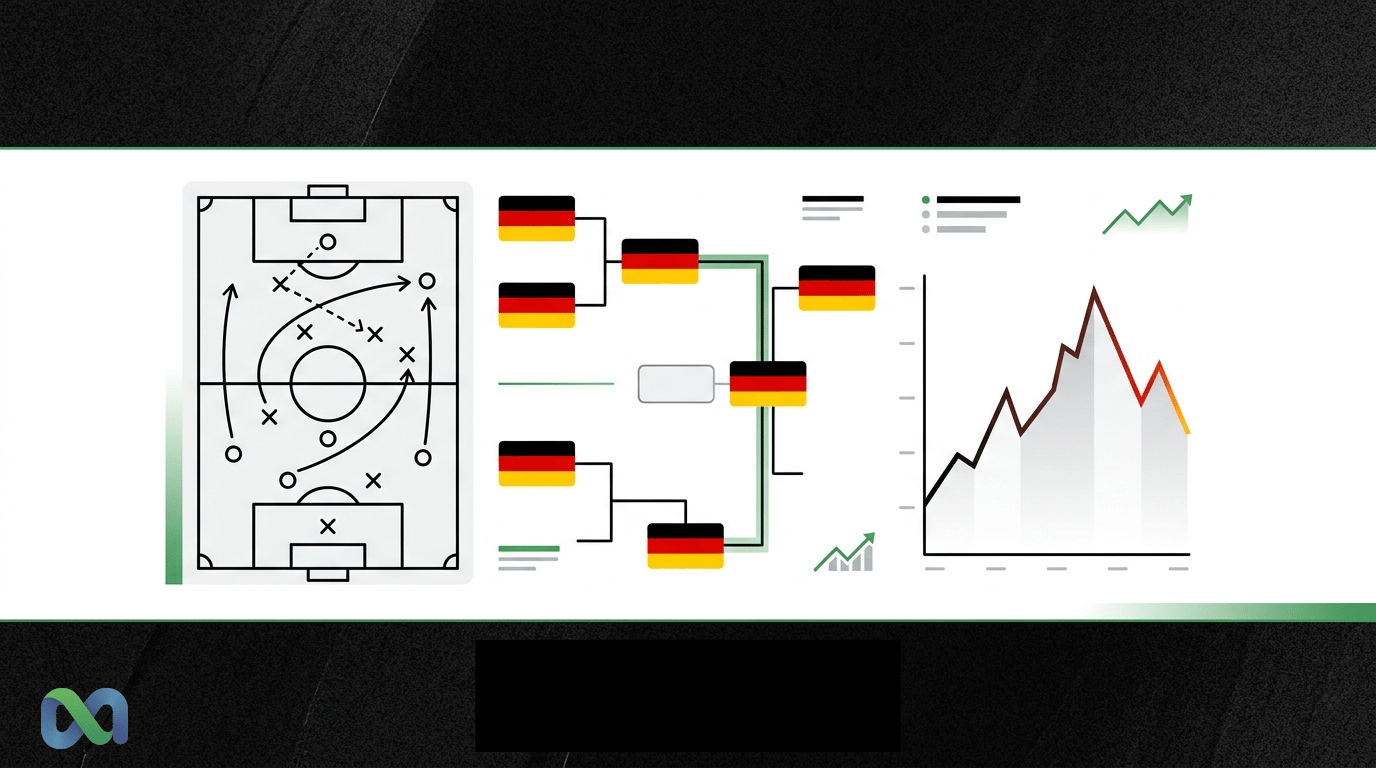
Germany World Cup 2026 starts with one central question. Is this team back at true contender level, or should the market still discount Germany because of recent tournament trauma?
The answer is not simple. Germany has elite talent, a modern coach, and a group that looks favorable on paper. However, the team also carries two straight group-stage exits, in 2018 and 2022. For a four-time world champion, that changes how any forecast should be built.
This guide breaks down Germany’s status, group, fixtures, World Cup history, projected squad, Julian Nagelsmann’s style, key players, and probability scenarios. The goal is to separate confirmed facts from projection. It also shows which news can move Germany’s price in World Cup 2026 markets.
Updated in May 2026. The final squad, injuries, and market probabilities can change before the tournament starts.
Germany World Cup 2026 Status, Group, and Fixtures
Germany is qualified for the 2026 World Cup. The team enters the tournament under Julian Nagelsmann, with a renewed core and clear pressure to respond. After two early exits in a row, the first objective is straightforward: win the group well and restore authority.
| Item | Germany in 2026 |
|---|---|
| Status | Qualified for the 2026 World Cup |
| Coach | Julian Nagelsmann |
| Base formation | 4-2-3-1, with build-up variations |
| Group indicated in the brief | Curaçao, Ivory Coast, and Ecuador |
| Main narrative | Rebuild, young talent, and redemption after 2018/2022 |
Germany’s Group at the 2026 World Cup
Germany’s group should be treated as an early advantage, not as a guarantee. Curaçao should be the opponent with the lowest historical weight. Ivory Coast brings physical power, transition speed, and players used to European football. Ecuador is usually organized, intense, and dangerous in high-tempo matches.
That creates two readings. The optimistic view is clear: Germany has the squad to control possession, create volume, and finish first. The risk view is just as important: if Germany repeats the errors of 2018 and 2022, any slip can create pressure before the knockout stage.
| Match | Opponent | Indicated date | Indicated city | What to watch |
|---|---|---|---|---|
| 1 | Curaçao | 14/06 | Houston | emotional control, goal difference, and a calm opener |
| 2 | Ivory Coast | 20/06 | Toronto | defending transitions and physical duels |
| 3 | Ecuador | 25/06 | New York | intensity, midfield control, and qualification scenario |
These dates appeared in press coverage cited in the research brief, including Placar’s analysis. Before final CMS publication, the official calendar should keep being checked against tournament organizers and the FIFA World Cup hub.
Germany’s World Cup History
Germany is not an ordinary World Cup team. According to FIFA’s official team profile, the country is a four-time world champion and has one of the strongest tournament records in football history. That history matters because it changes public expectations and market pricing.
| Historical metric | Germany |
|---|---|
| World Cup titles | 4 |
| Finals played | 8 |
| Total appearances | 21, according to the FIFA profile cited in the brief |
| Recent cycle | Group-stage exits in 2018 and 2022 |
The weight of 2018 and 2022 is large. Germany did not only lose matches. It lost the aura of a team that always grows inside a tournament. That affects the market because traders do not look only at talent. They also price stability, response under pressure, and trust in knockout matches.
Therefore, 2026 is not just another German World Cup campaign. It is a regime test. If the team starts strongly, the market can reprice Germany fast. If it slips in the group, the recent memory comes back immediately.
Coach and Playing Style: How Nagelsmann Sets Up Germany
Julian Nagelsmann gives Germany a more flexible identity. The base shape cited by search coverage is a 4-2-3-1, but the structure changes during matches. One full-back can move inside. Joshua Kimmich can help the build-up. Jamal Musiala and Florian Wirtz can drift between the lines.
The idea is simple: control the ball, speed up in the final third, and press right after losing possession. When it works, Germany suffocates weaker opponents. It also creates chances without depending only on crosses.
The problem appears when the press fails. Germany’s defense can still suffer against fast transitions. That has been a sensitive point in recent cycles. Against teams that defend deep and attack space, Germany must protect midfield better.
What Must Click
Three points define the team’s ceiling. First, the goalkeeper choice must create trust. Second, the No. 9 must offer presence without blocking Musiala and Wirtz. Third, the defense must handle direct attacks better.
If those points improve, Germany returns to the tier of real favorites. If not, the team can still win the group, but it remains vulnerable in the first hard knockout match.
Germany World Cup 2026 Lineup and Projected Squad
The official squad can still change. Injuries, club form, and final friendlies should matter. Even so, the German core already has clear names for editorial projection.
| Area | Probable or relevant names | Market reading |
|---|---|---|
| Goalkeepers | Marc-André ter Stegen, Oliver Baumann, Alexander Nübel | uncertainty with impact on clean-sheet markets |
| Center-backs | Antonio Rüdiger, Jonathan Tah, Nico Schlotterbeck | experience against pace and aerial pressure |
| Full-backs | Joshua Kimmich, David Raum, and balance alternatives | build-up quality versus defensive protection |
| Midfield | Kimmich, Leon Goretzka, Pascal Groß, Aleksandar Pavlović | control, pressing, and back-line protection |
| Creators | Jamal Musiala, Florian Wirtz, Leroy Sané, Serge Gnabry | technical ceiling and chance volume |
| Attack | Kai Havertz, Niclas Füllkrug, Nick Woltemade | choice between mobility and box presence |
Germany’s projected 2026 World Cup lineup should start from a 4-2-3-1. One likely version has Ter Stegen or Baumann in goal; Kimmich, Rüdiger, Tah or Schlotterbeck, and Raum in defense; two control midfielders; Wirtz, Musiala, and Sané or Gnabry behind Havertz or Füllkrug.
This list should not be read as a final squad. It is a role projection. For markets, role matters as much as name. Havertz as a false nine creates one version of Germany. Füllkrug as a central striker creates another.
Key Germany Players for 2026
Jamal Musiala
Musiala is the player who changes Germany’s attacking ceiling most. He breaks lines with dribbling, receives between midfield and defense, and forces opponents to close the center. When he is healthy and aggressive, Germany gains a dimension that few squads have.
That is why his fitness can move markets. Injury news does not only affect one lineup. It changes Germany’s chance of creating against low blocks and deciding tight games.
Florian Wirtz
Wirtz is the connector. He can play as a central attacking midfielder, drift right, or rotate with Musiala. His value is turning possession into final passes. That reduces the need for a dominant classic striker.
If Wirtz arrives in form, Germany becomes harder to mark. In addition, assist markets and young-player markets can draw more interest.
Joshua Kimmich
Kimmich is the structural piece. He can play at right-back, in midfield, or in a hybrid role. That decision changes the team’s balance. As an inverted full-back, he helps the build-up. As a midfielder, he protects the central zone better.
For Nagelsmann, this is a tactical decision. For the market, it is a signal of intent. A more conservative Kimmich can point to defensive concern. A freer Kimmich points to confidence in control.
Kai Havertz
Havertz offers mobility, combination play, and box arrivals. However, he is not a classic No. 9. That can be a strength or a problem. Against slow defenses, his movement opens space. Against physical center-backs, Germany may miss a fixed presence.
The attacking question is one of Germany’s main variables. Havertz, Füllkrug, and Woltemade represent different versions of the same team.
Antonio Rüdiger
Rüdiger brings experience, leadership, and aggression. In knockout matches, that matters. The question is his fit beside Tah or Schlotterbeck and the protection against balls played behind the defense.
Germany needs its back line to look reliable early. Otherwise, the market can discount the team even after wins with favorable scorelines.
Germany to Win World Cup 2026: Probabilities and Scenarios
Germany should be analyzed in layers. The outright winner market measures ceiling. The group-winner market measures early regularity. Quarterfinal, semifinal, and final markets measure path, draw, and tournament form.
In the outright market, Germany has pedigree and talent. However, France, Brazil, Argentina, Spain, England, and Portugal also enter with strong arguments. So Germany’s price must reflect both upside and uncertainty.
In the group market, Germany should start as favorite. If it wins the opener with control, the price can shorten. If it suffers against Curaçao or gives up many transitions, the discount can appear before the second match.
What Can Move Germany’s Probability
| Variable | Likely market effect |
|---|---|
| Musiala confirmed and healthy | higher attacking ceiling |
| Wirtz in strong form | better creation and assist outlook |
| Goalkeeper defined with confidence | stronger defensive-market outlook |
| Unstable No. 9 role | lower trust against low blocks |
| Defense exposed in transition | knockout-stage discount |
| Dominant opening win | fast positive repricing |
Probabilities are not fixed forecasts. They move with news, volume, and new information. Therefore, the best reading is dynamic. Germany’s price before the World Cup can be very different from its price after the first round.
Germany’s Path in a 2026 World Cup Simulator
A 2026 World Cup simulator is useful because it takes the analysis out of the abstract. Readers can test wins, draws, goal difference, and bracket paths. For Germany, that is essential. A first-place finish can create a very different route from a second-place qualification.
The key exercise is to simulate three scenarios. In the base case, Germany beats Curaçao and Ivory Coast, then plays Ecuador for group leadership. In the optimistic case, it wins all three matches and reaches the knockout stage with a strong goal difference. In the risk case, it slips in a physical match and enters the final group round under pressure.
These scenarios change the market read. A team that wins the group without stress can be priced as a semifinal candidate. A team that struggles to advance may still have talent, but it loses trust against elite rivals. For background on the tournament format and host-country setup, the 2026 FIFA World Cup overview is a useful reference point.
Editorial Strategy: Satellite Pages That Support the Pillar
The Germany page should work as a pillar. It solves broad search intent, but it also opens paths for specific searches. Musiala, Wirtz, Kimmich, Havertz, Rüdiger, and the goalkeeper battle all have satellite-page potential.
This matters for SEO and for product. A reader who arrives through the national team may want to understand one specific variable. A trader who arrives through Musiala may return to evaluate the champion market. Our editorial view is clear: each satellite page should explain a market variable, not repeat a biography.
The priorities are clear. Musiala changes the ceiling. Wirtz changes chance creation. Kimmich changes balance. Havertz changes the attack. Rüdiger changes the defense. The goalkeeper race changes trust.
How Traders Should Read Germany News Before Kickoff
Germany World Cup 2026 coverage will produce constant headlines, but not every headline has the same market value. A training report about Musiala’s fitness matters more than a generic quote about confidence. A confirmed goalkeeper hierarchy matters more than a friendly win against a weak opponent. Traders should separate signal from noise before changing a position.
The first signal is availability. If Musiala, Wirtz, Kimmich, and Rüdiger are all fit, Germany’s baseline improves. The second signal is role clarity. Nagelsmann must decide how much freedom Kimmich gets, who anchors midfield, and whether Havertz or Füllkrug leads the line. The third signal is defensive control. If Germany gives up clear transition chances in warm-up matches, the outright price should carry a larger discount.
The best approach is not to label Germany as overrated or underrated too early. Instead, build a checklist and update it after each confirmed piece of information. That is how prediction markets turn football news into a live probability, not just a narrative.
FAQ: Germany at the 2026 World Cup
Is Germany qualified for the 2026 World Cup?
Yes. Germany is qualified for the 2026 World Cup and will be coached by Julian Nagelsmann. The tournament is viewed as a redemption attempt after group-stage exits in 2018 and 2022.
What is Germany’s group at the 2026 World Cup?
The research brief indicates a group with Curaçao, Ivory Coast, and Ecuador. Germany should be favored, but the group requires attention because of transitions, physical intensity, and pressure if there is an early slip.
What is Germany’s projected lineup for World Cup 2026?
The projected lineup starts from a 4-2-3-1. Names such as Kimmich, Rüdiger, Musiala, Wirtz, and Havertz should be central. The main doubts are in goal, at center-back partner, and in the attacking format.
Who is Germany’s coach for the 2026 World Cup?
The coach is Julian Nagelsmann. His model seeks possession, counter-pressing, mobility between the lines, and build-up variations. The challenge is balancing that ambition with protection against counterattacks.
Is Germany a favorite to win the 2026 World Cup?
Germany belongs in the group of strong contenders, but it should not be treated as the isolated favorite. The talent is real. However, doubts in goal, at striker, in defense, and the recent tournament record reduce the margin of trust.
Which Germany players can stand out?
Jamal Musiala and Florian Wirtz have the highest creative ceiling. Joshua Kimmich defines balance. Kai Havertz can be a key attacking piece. Antonio Rüdiger leads the defense in high-pressure matches.
Conclusion
Germany enters the 2026 World Cup with a rare combination. It has history, talent, coaching, and a favorable early path. At the same time, it still must prove that it has moved beyond the recent cycle of frustration.
That is the most important market read. Germany can look elite again quickly if Musiala and Wirtz lead the attack, if the goalkeeper inspires confidence, and if the defense controls transitions. However, any sign of fragility can reopen the memory of 2018 and 2022.
Therefore, the best way to track Germany World Cup 2026 is by scenarios. Watch the group, simulate the path, follow squad news, and observe how each variable changes the probability before the knockout stage.
