


Loss Aversion: Meaning and Examples for Trading Decisions

Loss aversion is a tendency to give a loss more psychological weight than an otherwise comparable gain. The comparison depends on a reference point: an amount paid, an expected result, or another benchmark used to judge the outcome.
In trading, that reference point can make two economically similar positions feel different. A position below its purchase price may feel like a problem that must be repaired, while the same position above its purchase price may feel ready to sell.
That feeling is not enough to determine whether holding or selling is sensible. The decision also depends on current information, future payoffs, costs, risk capacity, and the alternatives available now.
What Loss Aversion Means
Loss aversion concerns the relative weight attached to losses and gains around a reference point. It differs from a general dislike of uncertainty, although the two can affect the same decision.
In their original prospect theory paper, Daniel Kahneman and Amos Tversky developed a model in which outcomes are evaluated as gains and losses rather than only as final wealth. The paper is a descriptive account of choices, not a rule for valuing every financial asset.
Kahneman's Nobel lecture discusses reference dependence and the unequal weighting of gains and losses. That research does not imply that every person uses one fixed loss multiplier in every setting.
For an investor, the practical question is whether a reference point is changing the assessment of an otherwise equivalent choice. A purchase price can be relevant to taxes or accounting. It does not, by itself, change an event's future payoff or probability.
The evidence for a specific decision must therefore be examined separately from the emotion attached to recording a gain or loss.
Loss Aversion Is Different From Risk Aversion
Risk aversion concerns preferences over uncertain outcomes. Someone may reasonably prefer a smaller certain amount to a risky outcome with a larger average because a loss would impair essential spending or breach a financial limit.
Loss aversion concerns how an outcome is evaluated relative to a benchmark. A change framed as a loss may feel different from the same change framed as giving up a gain, even when final wealth is the same.
This distinction prevents a common mistake: labeling every cautious decision a bias. Avoiding an exposure that could damage your finances can be consistent with your goals and constraints.
Similarly, remaining in a losing position does not by itself establish loss aversion. New evidence might support the position, transaction costs might be substantial, or the holding might serve a defined portfolio purpose.
The cognitive bias guide explains why a label should prompt a better review rather than replace one. Ask which assumption or comparison changed, and whether that change is justified by relevant information.
Worked Example: The Same Position With Two Purchase Prices
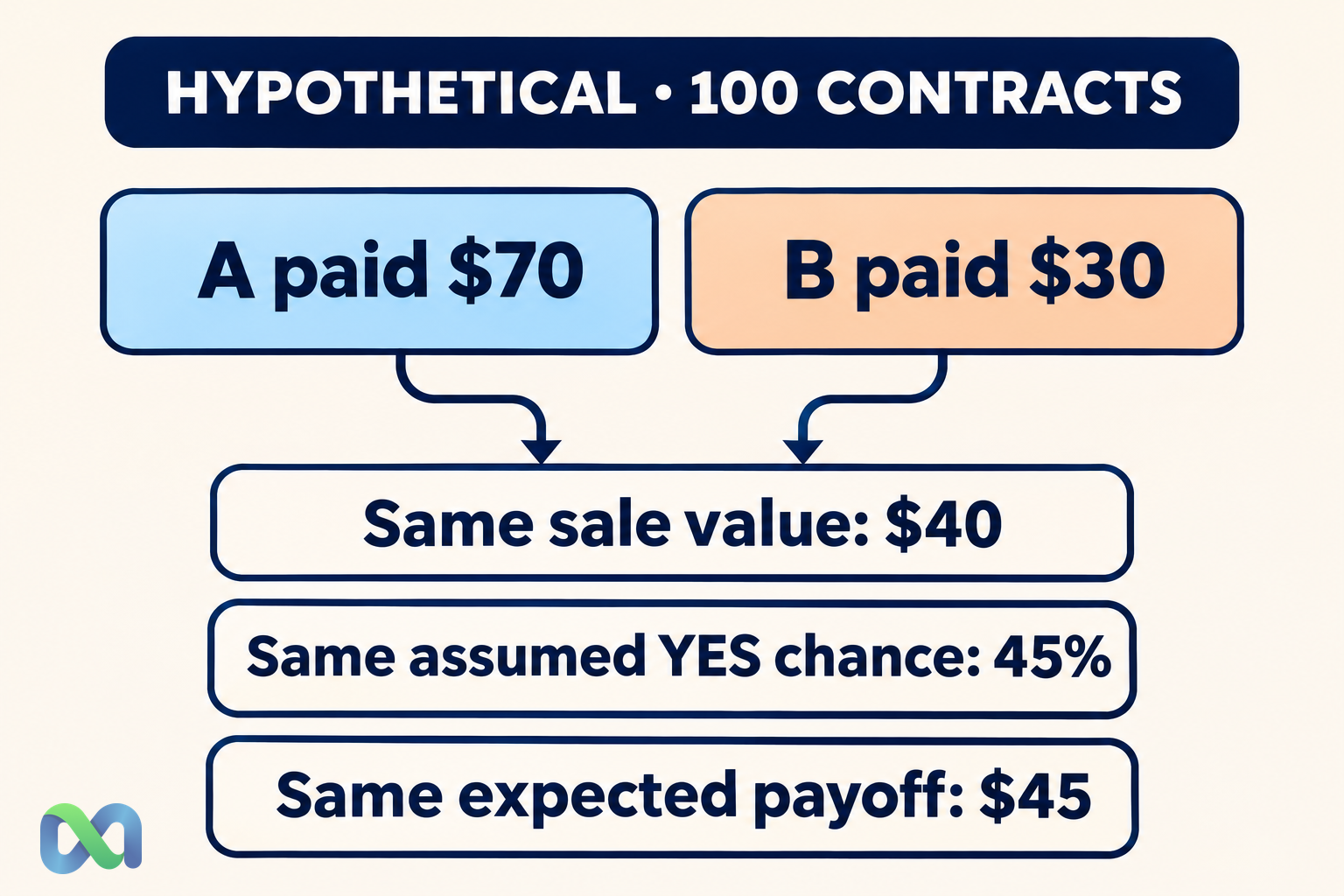
Imagine two hypothetical investors each hold 100 identical binary contracts. Each contract pays $1 if YES occurs and $0 otherwise. Both investors can sell their entire position now for $40 after the costs included in this example.
Investor A originally paid $70. Investor B paid $30. Their positions now have the same market value and future payoff, but one shows a $30 unrealized loss while the other shows a $10 unrealized gain.
| Detail | A | B |
|---|---|---|
| Cost basis | $70 | $30 |
| Sale proceeds | $40 | $40 |
| Unrealized | −$30 | +$10 |
Suppose both use the same hypothetical 45% probability for YES. Holding has an expected terminal payoff of 0.45 × $100 = $45. Relative to selling for $40, the expected payoff difference is $5 before any extra holding costs or adjustments.
The purchase prices do not change that forward-looking comparison. If one investor insists that holding is attractive only because it avoids realizing a loss, the reference point deserves scrutiny.
This is an expected-payoff example, not a recommendation to hold. The terminal payoff can still be $0. Taxes, financing, liquidity needs, and risk preferences could make a different choice appropriate.
Why Breaking Even Can Become the Wrong Target
An investor who paid $70 may decide to wait until the position returns to that amount. A break-even target is emotionally understandable, but the market is not required to revisit an individual purchase price.
To assess the target, separate the amount already spent from the evidence that affects future outcomes. Ask whether the same position would be worth buying today, at the current price, with the same alternatives and constraints.
That question does not automatically imply selling. It tests whether the original payment is carrying more weight than the current opportunity. A later improvement in the forecast could justify holding even after a loss; a weaker forecast could justify reducing exposure even after a gain.
The sunk cost fallacy guide addresses the related mistake of allowing unrecoverable past costs to drive a new commitment. Loss aversion describes the weighting of a loss; sunk cost reasoning describes how a past expenditure enters a current choice.
Those mechanisms can reinforce each other, but they should not be treated as interchangeable explanations for every losing trade.
An Illustrative Loss Multiplier Is Not a Universal Constant
A simplified value model can make the distinction visible. Suppose, purely for illustration, a $100 gain receives a subjective value of +100 units while a $100 loss receives −200 units. The assumed loss multiplier is two.
For equal chances of gaining or losing $100, the monetary expected value is zero. Under this invented subjective-value model, the average is 0.5 × 100 + 0.5 × −200 = −50 value units.
Those value units are not dollars and are not a measurement of a specific person's preferences. The example shows how unequal weighting can produce a different evaluation from a monetary average.
Real preferences may vary with the reference point, outcome size, wealth, context, and other features of the choice. Do not take a popular “losses count twice” phrase and use it as a calibrated formula for every investor or position.
The expected value formula explains monetary probability-weighted payoffs. Expected value and subjective preferences answer related but different questions; neither should be relabeled as the other.
A Review Process That Separates Evidence From Framing
Write the current alternatives without including the original trade narrative. For each option, record the amount that can be recovered now, the future payoff distribution, the time horizon, and the relevant costs.
Then add the financial constraints. A position may have positive expected payoff relative to an alternative while still exposing the investor to an unacceptable loss. A risk limit should be explicit before it is tested by an adverse outcome.
Review the probability estimate separately from the position's profit or loss. Ask what new evidence would change that estimate, and whether the same evidence would receive the same weight if the position were currently profitable.
Use a timestamped decision record. Preserving the assumptions helps a later review distinguish a sensible decision followed by a bad outcome from an unsupported decision followed by a lucky outcome.
For event contracts, also preserve the exact question and resolution rule. A reference point based on a different contract, deadline, or payout is not a clean comparison even if the two market labels look similar.
When a Purchase Price Still Has a Legitimate Role
Past transactions can affect taxes, accounting, contractual obligations, and portfolio records. Those effects are not erased by calling the original payment a sunk cost.
The useful distinction is between a purchase price's actual effects and its emotional role as a target. If a realized loss changes a tax liability, quantify that effect under the applicable rules. If the only argument is that a sale would make the loss feel final, the decision needs another explanation.
An investor's goals can also make a loss especially costly. Losing money needed for a near-term obligation is different from an equal percentage change in discretionary capital. A sound review incorporates those circumstances rather than demanding indifference to all losses.
The aim is consistency: use comparable information and constraints when comparing comparable choices. A new entry price, a visible profit, or a desire to return to break-even should not quietly replace the analysis of what can happen next.
Frequently Asked Questions
Does Loss Aversion Mean Selling Every Losing Position?
No. The concept identifies a potential distortion in how gains and losses are evaluated. Holding can be reasonable when current evidence and constraints support it. A loss alone is neither a sell signal nor a reason to add exposure.
Is a Stop-Loss Rule a Complete Solution?
No. A rule may help implement a defined risk policy, but its suitability depends on the instrument, liquidity, execution, and goal. It does not automatically correct a flawed forecast or guarantee a specific sale price.
Are Loss Aversion and the Disposition Effect Identical?
No. The disposition effect refers to a pattern of realizing gains more readily than losses. Loss aversion is one mechanism that may contribute to such behavior. Observing the pattern does not identify every cause behind it.
Can a Profitable Decision Still Reflect Loss Aversion?
Yes. An outcome does not reveal the quality of the reasoning by itself. Review the information and alternatives available when the choice was made, rather than judging the process solely by whether it later earned money.
