


Cognitive Bias: Types, Examples and Forecasting Mistakes

A cognitive bias is a systematic distortion in how someone interprets information, estimates a quantity, or remembers an event. In investing and forecasting, it can affect the evidence you select, the probability you assign, and the way you explain a result afterward.
Learning the names is useful only if it changes how a decision is made. A forecast needs a clear question, relevant evidence, realistic uncertainty, and a record that remains intact after the outcome is known.
What Is a Cognitive Bias?
A bias is more than an isolated mistake. It describes a recurring direction of error associated with a judgment process. A wrong forecast alone does not show which process produced it.
In their foundational paper on judgment under uncertainty, Amos Tversky and Daniel Kahneman described how simplifying rules can support quick judgments while also producing systematic errors. A shortcut can be useful in one setting and misleading in another.
For example, an event that is easy to recall may come to mind quickly because it received intense coverage. That does not establish how frequently comparable events happen. The ease of retrieving a story and the probability of the event are different quantities.
The practical goal is not to eliminate every shortcut. It is to recognize where a shortcut can distort a decision that deserves a more deliberate check.
Cognitive Errors and Emotional Biases
Behavioral finance uses several related classifications. The CFA Institute's public summary distinguishes cognitive errors from emotional biases. Its cognitive category includes reasoning, information-processing, and memory errors; its emotional category concerns judgments shaped by feelings and impulses.
The categories can overlap in practice. A person might selectively collect favorable information because admitting a possible loss feels unpleasant. That combines an evidence problem with an emotional response.
Avoid treating a list of biases as a diagnosis of another trader. You usually cannot infer someone's reasoning, financial constraints, or information from a single position. Inspect the decision process and the evidence that is available.
This guide uses cognitive bias for the thinking and memory problems discussed below. Broader references to behavioral bias can also include emotional patterns such as loss aversion.
Common Biases to Recognize
Confirmation Bias
You begin with a view and favor evidence that supports it, while applying a higher standard to contrary information. The problem is the uneven treatment of evidence. The confirmation bias guide works through that selection problem in more detail.
Anchoring
An initial figure becomes a reference point that receives too much influence. A purchase price or first forecast can keep shaping an estimate even when it has little relevance to the current question. The corrective task is to evaluate what the number actually tells you.
Base Rate Neglect
A vivid case description can distract from how often the event occurs in a relevant comparison group. The base rate fallacy guide explains why a seemingly strong signal may still leave substantial uncertainty.
Hindsight Bias
After learning an outcome, you remember the event as more predictable than it seemed beforehand. An unchanged forecast record makes it possible to compare later explanations with the probabilities and evidence actually recorded at the time.
Survivorship Bias
You evaluate the visible winners while failed, closed, or excluded cases are absent from the sample. The survivorship bias guide shows why the missing observations can change the conclusion.
Overconfidence
Confidence can exceed what evidence supports. It may concern your own performance, your standing relative to other people, or the precision of your estimates. Those are distinct problems, as Moore and Healy explain in The Trouble With Overconfidence.
Worked Example: A Signal That Looks More Decisive Than It Is
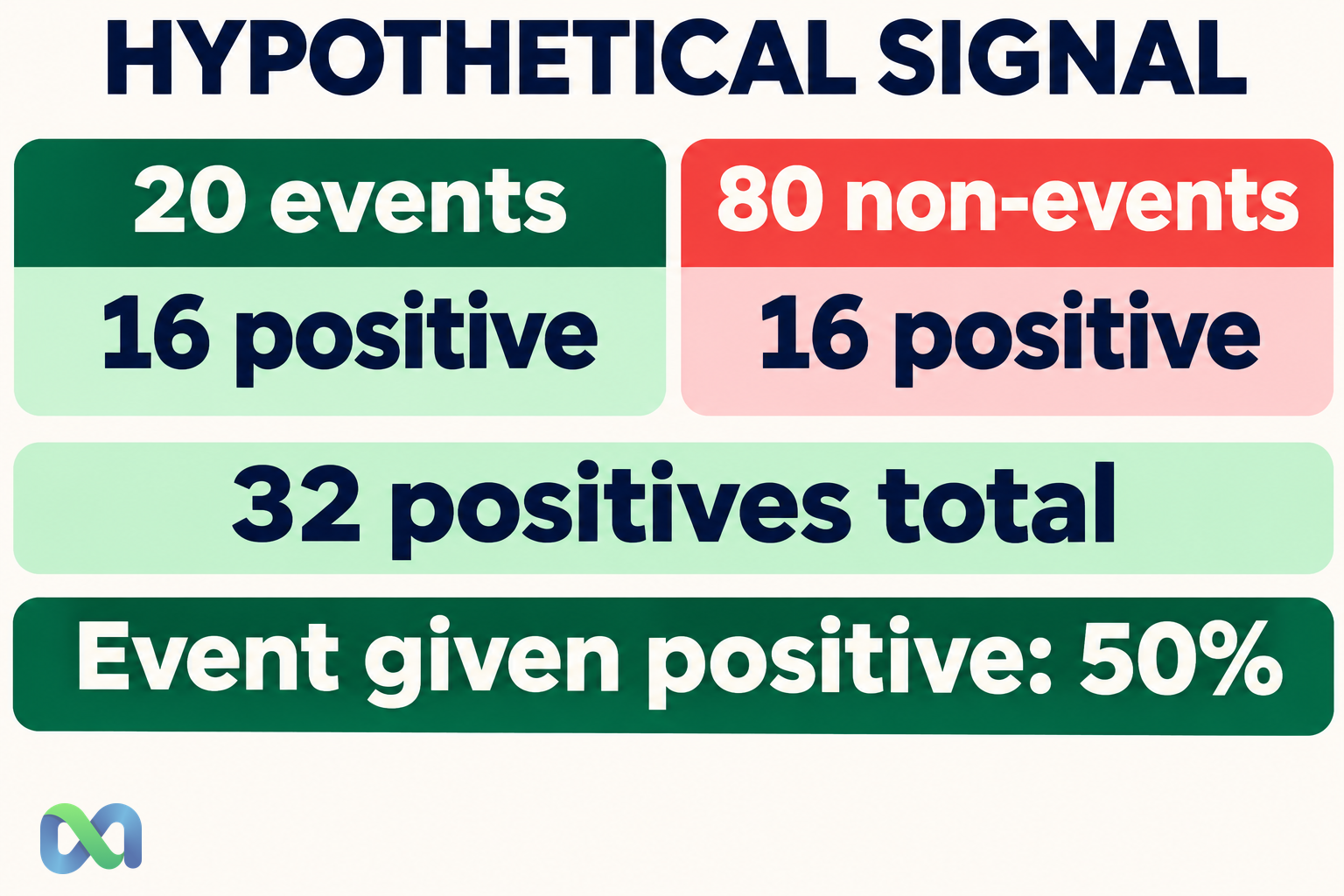
Consider a hypothetical forecasting signal applied to 100 comparable events. Twenty events occur, and 80 do not. The signal detects 80% of the events but also produces a positive result for 20% of the non-events.
Apply those rates to the two groups:
| Group | Count | Positive signals |
|---|---|---|
| Event occurs | 20 | 16 |
| No event | 80 | 16 |
| Total | 100 | 32 |
Among the 32 positive signals, only 16 correspond to an event. The event rate given a positive signal is therefore 16/32 = 50%.
Calling the signal 80% sensitive does not make every positive result an 80% event probability. The base rate and the false-positive rate both enter the comparison.
The example also creates several opportunities for biased reasoning. You could collect only the 16 successful signals, overlook the 16 false positives, or recall the successful cases more easily because they received more attention. None of those changes improves the underlying signal.
The counts are invented to make the calculation transparent. They are not measured results for a prediction platform, trading indicator, or investment product. Real data would need a defined sample and a reliable rule for deciding what counts as an event.
Build a Review Around the Decision
Use checks that target observable steps rather than asking whether you feel unbiased.
Before making a forecast, write the exact event definition and the deadline. Select a comparison group and explain why it is relevant. Record an initial estimate before looking at a prominent market price when that is practical.
Then list evidence that could move the estimate in either direction. Ask whether several reports are genuinely independent or simply repeat the same original source. Repetition can make a claim feel well supported without adding new information.
When you update the probability, record the new evidence and the size of the update. A large change should have an explanation that another reader can inspect. Merely replacing one confident story with another does not make the process more disciplined.
Finally, preserve the earlier version. A record that is continuously overwritten cannot reveal whether later memories match earlier judgments.
A Compact Bias Review Checklist
| Check | Question |
|---|---|
| Sample | What is missing? |
| Evidence | What would change it? |
| Estimate | Why this number? |
| Record | What did I write? |
Treat these as prompts for investigation. A missing item identifies a weakness to examine, rather than proving that a particular bias caused the decision.
For example, an analyst may omit failed funds because the dataset is incomplete, rather than because they intentionally favored winners. The analytical problem still needs correction. A label about motivation adds little unless the evidence supports it.
Likewise, agreement with a market price is not automatically anchoring. The market may contain relevant information. Ask whether you considered that information and how strongly you should weight it.
Measure Forecasts Without Rewriting Them
Keep the forecast, outcome, timestamp, and event rules together. Evaluate a set of forecasts chosen before you know which ones will look impressive.
A scoring method such as the Brier score helps make that review explicit. It does not turn one correct forecast into proof of skill or explain the psychological reason for every error.
Look at repeated patterns. Are forecasts near 80% occurring much less often than that? Are poor results concentrated in one type of event? Do large updates follow new evidence, or only changes in market sentiment?
Those observations can suggest where to investigate. They do not prove that changing a checklist will produce profitable trades. Trading outcomes also depend on prices, fees, execution, position sizes, and the amount of risk taken.
What Bias Awareness Cannot Do
Knowing a term does not provide a mechanical way to correct every estimate. Reducing a forecast by an arbitrary amount because you worry about overconfidence can introduce a new error.
A disciplined process also cannot remove uncertainty from the world. Some outcomes remain difficult to forecast even with excellent data. A fair evaluation asks whether the method handled available information well, while preserving the possibility that a good decision produced a bad result.
Use bias awareness to improve evidence selection and accountability. Keep the empirical question separate: does the revised process perform better on observations that were not used to design it?
Frequently Asked Questions
Is Every Wrong Prediction a Cognitive Bias?
No. A well-calibrated probability allows outcomes other than the most likely one. An error can reflect uncertainty, poor data, a weak model, or biased reasoning. The result alone does not distinguish them.
Can Experts Have Cognitive Biases?
Expertise does not establish that every judgment process is reliable. Evaluate the expert's methods, evidence, relevant track record, and treatment of uncertainty rather than relying on confidence or credentials alone.
Should I Ignore Market Prices to Avoid Anchoring?
No. Prices can provide useful information. It can help to form an initial independent view, then compare it with the market and investigate the difference. Ignoring relevant evidence is not a reliable correction for anchoring.
