


Confirmation Bias: Examples and Forecasting Mistakes

Confirmation bias is the tendency to favor information that supports an existing belief while giving less attention or weight to information that challenges it. It can affect what you search for, how you read evidence and which data points you remember.
In forecasting, the problem is not simply having an initial opinion. A forecast needs a starting point. The problem arises when the opinion changes the standard of evidence: supporting reports are accepted quickly, while contrary reports face a much tougher test.
How Confirmation Bias Enters a Forecast
Imagine expecting an economic release to exceed a threshold. You read a strong industry report and raise your probability estimate. Later, a weaker indicator appears. Instead of asking how informative it is, you dismiss it because it conflicts with the forecast you already favor.
That sequence can produce confidence without a balanced assessment of the evidence. It does not require deliberate dishonesty. The filtering may happen through source choice, attention or a plausible explanation that is applied only to inconvenient data points.
Researchers have examined both information selection and information weighting. In a study of active evidence sampling, participants in a perceptual task sought more information about a previously chosen alternative. A separate study of others' opinion strength examined asymmetric use of confirming and disconfirming opinions. These findings concern their experimental settings; they do not measure how much a specific trader's probability is distorted.
For a practical forecast, distinguish three stages: what enters the evidence set, how its reliability is assessed and how the assessment changes the probability. A weakness in any stage can carry through to the final estimate.
Three Places to Look for Selective Treatment
At the search stage, a person may collect several bullish reports while avoiding sources that would test the opposite case. Counting the number of supporting headlines then confuses a selected sample with a balanced record.
At the interpretation stage, the same source may be called reliable when it agrees and outdated when it disagrees. Reliability can genuinely change, but the reason should be tied to the source and its methods rather than its direction.
At the recall stage, striking successes may remain memorable while quiet failures disappear from the review. A person can thus believe that a forecasting method works consistently without keeping a record that supports that conclusion.
| Stage | Question to ask |
|---|---|
| Search | What evidence is missing? |
| Weighting | Is the standard consistent? |
| Review | Are all forecasts recorded? |
The table is a diagnostic aid, not a psychological test. A decision can have several causes, including limited time, different information access or a defensible view of source quality. Examine the actual reasoning before labeling every disagreement as bias.
Worked Example: Two Opposing Signals
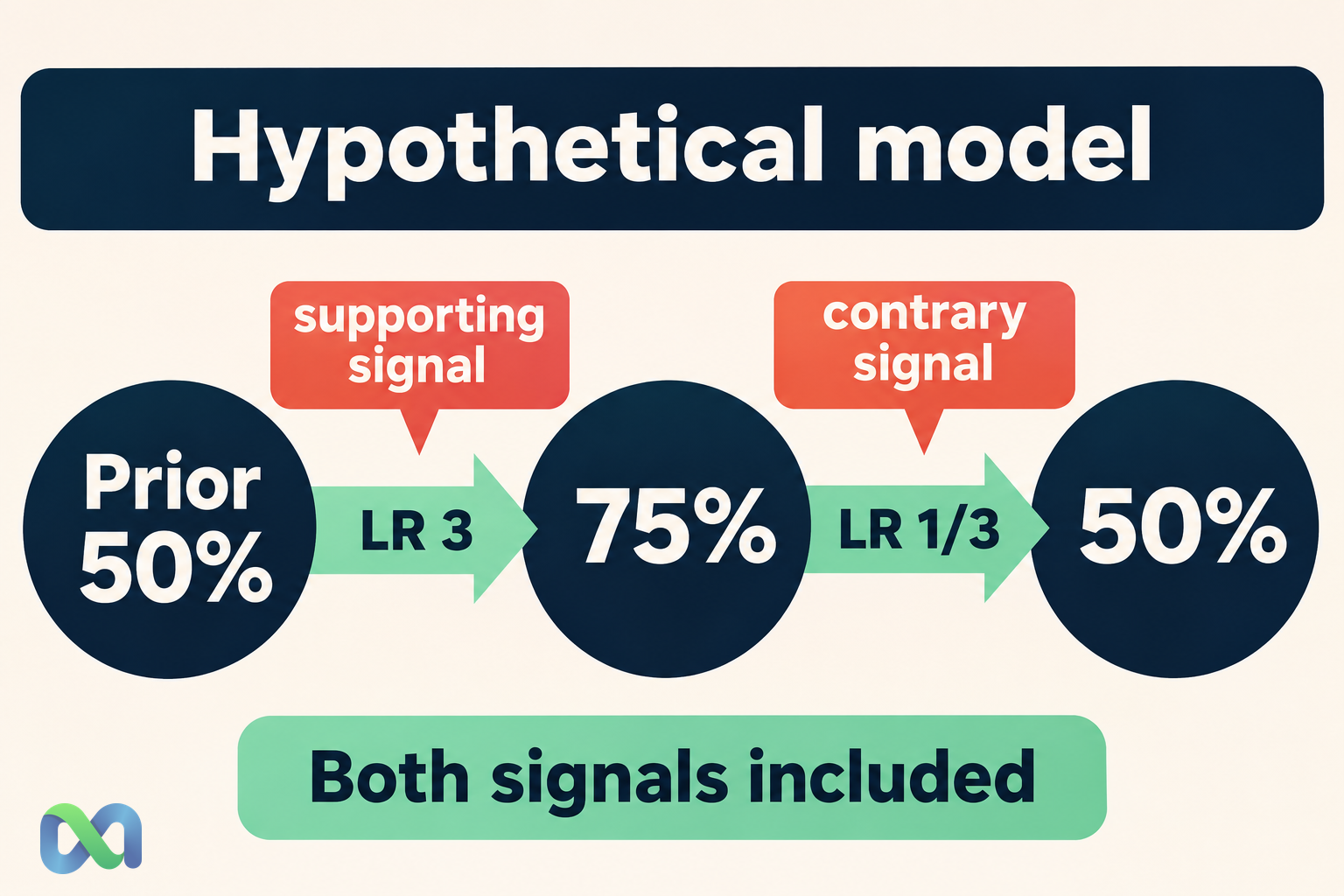
Consider a hypothetical event E with an initial probability of 50%. We assume two separately collected signals that are conditionally independent given whether E occurs. The inputs below are chosen to illustrate updating; they are not observed market statistics.
For the first, supporting signal, assume a 75% chance of seeing it when E occurs and a 25% chance when E does not occur. Its likelihood ratio is 0.75 / 0.25 = 3.
Initial odds are 0.50 / 0.50 = 1. Multiply by the likelihood ratio to obtain odds of 3. Converting back to probability gives:
Probability after supporting signal = 3 / (1 + 3) = 75%
Now observe the second, contrary signal. Assume its chance is 25% when E occurs and 75% when E does not occur. Its likelihood ratio is 0.25 / 0.75 = 1/3.
Apply that information to the updated odds:
Final odds = 1 × 3 × (1/3) = 1
Probability after both signals = 1 / (1 + 1) = 50%
| Evidence included | Model probability |
|---|---|
| Starting information | 50% |
| Supporting signal only | 75% |
| Both signals | 50% |
If a person keeps the favorable update and simply omits the contrary signal, the reported estimate stays at 75%. The arithmetic in the favorable update is correct; the evidence set is incomplete under the stated model.
The example does not show that two opposite headlines should always cancel. Here they cancel because their stated likelihood ratios are reciprocals. Different reliability assumptions would produce a different result. Nor does 50% become an objectively verified chance just because the arithmetic is coherent.
The Bayes' theorem guide explains the update rule in more detail. Conditional probability explains why a signal's probability given an event is different from the event's probability given that signal.
Contradictory Evidence Still Needs Evaluation
Avoid replacing “favor confirming evidence” with “believe whatever contradicts me.” A weak contrary claim does not become strong just because it challenges your position. Apply the same questions to both directions.
Who produced the information? What was measured? Was the method suitable for the event being forecast? Is the release current, and does it concern the same population or time horizon? These questions help distinguish a substantive challenge from an irrelevant data point.
Also ask whether apparently independent reports repeat a common source. Five articles quoting one survey are not five independent measurements. Multiplying their likelihood ratios as though they were separate data points can create excessive confidence even when every article is accurate.
If an event rule depends on a specific official release, commentary about a different indicator may provide context without directly deciding the outcome. Explain that relationship before changing an estimate. The quality of the link between evidence and event matters more than whether the headline sounds favorable.
Confirmation Bias and Related Mistakes
Confirmation bias concerns selective treatment of evidence. The base rate fallacy concerns giving insufficient weight to the underlying prevalence of an event. Both can occur in the same forecast, but repairing one does not by itself repair the other.
For example, reading only success stories may encourage a person to ignore how rare the outcome is. Adding the base rate improves the starting point. A balanced procedure is still needed when later evidence arrives.
The gambler's fallacy is different again: it treats an independent outcome as due because of earlier results. A forecaster might then select only evidence that supports the expected reversal. The independence error and the evidence-selection error should each be examined.
Confidence itself is not a diagnosis. Strong evidence can justify a strong view. A useful check is whether the probability would change if the evidence changed, and whether the same standards apply when your preferred conclusion is reversed.
Build an Evidence Record Before Taking a Position
Write the event, time horizon and initial estimate before reviewing a fresh signal. Record why the estimate has that value and which assumptions matter most. This creates a reference point against which later reasoning can be compared.
For each material update, keep a short entry: source, data point, reliability concern, direction of the update and explanation of its size. A number without its reasoning can be difficult to audit after the event has resolved.
Include a specific question about disconfirmation: what data point would make the current view less credible? The answer should describe evidence that could actually occur. A condition so vague that every possible result supports the forecast provides little discipline.
Review evidence before and after forming a position with the same criteria. Money committed to a view can make a contrary interpretation uncomfortable, but discomfort is not a statistical reason to discard it. Distinguish the explanation for the forecast from the desire to defend the earlier decision.
These routines are process controls. They do not eliminate human bias or guarantee accurate predictions. Their value is that they leave a record of what was considered and make inconsistent reasoning easier to identify.
Review the Process After Resolution
A correct outcome does not prove that the information process was sound. Someone can ignore contrary evidence and still end up correct. Likewise, a well-reasoned probabilistic forecast can be followed by the less likely outcome.
Review a series of recorded forecasts rather than a memorable success. Check whether contrary data points were regularly omitted, whether estimates changed for defensible reasons and whether explanations were rewritten after results became known.
Separate factual errors from uncertain judgments. If a source reported the wrong figure, correct the record. If a reasonable signal happened to be misleading in one case, ask how often that could occur under the model before abandoning it entirely.
The practical aim is a forecast that can be updated and inspected. You do not need to defend every prior estimate. You need a consistent way to decide which evidence belongs in the next one.
Frequently Asked Questions
Is confirmation bias the same as being wrong?
No. It describes how evidence is selected or interpreted. A conclusion can be correct despite biased reasoning, and a careful forecast can still be followed by an unexpected outcome.
Should every opposing opinion change my forecast?
No. Assess its relevance, reliability and dependence on other information. An opinion deserves weight because of the evidence it carries, not simply because it contradicts your view.
Does using a formula prevent confirmation bias?
No. A formula can correctly process a selectively chosen set of inputs. The worked example shows how omitting one signal can change the result even when the retained calculation is correct.
Can a checklist guarantee unbiased decisions?
No. A checklist can make the process more explicit and easier to review. It cannot show the true probability of an event, remove every judgment call or guarantee a favorable financial result.
