


Martingale Explained: Probability, Trading and Doubling Risk

A martingale is a mathematical process whose expected next value, given the information currently available, equals its current value. The same word also names a doubling system in which a position is increased after each loss. These are different concepts.
The distinction matters in trading. A property of a price or probability model does not create a profitable position-sizing rule. Doubling after losses can produce many small winning cycles while concentrating the downside in a much larger losing cycle.
The examples below use invented, fair, independent outcomes to expose that arithmetic. They are not a forecast, a live strategy, or a description of Macro Markets' pricing mechanism.
The Martingale Definition in Plain English
Let X represent the value of a process at successive times. If its conditional expected next value equals its current value, the process has the martingale property relative to the stated information.
“Conditional” is important: the expectation uses everything included in the model's current information set. A process can behave differently when the information available to the observer changes.
Harvard's probability lecture on martingales gives the formal definition and examples. The mathematical conditions include finite expected absolute values, so the term is more precise than saying a chart looks random.
Consider a hypothetical value of $100. In the next step it becomes $110 or $90 with equal probability. Its conditional expected value is 0.5 × $110 + 0.5 × $90 = $100. That single step matches the martingale condition under the stated model.
It does not mean the next value must remain at $100. It means the model's weighted average of possible next values equals $100. An individual realized path can still move sharply.
A Doubling System Changes Exposure, Not the Outcome Probability
In the system commonly called a martingale strategy, a participant starts with a small position, doubles it after a loss, and returns to the initial size after a win. The intended logic is that the next win recovers earlier losses and leaves a small profit.
That arithmetic requires a specific payout structure. For the example here, each success earns a net amount equal to the amount at risk, and each failure loses that amount. Assume independent outcomes with a 50% success probability and no costs.
Under those assumptions, increasing the position does not increase the chance of success on the next attempt. Previous losses also do not make a success due. The gambler's fallacy guide explains that mistaken inference about independent outcomes.
Actual trading positions may have unequal gains and losses, fees, changing probabilities, and correlated outcomes. A simple doubling schedule should not be carried over to those settings as if the example's recovery arithmetic still applied unchanged.
Worked Example: A $5 Start Requires $315 for Six Attempts
Start a hypothetical cycle at $5 and double after each failure. Allow no more than six attempts:
| Attempt | Amount at risk |
|---|---|
| 1 | $5 |
| 2 | $10 |
| 3 | $20 |
| 4 | $40 |
| 5 | $80 |
| 6 | $160 |
The total required to absorb six losses is $5 + $10 + $20 + $40 + $80 + $160 = $315. A seventh attempt would require another $320.
Suppose the first five attempts lose and the sixth succeeds. Earlier losses total $155. The sixth success earns $160 net, leaving a $5 profit for the cycle. A success on any earlier attempt also leaves $5 under this payout rule.
If all six attempts lose, the cycle loses $315. A starting balance of $315 cannot fund the next $320 position. The system's exposure grows much faster than its successful cycle profit.
This is a capped six-attempt example. It does not assume infinite capital, unlimited position sizes, or the ability to continue indefinitely.
Many Winning Cycles Can Still Have Zero Expected Profit
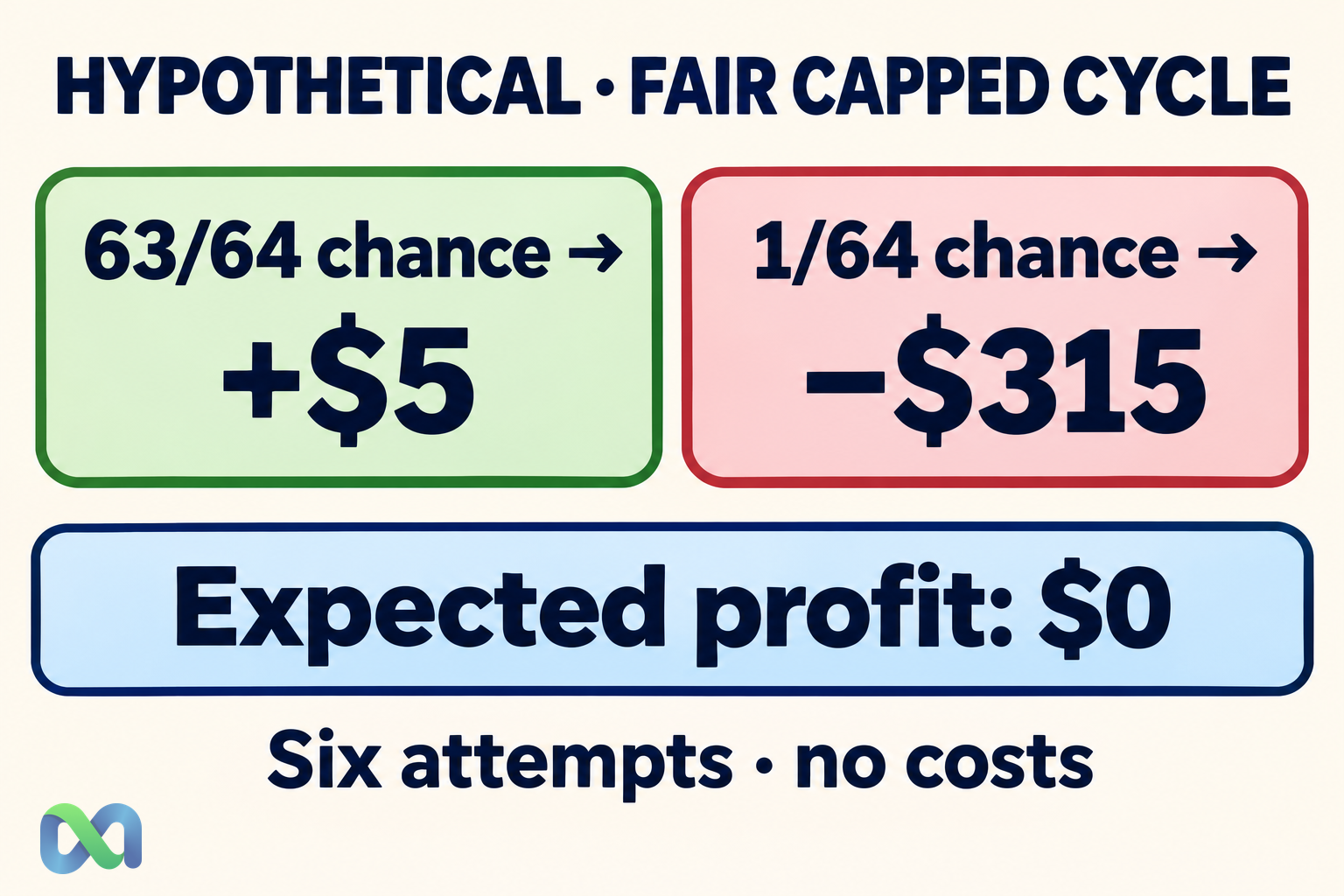
With independent fair outcomes, the chance of six consecutive losses is (1/2)⁶ = 1/64, or 1.5625%. The probability of at least one success within the six attempts is 63/64, or 98.4375%.
That high cycle success rate can look persuasive when viewed alone. Include both cycle payoffs:
Expected cycle profit = (63/64 × $5) + (1/64 × −$315) = $0.
The small profit is common, but the large loss exactly offsets it in expectation under the fair, cost-free assumptions. Transaction costs would reduce the expectation when they represent extra positive expenses.
The expected value formula provides the broader framework: multiply each outcome's payoff by its probability and add the results. A win rate is only one input.
Do not interpret the 1.5625% figure as a universal account-ruin probability. It is the probability of losing this specific capped cycle under the stated independent 50% model. A changing balance, different payouts, costs, or correlated outcomes changes the problem.
Why Stopping Rules Need Conditions
The intuition that one can keep going until a success arrives hides a resource assumption. A sequence of losses has no fixed maximum length in an independent fair model. Any finite balance or position limit can prevent the next increase.
Oxford's martingale notes explain optional stopping and why its conditions matter. Under suitable conditions, such as a bounded stopping time, stopping a martingale does not create an expected gain merely by choosing when to stop.
The six-attempt cycle has a fixed maximum number of steps. Its direct payoff calculation is enough to show the zero expectation; no appeal to unlimited continuation is needed.
More elaborate strategies can also hide unbounded exposure or assumptions about when a process stops. A mathematical claim about eventual success should be checked against the actual stopping rule, available capital, and maximum loss.
This does not imply all decisions involving stopping are economically identical. Information, costs, financing, and the process being traded matter. It means a stopping rule alone is not evidence of an advantage in a fair model.
Martingales in Finance Are Model Statements
In financial mathematics, martingale arguments are often made about discounted prices or conditional expectations under a stated probability measure. A pricing measure used in a model is not automatically the same as an investor's real-world forecast.
It would therefore be a mistake to infer that every traded asset has zero expected actual return, that all price changes are independent, or that a market price must equal an unknowable true probability. Those are separate claims that require their own assumptions.
For a binary event, the conditional probability of its eventual outcome can form a martingale as information accumulates under a coherent probabilistic model. That theoretical statement does not remove bid-ask spreads, funding requirements, access restrictions, or contract-resolution risk from a real trade.
The conditional probability guide explains how information enters a forecast. The practical issue remains whether your estimate and the available price justify the exposure after costs and uncertainty.
Review the Exposure Before Reviewing the Win Rate
Write the position schedule and the cumulative loss after each failed attempt. Check the actual payout structure and the largest position you can fund. If a recovery requires a position that exceeds the balance or limit, record that as a failure state rather than assuming continuation.
Evaluate dependence between outcomes. Two positions tied to the same event or economic shock do not automatically behave like separate independent coin flips. A run of losses can also coincide with worsening liquidity or tighter collateral requirements.
Compare the proposed exposure with a fixed maximum-loss policy. The educational point is to make the downside visible before a sequence begins, not to search for a starting size that makes large losses feel remote.
Finally, preserve all failed and successful cycles in any review. A record showing only completed recoveries leaves out the outcome that drives the risk. A persuasive history of small gains is incomplete without the largest loss and the capital needed to continue.
Frequently Asked Questions
Does a Martingale Strategy Guarantee a Profit?
No finite-capital guarantee follows from doubling. In the hypothetical six-attempt example, a successful cycle gains $5, but an unsuccessful cycle loses $315. The next required position can exceed the remaining resources.
Is a Martingale the Same as a Random Walk?
No. A fair random walk can be a martingale, but martingales form a broader class. The defining property is conditional expectation relative to information, not a specific step size or independent-increment structure.
Does a Losing Streak Improve the Next Probability?
Not in the independent 50% example. The next success probability remains 50%. In a real process probabilities may change with evidence, but past losses alone do not establish that change.
Can Position Sizing Create an Edge?
Position sizing changes exposure and the distribution of gains and losses. It does not by itself turn a fair, cost-free outcome into a positive expected-value opportunity. The underlying probabilities, prices, payoffs, and costs still determine the economic advantage.
