




Prediction Markets Are Becoming Public Markets
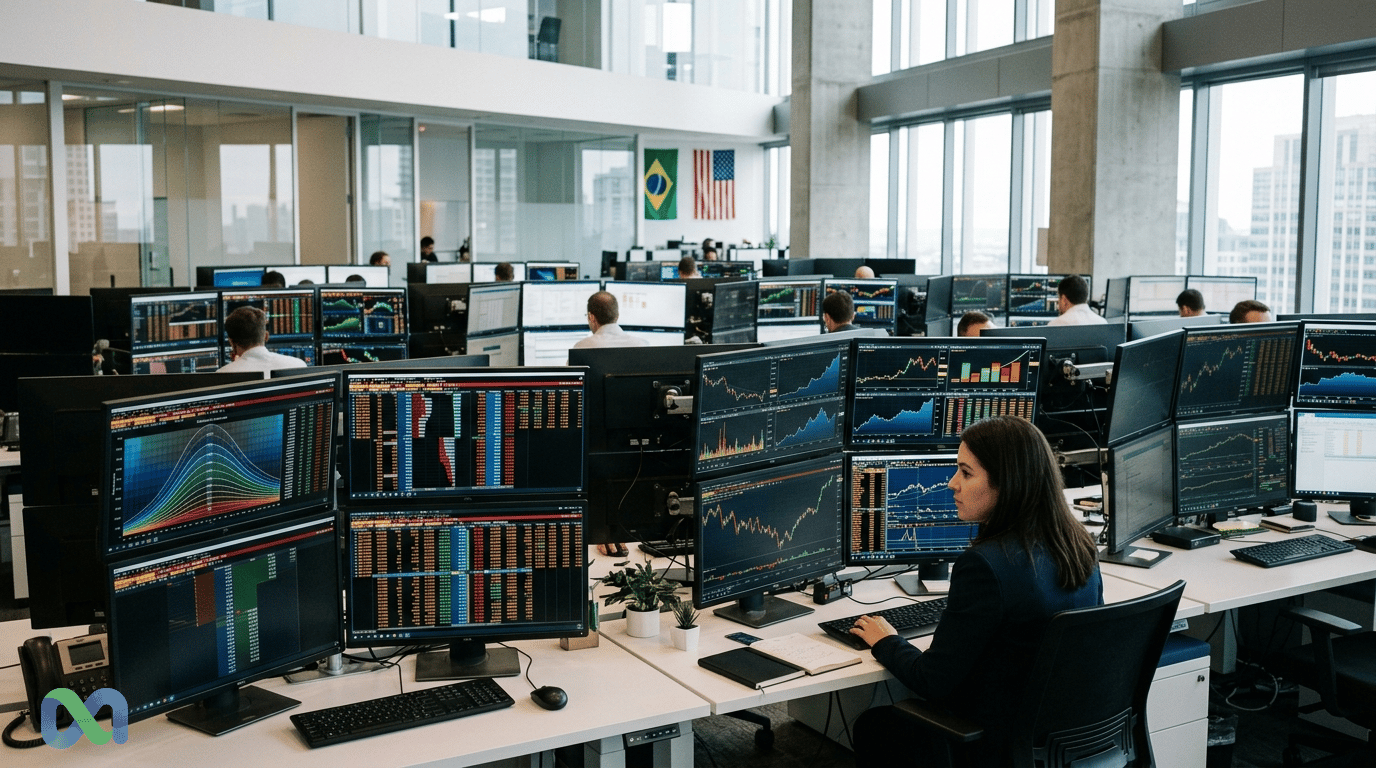
Bloomberg's framing captures a real shift in market structure. Prediction markets are starting to look less like niche event contracts and more like public information markets.
That does not mean every event market is ready for institutional capital. It means the category is moving toward open access, continuous pricing, broker distribution, automated trading, and stronger regulatory scrutiny. Those are the same forces that shaped public equity and futures markets.
The useful question is not whether prediction markets are "the new stock market." They are not. The better question is what has to happen before event probabilities can become serious market data.
For macro analysts, political traders, and investors watching Latin America, that question matters. Election odds, central-bank expectations, inflation outcomes, and geopolitical risk can all become tradable signals when markets are liquid and transparent enough.
Reviewed: 05/20/2026. Disclaimer: this article is educational analysis, not investment advice.
According to Bloomberg, the public-market analogy is now part of the mainstream debate around prediction markets. In our experience tracking political and macro event markets, the useful signal is not one isolated price. It is how prices move over 4 years of election cycles, rate decisions, and regulatory events. Our experience also shows that thin markets can look precise before liquidity arrives. Our experience is that analysts should compare market prices with polls, official data, and legal context.
What Are Prediction Markets?
Prediction markets are trading venues where contracts settle based on future event outcomes. A contract price can be read as a market-implied probability. If a contract trades near 62 cents, the market is implying roughly a 62% chance of that event, before fees and market frictions.
The contract could ask whether a candidate wins an election, whether a central bank cuts rates, or whether inflation lands above a threshold. Traders buy and sell those outcomes as new information arrives.
This is why prediction markets can move faster than surveys. A poll captures stated opinions at a point in time. A prediction market reprices whenever traders believe new information changes the expected outcome.
That speed is useful, but it is not magic. Market prices can be wrong, thin, manipulated, or distorted by rules. They are signals, not guarantees.
Event Contracts and Market-Implied Probabilities
An event contract turns an uncertain future event into a tradable instrument. The instrument has a defined resolution rule, a deadline, and a payout condition.
For example, a contract might settle at 1 if Brazil's central bank cuts the Selic rate at a specific meeting. It settles at 0 if the cut does not happen. The price between 0 and 1 reflects what traders are willing to pay for that outcome.
This structure converts disagreement into price. One trader may believe the event is underpriced. Another may believe the market is too optimistic. Their trades create a live probability estimate.
The key benefit is continuous updating. When a new inflation print, campaign poll, court ruling, or central-bank statement appears, traders can adjust prices immediately.
Why Prices Update Faster Than Commentary
Traditional commentary is slow because it has editorial and analytical lag. Analysts need time to write notes, outlets need time to publish, and readers need time to digest the argument.
Prediction markets compress that process. Traders can express a view in seconds. That does not make the view correct, but it makes the signal timely.
However, speed also creates new risks. Fast markets reward automation, arbitrage, and information advantages. If the market has weak surveillance, faster trading can make the price less trustworthy rather than more trustworthy.
That is why the public-market analogy matters.
Why Bloomberg Calls Them the New Public Markets
Bloomberg's May 2026 article, Prediction Markets Are the New Public Markets, points to a broader change. Prediction markets are becoming places where public information gets priced, traded, and watched in real time.
That sounds close to public markets. Public equities turn company information into prices. Futures markets turn expectations about rates, commodities, or indexes into prices. Prediction markets can turn political and macro events into prices.
The analogy is strongest when the market has open access, meaningful liquidity, transparent rules, and reliable settlement. It is weakest when contracts are thin, opaque, or designed mainly for entertainment.
Open Access, Continuous Pricing, and Tradable Information
Public markets became powerful because many participants could trade the same instrument under shared rules. The market price then became a reference point for everyone else.
Prediction markets are trying to do something similar with events. Instead of asking only analysts or pollsters what they think, the market lets traders put capital behind their view.
That capital commitment matters. It gives the signal a different character than a survey response. A trader who buys an outcome has a financial reason to research, monitor, and update the position.
Still, capital commitment does not remove bias. It can even amplify bias when liquidity is low. A small number of confident traders can move a thin market more than they should.
Where the Public-Market Analogy Breaks
Prediction markets are not public companies. They do not represent ownership, cash flows, dividends, or voting rights. They are event contracts with binary or bounded payouts.
That changes the risk profile. A stock can compound for years. An event contract usually resolves to a fixed outcome. Once the event is settled, the instrument disappears.
The information environment is also different. Companies publish financial statements, hold earnings calls, and face disclosure rules. Many political or macro events do not have an equivalent disclosure system.
This is the main bottleneck. Prediction markets can behave like public information markets only when rules, surveillance, and settlement quality support trust.
Prediction Markets vs Public Markets vs Betting Platforms
The distinction matters because the category is often described with the wrong vocabulary. A serious prediction market is closer to a market-data venue than a casino product, but only if the structure supports transparent price discovery.
| Feature. | Public Markets. | Prediction Markets. | Betting Platforms. |
|---|---|---|---|
| Core instrument. | Equity, debt, futures, options. | Event contracts. | Wagers or house-set odds. |
| Price meaning. | Value, yield, risk, or expected payoff. | Market-implied event probability. | Bookmaker or pool price. |
| Main use. | Capital allocation and hedging. | Forecasting, hedging, and information discovery. | Entertainment and speculation. |
| Key trust requirement. | Disclosure, custody, clearing, surveillance. | Resolution rules, liquidity, surveillance, compliance. | Payout reliability and consumer protection. |
| Main weakness. | Complexity and systemic risk. | Thin markets and event-rule disputes. | Opaque margins and house incentives. |
This table shows why the category is contested. Prediction markets can produce useful probabilities, but they need market-grade infrastructure to avoid becoming just another form of betting.
The Market Structure Shift: From Crowd Wisdom to Trading Venues
Early prediction-market narratives focused on the wisdom of crowds. That idea still matters, but it is incomplete. The next phase is about market structure.
If a market has real volume, traders do not only ask "what does the crowd believe?" They ask about spreads, depth, fees, latency, data access, risk limits, and settlement quality.
Those are trading-venue questions. They are also the questions that decide whether institutional users can trust the market.
Liquidity Providers and Market Makers
Liquidity is the first test. A price is useful only if traders can buy or sell at reasonable size without moving the market too much.
Thin prediction markets can look precise while being fragile. A displayed 64% probability may reflect one trader's small order, not broad market agreement.
Market makers improve that problem by quoting both sides. They narrow spreads, absorb order flow, and make it easier for new information to enter prices.
However, market makers need incentives. They need enough volume, clear rules, and manageable resolution risk. If those conditions are missing, liquidity will remain shallow.
AI Agents, Arbitrage, and Speed
AI is making the shift faster. Automated systems can scan news, compare prices across venues, and execute trades when probabilities diverge.
This can improve price discovery. If one market is slow to react to a data release, an algorithm can close the gap. Over time, that makes stale prices less common.
Yet automation can also create noise. Bots may overreact to headlines, misread ambiguous language, or crowd into the same trade. A fast market is not always a wise market.
The more algorithmic the category becomes, the more it needs controls that public markets already know well: monitoring, abuse detection, and clear audit trails.
Why Data Feeds and Surveillance Matter
Public markets rely on data infrastructure. Quotes, trades, order books, and reference prices travel through systems that institutions can monitor.
Prediction markets need a similar layer. Analysts need clean historical data. Traders need reliable feeds. Regulators need records that can show whether suspicious activity occurred.
Bloomberg has also covered insider-trading concerns in prediction markets, including cases that tested how market-integrity rules apply to event contracts. That coverage underlines the point: the category cannot scale on attention alone.
Trust has to be built into the plumbing.
The Growth Case: What a $1 Trillion Market Would Require
Financial-news coverage has highlighted forecasts that prediction-market volume could reach very large numbers by 2030. Those forecasts should be read as scenarios, not facts.
The difference matters. Trading volume is not revenue. It is also not the same as deep liquidity, durable user demand, or high-quality price discovery.
A market can print large volume if contracts churn quickly. That does not automatically make the market useful for macro analysis.
Distribution Through Brokers and Exchanges
The growth case depends on distribution. Prediction markets become more mainstream when users can access them through brokers, exchanges, wallets, or financial platforms they already use.
That is how other asset classes scaled. Ease of access lowers friction. It also brings new compliance requirements.
If event contracts appear beside stocks, options, crypto, or futures, users will expect a similar standard of operational reliability. They will also expect clearer risk labeling.
This is one reason public-company involvement matters. Public companies can bring distribution, brand trust, and compliance teams. But they can also draw more regulatory attention.
Beyond Sports: Politics, Macro, Crypto, and Geopolitics
The most important prediction markets are not always the most entertaining ones. For Macro Markets, the highest-value contracts are tied to political and economic outcomes.
Election markets can show how traders price a candidate's path as polls, alliances, court decisions, and economic data change. Central-bank markets can show how traders interpret inflation and employment data before a policy meeting.
Crypto markets can price protocol events, ETF decisions, or regulatory outcomes. Geopolitical markets can price trade restrictions, elections, sanctions, or conflict risk.
These use cases are closer to professional analysis than entertainment. They turn uncertain events into time-stamped probability data.
Volume Is Not Revenue
The $1 trillion headline is useful only if readers understand what it measures. Volume usually means notional trading activity. It does not mean platforms earn $1 trillion.
Revenue depends on fees, spreads, subscriptions, data products, and other monetization. Liquidity quality depends on depth, participant diversity, and market-maker behavior.
Therefore, a large-volume market can still have weak economics. It can also have strong economics while producing poor forecasts if incentives are misaligned.
For analysts, the better question is whether the market produces a reliable probability series. That is the product that matters.
Regulation and Trust Are the Bottleneck
Prediction markets sit near several regulatory boundaries. They can look like derivatives, gaming products, political instruments, data products, or consumer-finance tools depending on design and jurisdiction.
That ambiguity creates opportunity and risk. It lets platforms experiment. It also makes institutional adoption harder.
Users need to know who supervises the venue, how contracts resolve, what happens during disputes, and what protections exist against abuse.
Insider Information and Manipulation
Market integrity is not optional. If a trader can use privileged information about a legal decision, corporate action, campaign announcement, or government process, the market can lose credibility fast.
Thin event markets are especially exposed. A few aggressive orders can distort the price, shape public perception, or create a misleading signal.
This is why surveillance matters. Venues need to monitor suspicious patterns, document trade activity, and respond to manipulation attempts.
Without that layer, prediction markets may still attract users. But their prices will not deserve the same analytical weight as public-market prices.
Federal, State, and Local Oversight
The U. S. debate often centers on federal and state authority over event contracts. Other countries have their own mix of securities, derivatives, gaming, and consumer rules.
Latin America adds another layer. Local regulators and central banks may see event contracts through the lens of capital markets, payments, consumer protection, or election integrity.
For Brazil, institutions such as the Banco Central do Brasil and Comissao de Valores Mobiliarios shape how financial innovation is interpreted. Prediction-market platforms need to understand that local context.
Regulatory clarity does not have to kill the category. In many cases, it is what makes larger participation possible.
Disclosures, Limits, and Compliance Controls
Public-market-like prediction venues need more than a clean interface. They need clear disclosures, contract specifications, participant limits, market monitoring, and fair resolution procedures.
They also need plain language. Users should understand that a 70% probability is not a certainty. They should also know that markets can move sharply as new information arrives.
This is where responsible platforms can separate themselves from entertainment-first products. Better controls can make the market more credible, not less attractive.
What This Means for Latin America
Latin America is a natural region for prediction markets because political and macro events matter so much for asset prices, business planning, and household expectations.
Brazil alone offers a deep calendar of events: presidential elections, congressional negotiations, COPOM meetings, inflation releases, fiscal-rule debates, and Supreme Court decisions.
Each event can affect currencies, rates, equities, crypto flows, and investor sentiment. A market-implied probability can help analysts track how expectations change over time.
Election Probabilities as Live Political Risk Data
Election polling remains important, but it has limits. Polls measure stated preferences. Prediction markets measure prices set by people willing to take risk.
That does not make markets superior in every case. Polls can be more representative. Markets can be more responsive. The best analysis uses both.
For example, a candidate's market probability may move after a corruption allegation, a new alliance, or a televised debate. The move shows how traders interpret the information before the next formal poll arrives.
That live signal can be valuable for analysts who follow political risk.
COPOM, Inflation, and Macro Event Contracts
Central-bank events are another strong use case. A COPOM contract can price the market's view of a rate decision before the meeting.
Inflation contracts can show how traders interpret high-frequency data, commodity prices, fiscal news, and currency moves. Over time, those prices can become a useful record of changing macro expectations.
This is not a replacement for economist forecasts. It is a different lens. Forecasts explain the argument. Markets show where capital is positioned.
Why Local Market Context Matters
Global platforms often focus on U. S. politics, U. S. sports, and U. S. regulation. That leaves room for local platforms with stronger regional knowledge.
Brazilian politics has its own calendar, institutions, parties, and legal risks. Latin American macro events also require local context. A market that ignores those details will price events poorly.
That is where specialized prediction markets can matter. They can build contracts around events that global venues treat as secondary.
For Macro Markets, the opportunity is not just to list events. It is to turn local political and macro knowledge into transparent probability data.
How Traders Should Read Prediction-Market Prices
A prediction-market price is a useful signal when it is liquid, transparent, and tied to a clear resolution rule. It is weaker when volume is thin, the rule is vague, or the participant base is narrow.
Before using a price as evidence, ask four questions.
First, how much liquidity supports the price? A deep market deserves more weight than a thin one.
Second, is the resolution rule clear? Ambiguous wording can make the final result contested.
Third, who may have better information? Event markets can attract informed traders, but they can also attract insiders.
Fourth, did the price move for a reason? A probability move after a credible data release means more than a move caused by one large order.
This discipline keeps the signal useful. It also avoids the biggest mistake: treating market probability as truth.
FAQ: Prediction Markets as Public Markets
Which prediction markets are publicly traded?
Many prediction-market platforms are private companies or crypto-native venues, not publicly traded stocks. Investors may get indirect exposure through public companies that distribute or integrate event contracts, but that is not the same as owning a prediction-market exchange.
Are prediction markets the same as betting?
No. A prediction market uses tradable contracts to produce market-implied probabilities about future events. Betting platforms often rely on house-set prices or entertainment-first design. However, weak prediction markets can still behave like betting products if they lack transparency and surveillance.
Can prediction markets be manipulated?
Yes. Any thin market can be moved by concentrated trading. Event markets also face risks from insider information, ambiguous resolution rules, and coordinated activity. Strong liquidity, surveillance, and clear contract design reduce those risks.
How do AI traders affect prediction-market prices?
AI traders can make prices faster and more efficient by scanning news, comparing venues, and executing arbitrage. They can also add noise when models misread information or crowd into similar strategies. Automation improves markets only when controls and data quality keep pace.
Are prediction-market prices investment advice?
No. Prediction-market prices are market signals, not guarantees or investment advice. They should be used alongside polling, economic data, legal analysis, and expert research.
The Bottom Line
Prediction markets are becoming public information markets. That is the core insight behind the Bloomberg debate.
The category is moving from crowd-wisdom experiments toward trading venues with liquidity providers, data feeds, automated strategies, and regulatory scrutiny. That shift can make event probabilities more useful for professional analysis.
But the public-market analogy has a hard condition. Prediction markets need public-market-grade trust.
That means clear rules, reliable settlement, deep liquidity, market surveillance, responsible disclosures, and local regulatory awareness. Without those elements, prices may be fast but fragile.
For Latin America, the opportunity is significant. Political and macro events already drive real economic decisions. Transparent event markets can turn those expectations into live probability data.
The winners will not be platforms that merely copy betting language. They will be venues that treat prediction markets as serious market infrastructure.
