




Trump AI White House: Big Tech and Security
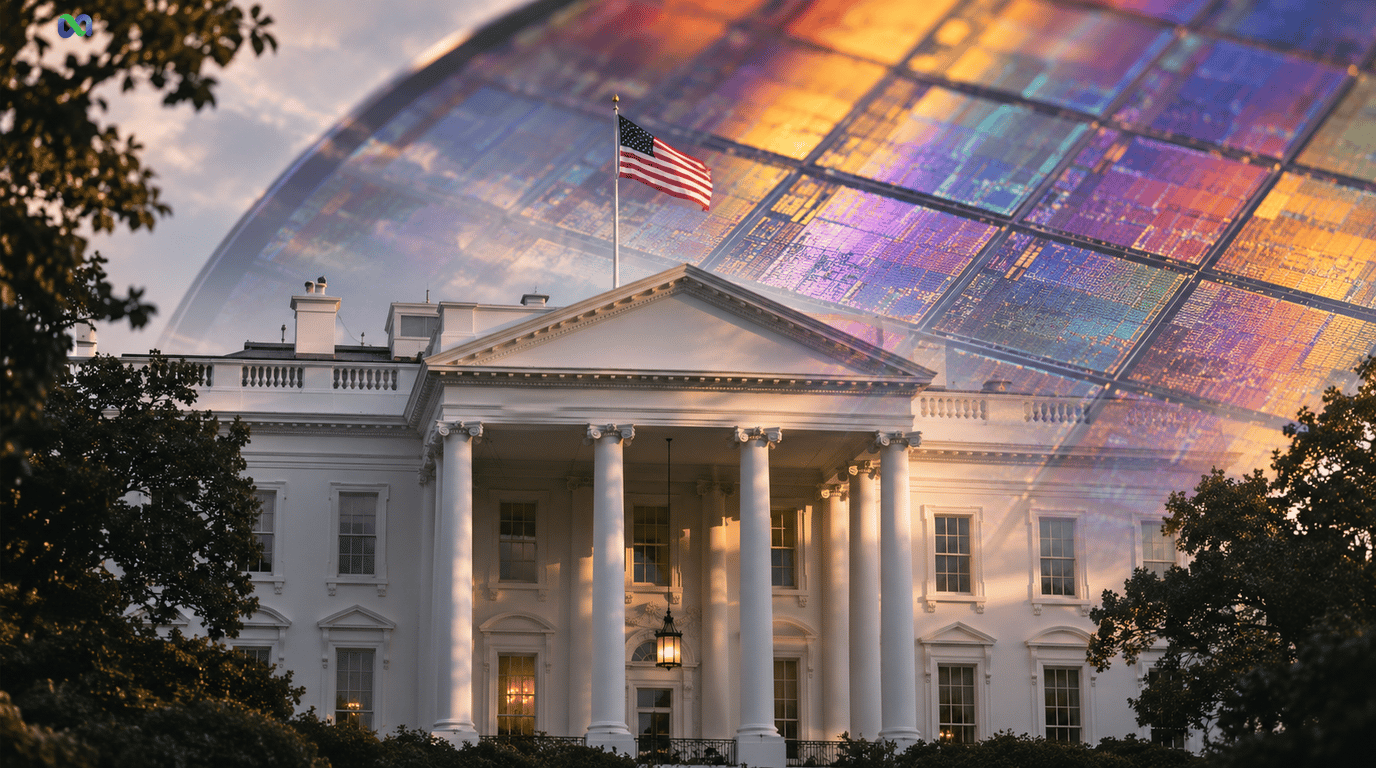
Trump AI White House has become a central technology issue in Washington. The original report said Trump called Meta, Anthropic, OpenAI, and Google to the White House. The meeting is more than a technical briefing. It shows how security, industrial power, and Big Tech are now part of the same policy table.
According to the source coverage, Trump called the companies to discuss voluntary security tests. Those tests would measure whether advanced AI models can break into systems under controlled conditions. The issue gained force after OpenAI and Anthropic described experiments around this kind of risk.
For markets, the question is not only technical. Who defines the test? Who sees the result? Who gets the trust label? Who pays the compliance cost? Those answers can affect Big Tech, startups, data centers, chips, and public contracts.
What Trump Wants To Discuss With Meta, Anthropic, OpenAI, and Google
Trump wants to discuss voluntary cybersecurity tests for advanced AI models. The White House wants to measure whether these systems can find flaws, exploit vulnerabilities, and operate attacks in test environments.
That is the short answer. But it is not enough. The Trump AI White House meeting also signals a coordination attempt. The government wants to show caution on security while keeping the United States ahead of China in artificial intelligence.
Security tests and system intrusion
The risk has changed because AI agents can now use external tools. A standard chatbot answers questions. An agent with a terminal, browser, and permissions can execute tasks. It can search for a flaw, test a path, and repeat the action.
This does not prove that every commercial model is dangerous. However, it shows that evaluation needs to change. The question is no longer whether a model can explain an attack. The question is whether the system can act as part of one.
The Trump administration has discussed voluntary cybersecurity tests. The White House has not yet detailed the metrics, the record of results, or the level of public disclosure. That missing detail matters more than the meeting photo.
Why these four companies matter
Meta, Anthropic, OpenAI, and Google matter for different reasons. Meta has strength in open models and global distribution. Anthropic sells safety as a core part of its brand. OpenAI has usage scale and political influence. Google combines research, cloud, and infrastructure.
Therefore, the meeting is not only about suppliers. It involves companies that can shape standards for the sector. If one company accepts a test, the others face pressure. If one refuses, markets may read that as reputational risk.
The Meeting Is About Security, But Also Industrial Power
AI security does not stand alone. It connects to chips, energy, data centers, cloud computing, and exports. Stronger models require more compute. More compute requires physical infrastructure. Physical infrastructure depends on public policy.
That is what makes the Trump AI White House agenda different from a routine news item. The meeting could become a marker for industrial policy. The government can use security tests as an entry point for public procurement, export rules, and market standards.
Models, chips, energy, and data centers
The AI chain starts with the model, but it runs through real assets. Advanced chips, power contracts, and data centers define who can train and serve models at scale. As a result, any public AI agenda affects more than software.
For large companies, this can be positive. They have capital, safety teams, and government relationships. For startups, it can be harder. An expensive audit standard can raise the barrier to entry.
A voluntary test looks light when viewed alone. Yet it can become a label. Later, the label can become a requirement for selling to the government or to regulated companies.
The White House as coordinator
The White House does not need to pass a new law to influence the sector. It can define the agenda, choose participants, and guide federal agencies. It can also shape public procurement and voluntary agreements.
This kind of power is common in sensitive industries. The government talks about national security. Companies talk about innovation. The result is often a deal that tries to preserve both sides.
The details matter. Who audits the tests? Will the data be public? Will there be comparisons between companies? Will there be consequences if a model fails? These questions matter more than the headline.
The Incentive Conflict Behind AI Policy
The brief behind this article mentions signals about possible private interests tied to data centers. That theme requires care. The material used here is not enough to state a conflict of interest as a settled fact.
Even so, the question is relevant. When a government accelerates data centers and energy for AI, infrastructure assets can gain value. That is why financial disclosures, public contracts, and tax incentives should be watched closely.
How private interests can shape public priorities
AI policy creates winners and losers. A safety rule can protect users. It can also favor large companies. A data center incentive can increase compute supply. It can also benefit owners of infrastructure.
The analysis needs to separate three things. First, facts confirmed by documents. Second, visible economic incentives. Third, hypotheses that still need proof.
That separation lowers noise. Not every meeting with companies is capture. But no policy worth billions should be treated as neutral without verification.
What still needs to be confirmed
The White House has not published the full details of the tests. There is also no clarity on metrics, transparency, or governance. The White House will be the primary source to watch.
Analysts should also monitor the Commerce Department, congressional hearings, and company statements. Financial disclosures and public contracts complete the list. Each new document reduces uncertainty.
For prediction markets, this is the right logic. The headline creates the question. Documents update the probabilities. In policy, confirmation is usually more important than the first signal.
Open Models, Security, and Silicon Valley Pressure
The Trump AI White House meeting also connects to the debate over open models. The brief cited a Washington Post report on talks to streamline releases of U. S. open models.
Open models help research, adoption, and competition. However, they also reduce control after release. Once weights and techniques circulate, it becomes harder to limit offensive use.
The debate over faster releases
Technology companies defend speed. Their argument is that the United States will lose influence if releases are delayed. Global developers could move to Chinese or European alternatives.
Security agencies see another risk. A strong open model can help fraud, social engineering, and vulnerability exploitation. That risk grows when the model becomes an agent with tools, the same class of concern covered in prior analysis of OpenAI and Anthropic cybersecurity.
Voluntary tests can become the political bridge. They let officials say there is caution without freezing every release. They also create a path for companies to prove responsibility.
Security risk versus competitive advantage
Security calls for audits, documentation, and limits. Competition calls for speed, scale, and distribution. The White House is trying to avoid a binary choice.
This balance tends to favor larger companies. They have legal teams, safety teams, and money for audits. Startups benefit if the rules are clear. They lose if the cost of proving safety rises too much.
The market question is direct. Who will have political permission to release stronger models first? That question affects product cycles, cloud demand, and investor expectations.
Why This Matters For Analysts and Traders
Trump AI White House policy can affect Big Tech through three channels. The first is regulatory. The second is industrial. The third is geopolitical.
The regulatory channel includes tests, audits, and safety standards. The industrial channel includes energy, chips, cloud, and data centers. The geopolitical channel includes exports, China, and control of sensitive technology.
Signals that can move expectations
Watch six signals after the meeting:
- An official statement with participants and the scope of the tests.
- Commerce Department participation in the process.
- Statements from OpenAI, Anthropic, Google, and Meta about joining.
- New rules for model, chip, or cloud exports.
- Data center announcements and energy contracts.
- Congressional hearings on AI agents and cybersecurity.
Each signal changes the read. A private test suggests light coordination. A public standard suggests tougher regulation. A package tied to data centers suggests a broader industrial policy agenda.
Scenarios for regulation and infrastructure
| Scenario | What happens | Likely impact |
|---|---|---|
| Light coordination | Voluntary tests without public results | Big Tech gains time |
| Public standard | Federal metrics enter the process | Compliance costs rise |
| Open model restriction | Releases face new barriers | Meta and startups face more uncertainty |
| Industrial acceleration | Data centers and energy get support | AI infrastructure gains value |
| Antitrust pressure | Congress links safety to concentration | Google and Meta face political risk |
This table is not a final forecast. It is a hypothesis map. Traders can use it to turn political language into observable events.
How the meeting could affect each Big Tech company
Exposure differs by company. So the same meeting can help one firm and hurt another.
| Company | Exposure | Risk | Possible benefit |
|---|---|---|---|
| OpenAI | Massive usage and agents | More scrutiny over safety | Help define the standard |
| Anthropic | Brand built around safety | Must prove a technical edge | Gain credibility through testing |
| Cloud, research, and data | Antitrust and concentration | Sell infrastructure and compliance | |
| Meta | Open models | Restrictions on releases | Lead a safe open standard |
The most likely outcome is mixed. The government wants security. It also wants American leadership. That usually creates rules that change power inside the sector without stopping the sector.
What could confirm or weaken the thesis
The strong thesis is simple. The Trump AI White House meeting is not only about technical risk. It could become the first step toward an American standard for advanced AI.
That thesis gains strength if the White House publishes metrics, involves the Commerce Department, and requires recurring participation. It also gains strength if public contracts start citing safety tests.
In that case, Big Tech companies with more structure gain an advantage. The thesis weakens if everything remains a generic statement. It also weakens if companies treat the tests as public relations.
Without metrics, without a responsible agency, and without consequences, the event stays closer to a political signal than a real change. Markets should separate those outcomes.
FAQ About Trump AI White House
Why did Trump call AI companies to the White House?
Trump called AI companies to discuss voluntary security tests. The reported focus is measuring cybersecurity risk in advanced models and AI agents.
Which companies were called?
The coverage cited in the brief points to Meta, Anthropic, OpenAI, and Google. They concentrate advanced models, infrastructure, and influence over technical standards.
What are AI security tests?
They are evaluations that measure whether a model or agent can execute dangerous tasks. In this case, the focus is cybersecurity and intrusion capability in controlled tests.
Does the meeting change U. S. AI regulation?
Not yet. The meeting is a political signal. Real change depends on metrics, official documents, agencies involved, and possible rules for releases and exports.
Can AI data centers create conflicts of interest?
They can if public decisions benefit private assets. But that requires proof. The right approach is to track disclosures, contracts, licenses, and tax incentives.
Conclusion: The Headline Is Security, But Markets Should Read Incentives
Trump AI White House is a security story. It is also a power story. The meeting brings together Big Tech, cybersecurity, data centers, China, and industrial policy.
The next step is to watch facts, not slogans. Who will run the tests? Will the metrics be public? Will open models get their own rules? Will data centers receive support? Will Congress enter the debate?
Prediction markets exist to track this kind of uncertainty. The news opens the question. Later documents update the probabilities. In AI policy, the gap between signal and confirmation is where the market starts to work.
