




Vini Jr Real Madrid Contract Renewal: What Changed
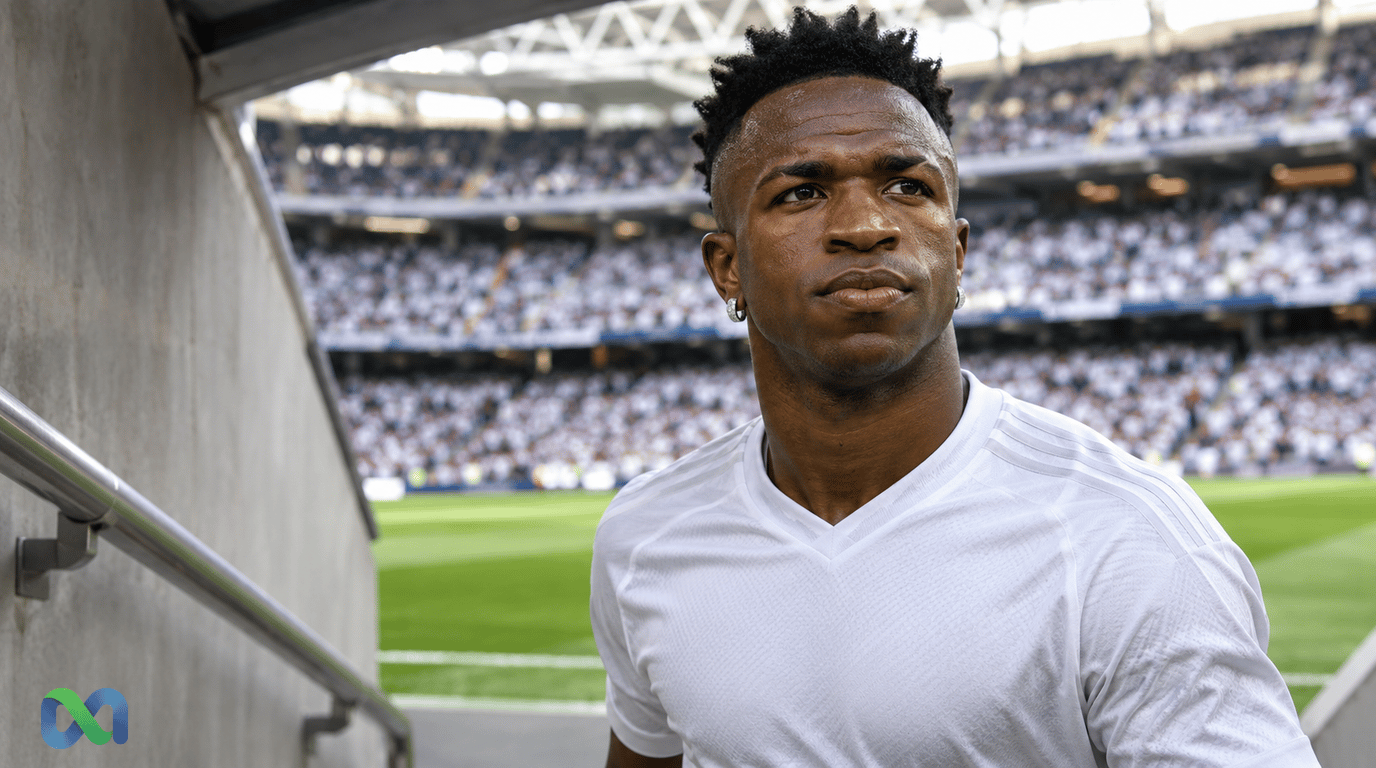
The Vini Jr Real Madrid contract renewal has entered a more concrete phase because the club did more than raise the headline number. According to coverage from CNN Brasil, ESPN Brasil, Terra, and O Globo, Real Madrid is now discussing a more flexible structure to keep the Brazilian forward through June 2031.
The core issue is not only annual salary. The negotiation now turns on signing bonuses, individual targets, loyalty clauses, and Vini Jr's strategic weight in the sporting project. In practical terms, Real Madrid is trying to buy stability before the current contract, which runs until 2027, becomes a larger source of risk.
That matters for fans, analysts, and traders because star contracts move expectations. A positive meeting lowers the perceived chance of an exit, but it does not remove the risk. Until there is a signature, each new report can change the implied price of Vini Jr staying at Real Madrid.
Vini Jr Real Madrid Contract Renewal: What Changed in the Offer
Real Madrid's new offer to Vini Jr was described as a meaningful improvement over previous talks. CNN Brasil reported a contract through June 2031, with pay close to the top of the squad and more openness to variable components.
The reported package includes a high fixed salary, a signing bonus, and performance-linked incentives. ESPN Brasil cited an annual figure around R$130 million. Terra and CNN also noted that the club opened a path toward renewal after becoming more flexible on points that had blocked the conversation.
In simple terms, Real Madrid appears to have changed the payment design. Instead of solving everything through fixed salary, the club can use bonuses and targets to move closer to the player's demands. That structure preserves some payroll control while recognizing Vini Jr's market value.
A Contract Through 2031 and an Above-Standard Package
A deal through 2031 would put Vini Jr at the center of Real Madrid's sporting cycle for five more seasons beyond the current contract. It would cover the squad transition, the player's physical peak, and the period in which the club needs to maximize global revenue.
The length also changes the balance of the negotiation. For the club, a long extension lowers the risk of losing an elite asset under time pressure. For the player, the deal must compensate him for years in which he could test other offers.
That is why the 2031 date is not just a timeline. It is a strategic lock. Real Madrid buys predictability, while Vini Jr tries to capture part of the value he creates on and off the pitch.
Salary, Bonuses, and Loyalty Clauses
Reports indicate that the salary could approach 20 million euros per season. However, the discussion goes beyond that number. The signing bonus became central because it brings value forward without necessarily lifting the full annual fixed cost.
That difference matters. Fixed salary weighs on the squad structure every year. Bonuses and targets allow the club to meet a larger demand through a more tailored package. Real Madrid usually protects its salary hierarchy, so this contract engineering helps avoid an internal rupture.
One simple way to read the package is to separate four blocks.
- Fixed salary: the guaranteed annual amount paid to the player.
- Signing bonus: the premium for renewing and committing long term.
- Individual targets: payments tied to performance, awards, or appearances.
- Loyalty clauses: incentives to stay through the contract cycle.
This mix reduces noise. The club improves the offer without turning every euro into recurring salary. The player, in turn, receives immediate recognition of his status.
Why Vini Jr Has More Bargaining Power
Vini Jr has gained bargaining power for three clear reasons. The first is contractual: his current deal runs until 2027. The second is sporting: few wingers in the world create the same imbalance. The third is commercial: his global brand has grown alongside Real Madrid.
When those factors appear at the same time, the club must act before the external market gains strength. Pressure does not come only from a formal bid. It comes from the perception that other clubs or projects could pay more, even if they are only monitoring the situation.
The Current 2027 Contract Raises Time Pressure
A contract until 2027 still gives Real Madrid room. There is no absolute urgency like there would be in the final year. Even so, the decision window has already opened.
Elite clubs usually renew their main assets before the timeline becomes uncomfortable. If talks enter 2026 without progress, the tone changes. The player gains more leverage, and every report about outside interest carries more weight.
That is why the positive August meeting matters. It signals that Real Madrid does not want to test that limit. The club would rather negotiate now, while it still controls much of the process.
Technical Value, Global Brand, and Scarce Replacements
Vini Jr is hard to replace because he combines speed, one-on-one creation, Champions League experience, and commercial relevance. That package is rare. Even clubs with large budgets can find few players who offer something similar.
A replacement would not only be expensive. It would also carry sporting risk. The new player would need to adapt to the Bernabeu, the squad, the shirt, and Real Madrid's competitive demands.
This scarcity increases the opportunity cost. If Real Madrid saves money on the renewal, it may spend more later on a transfer fee, signing bonus, salary, and adaptation risk. The price of retaining Vini Jr must be compared with that full cost, not only with the current wage bill.
How the Vini Jr Real Madrid contract renewal buys stability
Real Madrid's change in posture looks like a risk management decision. The club is not only rewarding a player. It is reducing volatility around one of the squad's most important assets.
In markets, stability has a price. A club that lets a star enter a speculation cycle loses control of the story. The press starts asking about an exit, the player faces constant noise, and the squad lives with uncertainty.
Renewing early can be expensive. Waiting too long also has a cost. The improved offer suggests that Real Madrid decided to pay a retention premium to reduce that risk.
Retention Versus Replacement Cost
The replacement cost for Vini Jr would be high even before any transfer fee. An elite forward with similar age, output, and visibility would command a major salary and bonus package. Real Madrid would also need to negotiate with another selling club.
There is also performance risk. Signing a star does not guarantee immediate fit. Real Madrid already knows Vini Jr's output, his behavior in major matches, and his relationship with the supporters. That knowledge has value.
So the right question is not whether Vini Jr deserves each component of the package. The right question is whether Real Madrid can find a better, cheaper, and less risky alternative. Today, that alternative is not obvious.
How Bonuses Reduce Noise Without Exploding Fixed Salary
Signing bonuses and loyalty clauses are useful because they move part of the cost to specific moments. They can satisfy the player without creating a new automatic salary floor for the whole squad.
That logic matters in elite dressing rooms. When one player earns a fixed salary far above everyone else, other agents use that number as a reference. Bonuses and targets give the club more flexibility in internal communication.
The result is a contract that can be large, but more manageable. For Vini Jr, the package recognizes his current value. For Real Madrid, it protects the salary architecture and reduces negative headlines about an impasse.
What This Changes for the Vini Jr Exit Market
An improved offer lowers the probability of an exit, but it does not take the risk to zero. That is the balanced reading. Until the contract is signed, the negotiation remains exposed to noise, counteroffers, and new demands.
Coverage has mentioned monitored interest from clubs such as Arsenal, but the open sources do not confirm an official bid. There has also been frequent speculation about projects capable of offering numbers far above the European standard. That backdrop helps Vini Jr at the table.
For anyone tracking sports prediction markets, the news works as a repricing event. Before the meeting, the risk of an impasse had more room. After the improved offer, the case for staying gets stronger, although it still depends on the player's final decision.
The same logic applies to other elite names. Rodrygo's role in the 2026 World Cup, Pedri's weight for Spain, and the probabilities around Brazil, France, and Argentina show the same pattern. When a star's status changes, the market adjusts the team's ceiling.
Arsenal Is Monitoring, but No Official Bid Is Cited
Arsenal appears in the news as a club watching the situation. That does not mean there is a formal offer or an advanced negotiation. It means the market is observing any opening around an elite player.
That distinction prevents exaggeration. Monitored interest is different from a bid. It is also different from personal terms. In European soccer, many clubs follow contract situations without necessarily acting.
Still, the existence of that interest matters in the negotiation. Real Madrid knows that if talks cool down, other projects may try to turn observation into an offer. That possibility increases the incentive to close quickly.
A Positive Meeting Changes Expectations, Not the Contract
The August 5 meeting was described as positive by parts of the press. That signal improves the staying scenario. However, it should not be confused with a completed agreement.
Negotiations of this size usually advance in layers. First comes alignment on values. Then come signing bonuses, payment schedules, targets, image rights, and contract protections. Each point can delay or accelerate the outcome.
That is why the probability of a renewal has improved in the news cycle, but still needs confirmation. The market should treat the offer as material progress, not as a settled fact.
Scenarios for the Next Few Weeks
The Vini Jr case has three main scenarios. The first is a quick agreement. The second is another round focused on bonuses. The third is an impasse that reopens outside speculation.
None of them should be read as binary. The most likely outcome can change with a statement, a meeting, or a report about values. Elite contracts are sensitive to details because each adjustment changes incentives.
Scenario 1: A Quick Agreement
A quick agreement becomes more likely if both sides accept the new structure. In that case, Real Madrid announces the renewal through 2031 and ends the noise before the season gains intensity.
That would be the best scenario for the club. It preserves stability, reinforces Vini Jr as a central piece, and prevents other clubs from finding room. For the player, it would validate his status financially.
Scenario 2: Another Bonus Round
The second scenario is a longer but still constructive negotiation. The sides agree on the broad structure, but adjust the signing bonus, targets, and loyalty clauses.
This path does not mean crisis. In major contracts, financial details can consume weeks. The key signal will be the tone of leaked information. If reports remain positive, the rupture risk stays contained.
Scenario 3: Impasse and Outside Speculation
The third scenario appears if the bonus or salary hierarchy blocks the deal again. In that case, reports about Arsenal, Saudi Arabia, or other projects could gain strength.
That still does not look like the base case based on recent sources. Even so, it is the risk Real Madrid is trying to reduce. The longer the signature takes, the more room there is for speculation.
FAQ on Vini Jr's Renewal
What is Real Madrid's new offer to Vini Jr?
The reported offer includes a contract through June 2031, salary near the top of the squad, and variable components. The press has cited figures around R$130 million per year, plus a signing bonus and incentives.
Is Vini Jr's Real Madrid renewal already done?
No. Sources indicate progress and a positive tone, but there is still no official signing announcement. The final decision depends on Vini Jr, his representatives, and the economic details of the contract.
Why is the signing bonus so important?
The bonus brings value forward for the player without turning the whole package into fixed annual salary. That helps Real Madrid improve the offer while protecting its salary hierarchy.
Could Arsenal sign Vini Jr?
Arsenal appears as interested or attentive to the scenario, but open sources do not cite an official offer. Until the renewal is signed, elite clubs can keep monitoring the situation.
When does Vini Jr's current contract expire?
Vini Jr's current Real Madrid contract runs until 2027. That deadline still gives the club control, but it already creates pressure to solve the extension before negotiations enter a riskier phase.
Quick Summary to Track the Case
The most important signal is simple. Real Madrid improved the offer and accepted deeper talks on bonuses. That shows the club wants to close the renewal before losing leverage at the table.
The second point is duration. A contract through 2031 would give Real Madrid several years of control over Vini Jr. For the player, that duration only makes sense if the package pays his market value.
The third point is external risk. Arsenal and other clubs may watch the situation. However, monitoring is not the same as making an offer. For now, the main conversation remains between Vini Jr and Real Madrid.
Therefore, the base scenario is progress. Still, there is no signature. The news changes expectations, but it does not end the process.
Conclusion
The Vini Jr Real Madrid contract renewal is more than a salary dispute. It shows how elite clubs price risk, scarcity, and stability. Real Madrid seems to understand that keeping Vini Jr may be expensive, but replacing him would likely cost even more.
The renewal advanced because the improved offer changed the structure of the deal. The club is willing to discuss bonuses and incentives to reduce exit risk. Vini Jr, in turn, is using performance, global brand value, and contract timing to capture more value.
The outcome still depends on a signature. Until then, every meeting and every leak can move expectations. For anyone who treats soccer as a market, that is the key point: a positive negotiation does not end uncertainty, but it changes the price of risk.
