


Limitless vs Macro Markets: Which Crypto Prediction Market Fits You?

Limitless and Macro Markets both turn future events into tradable outcomes for crypto-oriented users. The similarity is useful, but it can also hide the decision that matters most. Limitless is a non-custodial prediction exchange built on Base, while Macro Markets provides a crypto-native platform account and describes a hybrid execution model. Those structures create different wallet, funding, fee, resolution and operational risks.
Our verdict: Choose Limitless when you are eligible and prioritize self-custody, on-chain USDC settlement, public developer documentation, user-generated markets and a clearly documented CLOB/AMM protocol. Evaluate Macro Markets when you are eligible and prefer a platform account, crypto-oriented deposits and withdrawals, broad event coverage and a CLOB-primary design with an AMM fallback. Neither platform is always cheaper or more liquid. Compare the exact contract, executable price, available size, fee, resolution source and withdrawal route before trading.
Last reviewed and fact-checked: October 31, 2026.
Editorial disclosure: Macro Markets publishes this comparison and is one of the products evaluated. We apply the same documentation-first criteria to both platforms, identify first-party claims and state when public evidence is incomplete. We do not describe Macro Markets as a CFTC-designated exchange or as a non-custodial protocol. This is a documentation-based comparison; we did not fund both platforms and place simultaneous matched orders. Event contracts can lose the full amount committed. This article is educational, not financial, legal or tax advice.
Limitless vs Macro Markets: Quick Verdict
The central choice is self-custodial protocol versus managed platform account.
Choose Limitless if you are comfortable with wallets and want positions settled on Base. Limitless documents a non-custodial structure, USDC collateral, off-chain signed orders with on-chain matching and settlement, dynamic taker fees, maker incentives, public APIs and multiple wallet modes. It also lets users create certain markets. That transparency does not eliminate smart-contract, oracle, liquidity or jurisdiction risk. Our standalone Limitless Exchange review examines those fees, safety caveats, wallet paths and developer tools in detail.
Evaluate Macro Markets if you prefer an account-based product with approved crypto funding routes and a hybrid liquidity design. Macro Markets says its execution is CLOB-primary with an LS-AMM fallback and that its resolution process uses multiple AI agents to review evidence. These are meaningful product claims, but a design description is not a guarantee of a favorable quote, a fast withdrawal or a correct resolution. Verify the live implementation on the market you intend to trade.
Winner by use case
- Non-custodial Base protocol: Limitless.
- Public self-service API and SDK documentation: Limitless.
- User-generated price markets and custom markets: Limitless.
- Published trading-fee schedule: Limitless.
- Platform-account experience: Macro Markets.
- CLOB-primary execution with AMM fallback: Macro Markets, based on its first-party description.
- AI-agent evidence review: Macro Markets, based on its first-party description.
- United States resident: Limitless says trading is unavailable; verify Macro Markets eligibility directly rather than assuming access.
- Best liquidity or price: no permanent winner without a matched-contract snapshot.
- Lowest total cost: depends on the fee, spread, slippage, network route and withdrawal method for the exact transaction.
Our comparison methodology explains why access, executable cost and contract rules outrank a promotional feature list. If neither product fits, compare the broader set of Limitless alternatives.
Limitless vs Macro Markets at a Glance
| Decision factor | Limitless | Macro Markets | Practical edge |
|---|---|---|---|
| Product model | Non-custodial prediction exchange on Base | Crypto-native prediction-market platform account | Depends on custody preference |
| Operator named in terms | Street Chow Inc., Panama | Macro Markets Predictions Company | Read both current agreements |
| US access | Trading unavailable under current Terms | Confirm current eligibility and signup result | Do not infer access |
| Trading collateral | USDC and conditional outcome tokens on Base | Crypto-oriented balance using approved methods | Depends on starting asset and route |
| Execution | CLOB plus AMM venues; off-chain signed orders and on-chain settlement | CLOB-primary with LS-AMM fallback, according to launch materials | Different implementations of hybrid liquidity |
| Fees | Published AMM and dynamic CLOB taker schedule; resting makers can be fee-free | Current contract and wallet costs must be checked live | Limitless for public fee detail |
| Resolution | Pyth, Chainlink, sports feeds, venue parity, creator or manual review depending on market | Market criteria plus an AI-agent resolution process described by Macro Markets | Read the exact market rule |
| Market creation | User-generated and custom markets are documented | No equivalent public self-service flow verified for this review | Limitless |
| APIs | REST, WebSocket and SDK documentation for multiple languages | REST, GraphQL and WebSocket capabilities described in launch materials; verify current access | Limitless for verifiable public docs |
| Custody risk | Wallet, signer and smart-contract risk | Account, operator, KYC and withdrawal-review risk | Different, not absent |
Similar headlines do not mean identical contracts
Both platforms can list crypto, sports, politics, finance or major world events. A market titled “Will BTC exceed a target?” may still differ in observation time, exchange feed, averaging method, deadline, invalid-data rule and payout process.
Before treating two prices as comparable, match:
- the exact event and outcome;
- the observation time and time zone;
- the named resolution source;
- cancellation, postponement and correction rules;
- the quantity available at the executable price;
- trading, network and withdrawal fees; and
- whether the position can be sold before resolution.
A lower displayed probability is not automatically the better trade. One platform may show the last trade while the other shows a midpoint, and neither may have enough depth for your intended size.
Access, Wallets, Custody and Funding
Location is the first filter. A platform that does not permit your account is not a usable alternative, regardless of fees or interface quality.
Limitless eligibility
The current Limitless Terms of Service name Street Chow Inc., a Panamanian company, as the operator. Users must be at least 18 or the legal age of majority, have legal capacity and comply with their jurisdiction's law.
The Terms block access from Russia, Belarus, Cuba, Iran, North Korea, Syria and specified regions of Ukraine. They also state that trading is unavailable to users from the United States, China and the Canadian provinces of Ontario and Alberta. Lists and legal interpretations can change, so check the current Terms from your actual location before connecting a wallet.
Do not use a VPN or another method to evade a restriction. A successful page load does not prove trading eligibility, and circumvention can create account or position-management risk.
Macro Markets eligibility
Macro Markets' Terms require users to access the service only where the activity is lawful. The company can verify identity and location, block prohibited activity and restrict the account, deposits or withdrawals while checks are incomplete.
We did not find a public country table specific enough to convert that general requirement into a universal availability claim. Confirm the current signup result, market availability and legal position for your location. Crypto support and an English-language site do not establish permission to trade.
Wallet and custody models
The two platforms expose users to different operational risks.
Limitless: non-custodial wallets on Base
Limitless says the protocol has no protocol-level custody of user funds. Its wallet guide documents three paths:
- an external wallet such as MetaMask, Rainbow, Coinbase Wallet or Rabby;
- an embedded wallet created through social login; and
- a smart wallet that can batch transactions and abstract gas.
External-wallet users normally approve on-chain actions through their wallet. Smart-wallet users can trade with USDC while Limitless sponsors gas, which reduces the need to hold ETH. The convenience changes the signing flow but does not remove the need to understand the wallet owner, recovery method and permissions.
Non-custodial does not mean risk-free. Users still face private-key loss, malicious signatures, smart-contract bugs, Base congestion, token-address mistakes and oracle risk. Limitless' security page says its CLOB and NegRisk code is derived from audited Polymarket contracts, while also noting that Limitless-specific modifications are not covered by the upstream audit.
Macro Markets: platform account and crypto withdrawals
Macro Markets creates an account relationship rather than presenting the product as a self-custodial protocol. Its Terms say deposits must use approved methods shown on the platform and can include funds from a crypto wallet. Available assets, networks, limits and fees can change.
The Terms describe customer funds as held in separate customer bank accounts or dedicated crypto wallets. Cryptocurrency withdrawals go to the address supplied by the user and may require identity, ownership or transaction checks. That creates a different diligence checklist:
- confirm the contracting entity and account rules;
- verify the deposit asset and network;
- understand KYC and withdrawal-review conditions;
- test a small withdrawal before committing more capital; and
- keep records of transaction IDs and support correspondence.
The practical question is not simply “which one supports crypto?” Compare the full route:
starting asset → network → trading balance → position → settlement → withdrawal asset → destination
Every conversion, bridge, network and provider can add cost or failure points.
Markets, Execution and Total Cost
Limitless currently presents categories including crypto, sports, esports, finance, politics and major world events. Its documentation also distinguishes team-created markets, user-generated price markets and custom markets.
In a user-generated market, the creator can launch a price-based market subject to platform limits and receive a share of taker fees. Custom markets let a creator write a question, provide liquidity and report the result. That flexibility expands coverage, but it increases the importance of checking who created the market, who controls resolution and whether the rules are objective.
Macro Markets describes markets across elections, macroeconomic indicators, central-bank decisions, sports, technology launches and geopolitical events. Its product vision emphasizes a broad event layer and infrastructure other products can eventually build on. For this review, we did not verify a public self-service market-creation workflow equivalent to Limitless.
Limitless therefore has the clearer current edge for users who want to create markets. Macro Markets may fit users who prefer platform-curated coverage and an account workflow. Neither model guarantees good market quality. A large catalog can include thin or ambiguous markets, while a smaller catalog can miss the event you want.
Execution and liquidity
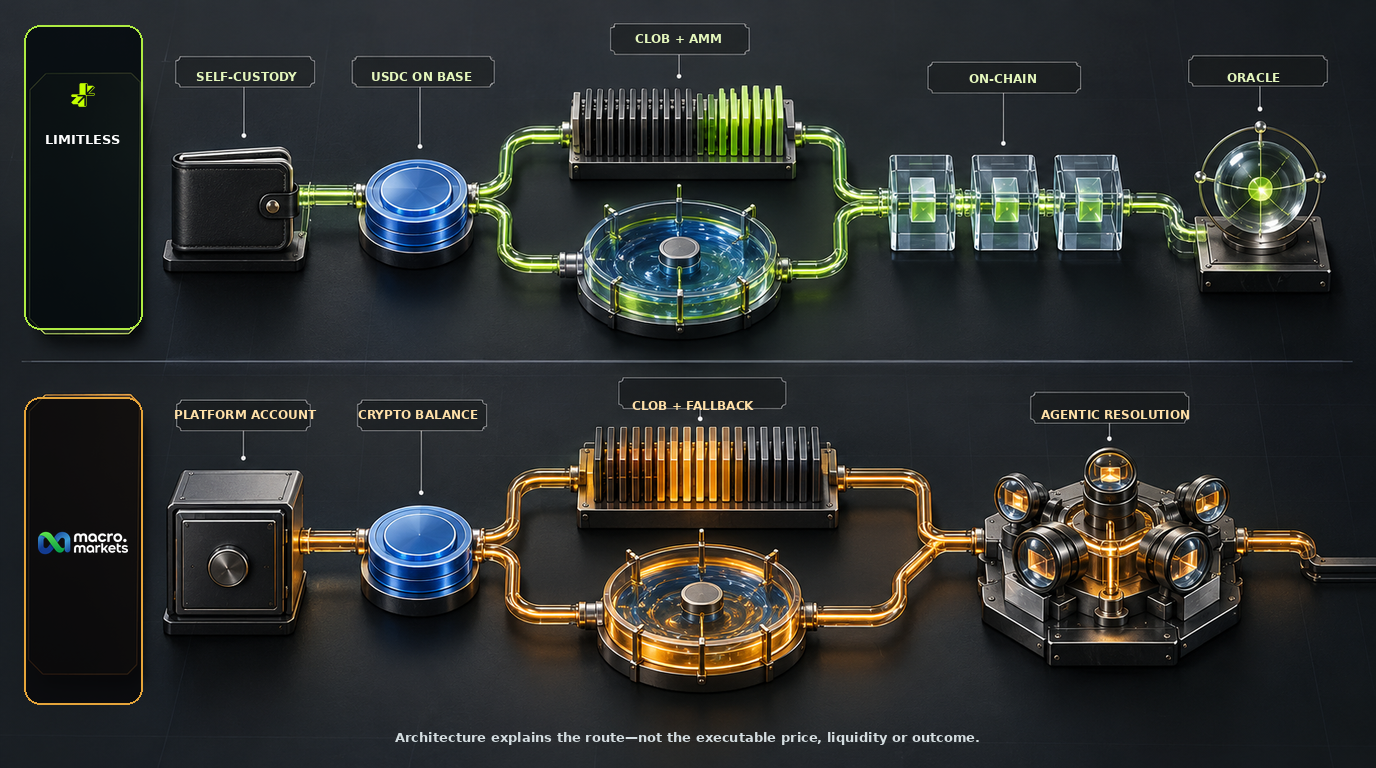
Both companies describe a mix of order-book and automated liquidity, but the implementations are not identical.
Limitless execution
Limitless documents a central limit order book where users sign orders off-chain and matched trades settle on Base. Its whitepaper also describes automated market makers for markets that need continuous two-sided liquidity. Users can place market orders that consume resting liquidity or limit orders that wait at a chosen price.
This structure gives advanced users price control, but a resting order may never fill. A market order can execute immediately while crossing the spread and consuming multiple price levels. AMM availability does not guarantee a favorable quote; price impact grows with size and pool conditions.
Macro Markets execution
Macro Markets' launch article describes a CLOB-primary, LS-AMM-fallback model. The order book is intended to handle trading when counterparties provide depth, while the AMM can provide a route when the book is thin.
That architecture could reduce the chance of a completely empty market, but it does not guarantee tight spreads, unlimited capacity or an inexpensive exit. Treat the displayed quote as an invitation to inspect the actual order, not as a promise.
How to compare liquidity honestly
There is no defensible platform-wide liquidity winner without matched observations. For the same economic contract and timestamp, record:
- best executable bid and ask;
- quantity available at each level;
- average fill for your intended size;
- explicit trading fee;
- price impact or slippage;
- rule and deadline differences; and
- exit conditions if you cannot hold to settlement.
Our bid-ask spread guide explains why the headline probability may not be your fill price.
Fees and total trading cost
Limitless publishes a more detailed fee schedule. Macro Markets requires more reliance on the live order and wallet flow.
Limitless fees
The current Limitless fee guide says:
- AMM markets generally charge 0.40% per trade;
- legacy CLOB buy taker fees range from 0.40% to 3.00%;
- legacy CLOB sell taker fees range from 0.42% to 1.50%;
- resting maker orders can be fee-free; and
- custom user-funded markets currently use a creator-set pool fee, documented as 2% per trade at review time.
The rate can vary with market price and venue. Newer trading venues pay fees in USDC on buys and sells, while legacy venues can use different fee assets. Promotional or specific markets may have reduced or zero fees. The order result and live confirmation are authoritative.
Macro Markets fees
Macro Markets' public Terms say service fees may apply and that payment providers or currency conversion can add charges. The market help page tells users to review fees and network information before confirming.
We did not find a public schedule detailed enough to calculate one universal Macro Markets trading fee against the Limitless curves. The honest conclusion is not that Macro is free or cheaper. It is to capture the live order preview and withdrawal route.
For both platforms, calculate:
total cost = trading fee + spread + slippage + conversion/bridge cost + network cost + withdrawal cost
The prediction-market fee calculator can compare scenarios without assuming the headline fee tells the whole story.
Resolution and Developer Tools
The platforms also differ in how they describe the path from event to payout.
Limitless resolution sources
Limitless says every market has a deadline, resolution condition and designated source. Its resolution documentation says Pyth resolves the majority of markets automatically. Chainlink TWAP is used for certain short-cadence crypto markets, while sports feeds, external-venue parity, creators and manual team review apply to other market types.
Winning shares become redeemable for $1 after the payout is posted on-chain; a 50-50 resolution redeems each share for $0.50. Manual markets typically resolve within 24–72 hours, according to the documentation. A market can appear resolved before on-chain redemption is ready.
Custom markets deserve extra attention because the creator's wallet reports the outcome. Read the rule, source and creator role before trading.
Macro Markets agentic resolution
Macro Markets says multiple AI agents gather primary sources, cross-check evidence and debate ambiguous cases. Its market help materials also say settlement follows the criteria and sources stated for the specific market.
An agentic workflow can accelerate evidence collection, but “AI” is not a substitute for clear authority and dispute rules. Before trading, check:
- the source named in the market;
- the observation deadline;
- who issues the final decision;
- whether a challenge or correction process exists; and
- when balances become available after settlement.
Neither an oracle brand nor an automated feed can repair an ambiguous contract. The written rule remains the first risk control.
APIs and automated trading
Limitless has the clearer public developer surface at the time of review. It publishes REST and WebSocket endpoints, authentication guides, order-signing documentation and SDKs for TypeScript, Python, Go and Rust. The docs also cover market data, positions, order management and partner accounts.
Limitless warns that it has no sandbox or testnet for these integrations. API flows use production and real USDC, so developers should rehearse with minimal size and strong safeguards.
Macro Markets' launch materials describe REST, GraphQL and WebSocket access. Before building against it, verify the current endpoint, authentication model, rate limits, permissions, order types, cancellation behavior and availability in your jurisdiction.
For either platform:
- never place private keys or unrestricted credentials in client code;
- use scoped credentials where available;
- implement idempotency and order-state reconciliation;
- stop trading when market data or signing state is uncertain; and
- test settlement and withdrawal, not only order placement.
Limitless is the stronger choice today for a developer who needs immediately inspectable public documentation. Macro Markets may be worth evaluating when its integration access and hybrid-liquidity model match the product being built.
Which Platform Should You Choose?
Choose Limitless when all of the following are true:
- your location is eligible;
- you understand Base, USDC and wallet permissions;
- self-custody matters to you;
- you want public APIs or SDKs;
- you value user-created markets or maker tools; and
- you accept smart-contract and oracle risk.
Evaluate Macro Markets when:
- your location and account are eligible;
- you prefer a platform account over direct wallet custody;
- the exact event you want is available;
- the CLOB/AMM quote is competitive at your size;
- you accept KYC and withdrawal-review conditions; and
- the market's resolution and challenge path are clear enough for the risk.
Use neither platform when you cannot verify legal access, do not understand the funding route, cannot afford a total loss or need guaranteed liquidity. Our guide to trading prediction markets provides a complete pre-order checklist.
Frequently Asked Questions
Is Limitless better than Macro Markets?
Limitless is better documented for self-custody, public APIs, published fees and user-created markets. Macro Markets may better fit users who prefer a platform account and want to evaluate its CLOB-primary, AMM-fallback design. The better trade still depends on the exact contract, price, depth, cost and resolution rule.
Are Limitless and Macro Markets available in the United States?
Limitless' current Terms say trading is unavailable to users from the United States. Macro Markets requires users to be in a jurisdiction where its services are lawful and can apply location controls. Verify Macro Markets access directly; do not infer eligibility from crypto support.
Is Limitless non-custodial?
Limitless describes its protocol as non-custodial and says users hold funds through external, embedded or smart-wallet structures on Base. Open positions and outcome tokens still carry smart-contract, signer and oracle risk.
Is Macro Markets non-custodial?
Do not describe it that way. Macro Markets uses a platform account, and its Terms describe customer funds in separate customer accounts or dedicated crypto wallets. Users should review the current account, KYC and withdrawal rules.
Which platform has lower fees?
There is no universal winner. Limitless publishes AMM and dynamic CLOB taker fees, while Macro Markets requires checking the live order and wallet flow. Spread, slippage, network, conversion and withdrawal costs can reverse the headline comparison.
Which platform has better liquidity?
Liquidity varies by contract, side, time and order size. Compare executable bids, asks and depth for matched contracts. An AMM fallback or a large platform-wide volume number does not guarantee an inexpensive fill.
Can users create markets on Limitless?
Yes, Limitless documents user-generated price markets and custom markets, subject to platform rules and limits. Review the Community badge, creator fee, liquidity and resolution authority before participating.
Does Limitless have an API?
Yes. Limitless publishes REST and WebSocket documentation plus SDKs for several programming languages. Its developer docs say integrations use production rather than a sandbox, so testing requires strong controls and minimal real-value orders.
Final Verdict
Limitless is the clearer choice for eligible users who prioritize a non-custodial Base protocol, public developer tooling, published fee mechanics and user-created markets. Macro Markets is the more relevant alternative for eligible users who prefer a platform account and want to evaluate crypto-oriented funding, broad event coverage and a CLOB-primary system with an AMM fallback.
That is a product-fit conclusion, not a permanent trading winner. Before entering any position, match the contract, inspect executable depth, calculate total cost and read the resolution source. If neither structure fits, use our guide to the best Limitless alternatives to compare regulated exchanges, broker interfaces and other crypto-native platforms.
