


Limitless Exchange Review 2026: Fees, Safety and How It Works

Limitless is a strong option for eligible traders who want a crypto-native prediction exchange with self-custodial wallet choices, USDC collateral on Base, public APIs and both order-book and automated-liquidity markets. Its product documentation is more detailed than many competitors' material, especially on fees, wallets, smart contracts and resolution.
The tradeoff is complexity. Limitless is not available for trading in several important jurisdictions, its fee depends on the market and venue, and a non-custodial design does not remove wallet, smart-contract, oracle or liquidity risk. A good experience therefore depends less on the brand as a whole than on the exact contract, executable quote, resolution source and wallet route.
Our verdict: Limitless is worth evaluating if you already understand Base and USDC, can legally use it and value public developer tooling. It is a weaker fit if you want a fiat-first account, guaranteed liquidity, simple jurisdictional access or a product whose contract changes have a dedicated published audit.
Risk warning: Prediction-market shares can lose their entire purchase price. A visible probability is not a guaranteed fill or exit price. Wallet signatures, network transfers and smart-contract interactions can be irreversible.
Editorial disclosure: Macro Markets publishes this review and operates a prediction-market platform that may compete for some of the same users. We applied our standard comparison criteria and include Macro Markets as an alternative. This is a documentation-based review using public sources checked on October 31, 2026. We did not open, fund or trade through a Limitless account.
Last reviewed: October 31, 2026.
Limitless Exchange Review at a Glance
| Question | Review finding |
|---|---|
| What is it? | A non-custodial prediction exchange built on Base |
| Operator | Street Chow Inc., a Panamanian company, according to the current Terms |
| Trading collateral | USDC on Base, with conditional outcome shares |
| Markets | Crypto, sports, esports, finance, politics and major world events |
| Execution | Central limit order books and automated market-maker pools, depending on the market |
| Wallet choices | External wallet, embedded wallet or smart wallet |
| Published fees | AMM markets generally 0.40%; legacy CLOB taker curves; resting maker orders can be fee-free; custom pools currently document a 2% fee |
| Resolution | Pyth, Chainlink, sports feeds, external venue parity, manual review or creator resolution, depending on the market |
| Developer access | REST, WebSocket and SDKs for TypeScript, Python, Go and Rust |
| Main strength | Detailed public technical documentation and a crypto-native, non-custodial workflow |
| Main limitation | Geographic, wallet, liquidity, fee and smart-contract complexity |
Best for: eligible crypto-native traders, market makers and developers who want transparent technical documentation and can inspect contract-level execution.
Skip it if: your location is restricted, you need a bank-funded US product, you do not understand wallet permissions, or you would rely on the displayed probability without checking depth and fees.
Review score: We do not assign a single numerical score. Limitless can be technically strong while still being unusable in a reader's jurisdiction or unattractive on a thin market. Eligibility and contract-level execution are hard gates, not minor scoring categories.
For our direct platform comparison, read Limitless vs Macro Markets. Our prediction-market comparison methodology explains the criteria used here.
What Is Limitless and How Does It Work?
Limitless is a prediction-market platform on the Base blockchain. Markets ask whether an event will happen, and outcome shares normally trade between $0 and $1. A winning share redeems for $1 after final settlement; a losing share becomes worthless. Traders can also sell before resolution if sufficient liquidity exists.
The platform covers crypto prices and events, sports, esports, finance, politics and world events. It combines two liquidity models rather than forcing every market into the same engine.
CLOB markets
A central limit order book lets participants post bids and offers at chosen prices. Limitless documents an off-chain signing flow using EIP-712, with matched orders settled against contracts on Base. A market order consumes available liquidity immediately; a resting limit order waits for another trader.
That distinction matters. A limit order gives price control but may never fill. A market order is more likely to fill immediately, but it can cross the spread, consume several price levels and incur a taker fee.
AMM and custom markets
Automated market-maker pools quote against a pool instead of a traditional book. They can keep a market tradable when there is no matching human order, but the quote can worsen as order size grows. The pool does not guarantee an inexpensive exit.
Limitless also documents two user-created formats. User-generated price markets carry a Community badge, trade through the order book and pay their creator a share of taker fees. Custom markets let a creator write a yes/no question, fund a pool and settle the result. Those features expand coverage, but they make the creator badge, liquidity source and resolution authority part of the risk assessment.
What the displayed probability means
A Yes share at $0.62 suggests that the market collectively prices the event near 62%, but it is not an objective forecast or a guaranteed purchase price. The figure may reflect a recent trade or available quote for a limited quantity. Your actual result depends on the price you can execute, fees and final resolution.
Before trading, verify:
- the exact market question and deadline;
- the best executable bid or ask;
- quantity available near that price;
- the venue and applicable fee;
- the named resolution source; and
- whether you plan to sell or wait for redemption.
Our guide to the bid-ask spread explains why a headline probability can differ from your fill.
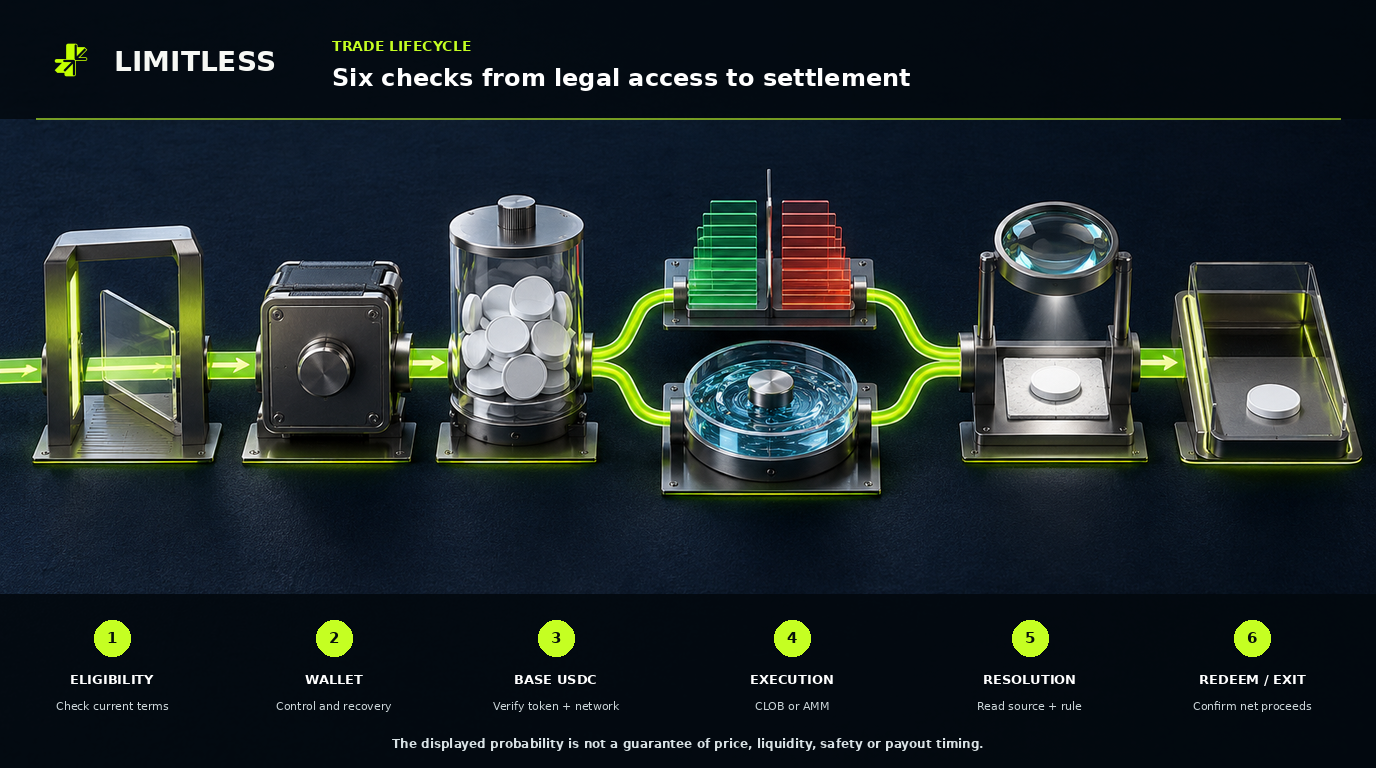
The safe path begins before the order: eligibility, wallet control, collateral, execution, resolution and redemption each require a separate check.
Limitless Exchange Review: Eligibility, Wallets and Funding
Location is the first decision. The current Limitless Terms of Service name Street Chow Inc. as the operator and require users to be at least 18 or the legal age of majority, have legal capacity and comply with local law. Limitless can request proof of age, identity or eligibility.
The Terms say the platform is unavailable to users accessing it from Russia, Belarus, Cuba, Iran, North Korea, Syria, Crimea, Donetsk and Luhansk. They separately say trading is unavailable to users from the United States, the Republic of China and the Canadian provinces of Ontario and Alberta. That wording is reproduced as published; readers should consult the current Terms rather than substitute an assumption about geography.
Do not use a VPN or another workaround to evade a restriction. Loading the website or connecting a wallet is not proof that trading is permitted. Eligibility can also change after an article is published.
Three wallet paths
The wallet documentation describes three account structures:
- External wallet: an externally owned account controlled by a private key, such as MetaMask, Rainbow, Coinbase Wallet or Rabby. The user generally approves on-chain actions in the wallet.
- Embedded wallet: a non-custodial wallet created through a social login such as Google or X. Transactions can be initiated inside the application.
- Smart wallet: a contract account built from the embedded wallet. It supports gas abstraction and batching, and Limitless sponsors transaction fees so the user can trade with USDC without separately holding ETH for routine actions.
Convenience changes the signing flow, not the underlying need for security. Verify how the wallet is recovered, which address controls the trading profile and what approvals you grant. If an external-wallet profile switches to smart-wallet trading mode, API orders signed with the external wallet key can be rejected until the mode is changed.
Funding and withdrawal risk
Limitless uses USDC on Base for collateral. The simplest route is to begin with the correct USDC token on the correct network. Bridging from another network, swapping another asset or using a third-party on-ramp adds provider fees, slippage, address risk and possible delays.
Use a small test amount before a meaningful transfer. Check the token contract, network, destination and wallet ownership independently. A blockchain transfer normally cannot be reversed because the sender chose the wrong address or network.
The relevant route is:
starting asset → Base USDC → trading wallet → outcome share → redemption or sale → USDC destination
Every additional conversion or bridge is part of total cost. If you prefer an account-based crypto workflow, compare Limitless with Macro Markets before deciding which custody model fits.
Limitless Exchange Fees and Liquidity
For this Limitless Exchange review, we used the current published fee guide. There is no single fee that applies to every trade.
Current published fee structure
According to the Limitless fee documentation:
- AMM markets generally charge a flat 0.40% per trade;
- legacy CLOB buy taker fees range from 0.40% to 3.00%;
- legacy CLOB sell taker fees range from 0.42% to 1.50%;
- resting maker orders can be fee-free when they do not execute immediately; and
- custom user-funded pools currently document a 2% per-trade pool fee paid to the creator as sole liquidity provider.
Promotional or specific markets can have reduced or zero fees. New trading venues can collect the fee in USDC on both buys and sells, while legacy venues use different fee handling. The final order response and confirmation are more authoritative than a general article.
The legacy CLOB curves are unusual enough to deserve attention. Buy taker fees are highest at low probabilities and decline as the contract price approaches $1. Sell fees peak near $0.50 and decline toward the extremes. A trader who looks only at the market probability can miss a material difference in net contracts received or collateral returned.
Maker does not mean guaranteed free execution
A resting limit order can avoid the taker fee according to the current documentation, but it still has opportunity cost and execution risk. The market can move away, the event can approach its deadline or another order can take priority. A maker rebate, when available, is not a substitute for a good price.
User-generated markets add a creator fee share taken from trading fees before the remaining maker-rebate pool is calculated. The current rate is attached to the market and shown on its Community badge. Check that market-specific disclosure instead of assuming a platform-wide rate.
Liquidity is market-specific
Limitless may have tight spreads and useful depth on an active crypto or sports market while a niche contract is expensive to trade. The correct comparison is not total platform activity. It is the average execution price for your intended size on the exact rule set.
Calculate:
total cost = explicit fee + bid-ask spread + slippage + bridge/swap cost + network cost + exit cost
Use our prediction-market fee calculator to model hypothetical orders. If you cannot see enough depth to estimate an exit, size the trade as if you may need to hold until resolution.
Resolution, Security and Developer Tools
Limitless has strong public documentation in all three areas. It also has caveats that should not be reduced to a marketing label.
How markets resolve
Each market has a deadline, resolution condition and designated source. The resolution guide says Pyth Network resolves the majority of markets automatically. Other markets can use Chainlink TWAP for short-cadence crypto questions, sports data providers, parity with an external venue, creator resolution or manual review.
Manual admin-created event markets typically resolve within 24–72 hours after the deadline, depending on data and complexity. Winning shares are redeemable for $1 after the payout is posted on-chain. A 50-50 resolution redeems each share for $0.50. A market can appear resolved in an API before the on-chain payout is ready, so an immediate redemption attempt may need to wait.
Custom markets require extra caution because the creator's wallet reports the result. Read who controls resolution, what evidence is binding and whether the question leaves room for interpretation. An automated oracle cannot repair ambiguous wording.
Is Limitless Exchange safe?
Limitless appears to be a real operating prediction exchange with public terms, contract addresses and technical documentation. Its security page says the protocol has no protocol-level custody of user funds and uses the canonical Gnosis Conditional Tokens Framework plus CLOB and NegRisk contract suites derived from Polymarket.
The same page cites audits of the upstream Polymarket contracts, then states that Limitless-specific modifications are not covered by the upstream ChainSecurity audit. That is a meaningful limitation. An audited ancestor is useful evidence about inherited code, but it is not the same as a dedicated audit of every deployed change, integration and operational control.
Relevant risks include:
- losing the full price of a wrong outcome;
- private-key loss, phishing or malicious signatures;
- excessive token approvals;
- contract or integration bugs;
- Base congestion or provider failure;
- thin liquidity and unfavorable exits;
- oracle, data-provider or manual-resolution errors;
- creator-controlled custom-market resolution; and
- access or compliance rules changing.
“Non-custodial” means the protocol is not described as holding user funds in a conventional platform account. It does not mean funds cannot be lost through a bad trade, compromised wallet, vulnerable contract or mistaken transaction.
Developer experience
Limitless publishes REST and WebSocket endpoints and SDK documentation for TypeScript, Python, Go and Rust. The public materials cover market data, positions, order signing, API tokens, venue discovery and order events. This is a real advantage for developers and market makers who want an inspectable integration surface.
There is no sandbox, testnet, mock mode or Base Sepolia deployment. The developer introduction says integrations operate against production with real USDC. That raises the testing standard: use minimal-value orders, scoped credentials, idempotent order handling, reconciliation and a hard stop when signing or market state is uncertain.
New venues also require clients to read contract addresses and fee modules from market data rather than hard-code one exchange address. SDK support reduces some friction, but production-only testing remains a material drawback.
Pros, Cons and the Best Limitless Alternatives
Pros
- Non-custodial architecture with Base settlement
- External, embedded and smart-wallet options
- Detailed public fee, wallet, resolution and security documentation
- CLOB and AMM market structures
- User-generated and custom-market features
- REST, WebSocket and four documented SDK languages
- Maker orders can be fee-free under the current CLOB rules
- Multiple automated resolution sources for suitable market types
Cons
- Trading unavailable in the United States and other named jurisdictions under current Terms
- Requires competence with USDC, Base, wallet recovery and permissions
- Fees vary by venue, price and order behavior
- Liquidity and exits can vary sharply by market
- Custom markets can place resolution authority with the creator
- No sandbox or testnet for developers
- Limitless-specific contract modifications are not covered by the upstream audit cited in its documentation
- Non-custodial operation shifts important security responsibility to the user
Alternatives to Limitless
| Platform | Best fit | Main distinction | Main caution |
|---|---|---|---|
| Macro Markets | Eligible users who want a crypto-oriented platform account and broader product comparison | CLOB-primary execution with an AMM fallback and an agentic evidence-review approach, according to first-party materials | Different custody and legal structure; verify eligibility, live fees, depth and withdrawal rules |
| Polymarket.com | Eligible international users comparing crypto-native market discovery | Large brand presence and on-chain international workflow | Separate from Polymarket US; geographic, wallet, fee and contract risk apply |
| Polymarket US | Eligible US users seeking a prediction-first regulated exchange product | CFTC-designated US exchange structure | Separate accounts and product from Polymarket.com; contract availability and fees vary |
| Kalshi | Eligible users who prefer a dedicated US exchange and fiat-oriented account | CFTC-designated contract market with public exchange rules | Not a crypto-native self-custodial protocol; fees and liquidity remain contract-specific |
Macro Markets belongs on the shortlist for eligible crypto-oriented users. It does not reproduce Limitless' non-custodial Base structure; instead, it offers a platform account and describes hybrid CLOB/AMM execution. That can suit users who do not want to manage a protocol wallet directly, but it introduces account, verification and withdrawal-process considerations. Read the full Limitless vs Macro Markets comparison for a criterion-by-criterion decision.
For a broader shortlist built around the same product, see the best Limitless alternatives. You can also compare Polymarket alternatives separately. No platform is automatically best: compare eligibility, contract rules, executable depth, total cost, custody and exit path.
Frequently Asked Questions and Final Verdict
Is Limitless Exchange legit?
Limitless is a real prediction exchange with public Terms, documentation, smart-contract addresses and developer interfaces. The current Terms identify Street Chow Inc., a Panamanian company, as operator. “Legit” does not mean risk-free or available everywhere; verify your jurisdiction, the exact market and wallet route.
Is Limitless Exchange safe?
It has a non-custodial architecture and uses established conditional-token components, but safety is not guaranteed. Limitless says its CLOB and NegRisk contracts derive from audited Polymarket code while its own modifications are not covered by the upstream audit. Users still face market, wallet, smart-contract, oracle and liquidity risk.
Can US residents use Limitless?
The current Limitless Terms say trading is unavailable to users from the United States. Do not use a VPN or other workaround. US users can compare products built for eligible US access, including Kalshi and Polymarket US.
What fees does Limitless charge?
The current guide lists a general 0.40% AMM fee, dynamic legacy CLOB taker fees, fee-free resting maker orders and a currently documented 2% custom-pool fee. Promotions and newer venues can differ. Check the live order because the applicable venue and fee behavior matter.
Does Limitless require KYC?
The Terms allow Limitless to request proof of age, identity and eligibility at any time. A wallet connection or social login should not be interpreted as a promise that verification will never be required.
Does Limitless have an API?
Yes. It publishes REST and WebSocket documentation plus TypeScript, Python, Go and Rust SDKs. There is no sandbox or testnet, so testing uses production infrastructure and real USDC.
Can I create a prediction market on Limitless?
Limitless documents user-generated price markets and custom yes/no pools. Community badges identify user-generated markets, while custom-market creators fund liquidity and report the result. Check the creator fee, rules, liquidity and resolution authority before trading.
Is Macro Markets a Limitless alternative?
Yes, for eligible users comparing crypto-oriented prediction products. Macro Markets uses a platform-account model and describes CLOB-primary execution with an AMM fallback, while Limitless emphasizes non-custodial wallets and Base settlement. The better fit depends on custody preference, access, market selection, executable price and resolution rules.
Final verdict
This Limitless Exchange review finds one of the more transparent crypto-native products on technical documentation. Its Base architecture, wallet options, public fee schedule, creator features and developer tooling make it compelling for eligible and technically capable users.
It is not the default recommendation for everyone. Jurisdictional restrictions eliminate it for many readers. Dynamic fees and uneven depth require contract-level inspection. Wallet and smart-contract risks remain, and the published security material clearly says that Limitless-specific changes are outside the cited upstream audit.
Choose Limitless when your location is eligible, the market rules are objective, depth is sufficient and you understand the complete USDC wallet route. Compare it directly with Opinion in our Opinion vs Limitless guide. Choose Macro Markets or another alternative when its account model, exact market, funding route or executable cost better matches your needs. Use neither when you cannot afford a total loss or explain how the contract resolves and how you will exit.
Read our how-to guide for trading prediction markets before placing an order.
