


Opinion vs Limitless: Which Prediction Market Fits You?
Opinion and Limitless both let eligible users trade event outcomes with crypto, but they are not interchangeable. Opinion documents a self-hosted-wallet CLOB on BNB Chain with settlement assets such as USDT and Opinion AI as the primary oracle for most current markets. Limitless documents Base/USDC settlement, three wallet modes, CLOB and AMM venues, and several resolution paths.
Our verdict: Choose Opinion when you are eligible, already use BNB Chain and USDT, want a conventional order-book route, or prefer its macro-oriented discovery and Opinion developer stack. Choose Limitless when you are eligible, already use Base and USDC, value external, embedded or smart-wallet choices, need its broader venue architecture, or want to create a Community or custom market. Neither is universally cheaper, safer or more liquid. The exact market, order, rules and exit path decide.
Last reviewed and fact-checked: October 31, 2026.
Editorial disclosure: Macro Markets publishes this comparison. It is not one of the two products ranked here, but we discuss it as an alternative below. This analysis is based on current first-party documentation and public product surfaces; it does not include synchronized funded trades on both venues. Prediction-market positions can lose their full value. This article is educational, not financial, legal or tax advice.
Opinion vs Limitless: Quick Answer
The shortest answer is BNB Chain, USDT and one CLOB route versus Base, USDC and a multi-venue wallet stack.
Opinion is the more straightforward choice for an eligible trader who already operates on BNB Chain, wants a visible order book, and accepts Opinion AI as the primary resolution mechanism on most current markets. Limitless is the more flexible architecture: it supports external, embedded and smart wallets, runs on Base with USDC, and can route markets through CLOB or AMM infrastructure depending on the market type.
Eligibility can end the comparison before product features matter. Opinion and Limitless both restrict trading from the United States and several other locations. Their lists are not identical, and “on-chain” does not mean “available everywhere.” Check the current Terms and the in-product notice before funding anything.
Winner by use case
- BNB Chain and USDT workflow: Opinion.
- Base and USDC workflow: Limitless.
- Single CLOB mental model: Opinion.
- Choice of external, embedded or smart wallet: Limitless.
- Custom link-only market with creator-funded liquidity: Limitless.
- Macro-oriented discovery: Opinion may feel more focused; inspect the live catalog.
- Maker orders: both currently document zero maker trading fees for their CLOBs, subject to the exact market and terms.
- Small taker orders: often Limitless on an AMM with a 0.40% fee, because Opinion's $0.25 fee floor can dominate a $5 fill; the Limitless market type can reverse this.
- Cheapest CLOB taker order: no permanent winner. Opinion ranges from 0% to 1%, while Limitless uses multiple legacy and new-venue schedules.
- Best liquidity: no platform-wide winner. Compare executable depth for the exact contract and size.
Our Opinion prediction market review and Limitless Exchange review evaluate each product separately. This page is about the decision between them.
Opinion vs Limitless at a Glance
| Factor | Opinion | Limitless | Practical meaning |
|---|---|---|---|
| Product | Crypto prediction exchange | On-chain prediction exchange | Both expose crypto, contract and resolution risk |
| Current operator in Terms | Superchillclub Limited | Street Chow Inc. | Read the current legal document, not an old review |
| US trading | Prohibited under current Terms | Prohibited under current Terms | Neither product is a US trading route |
| Wallet model | Self-hosted Web3 wallet | EOA, embedded or smart wallet | Recovery, gas and signing differ |
| Network | BNB Chain mainnet | Base mainnet | Determines collateral route, gas and token contract |
| Settlement asset | Assets such as USDT | USDC | Wrong-chain transfers remain a practical risk |
| Execution | CLOB | CLOB or AMM, depending on venue | Fee and slippage mechanics differ by market |
| Maker fee | Currently zero | Currently zero on CLOB | A resting order can avoid explicit maker fees but may not fill |
| Taker fee | 0-1%, with $0.25 minimum fee | AMM 0.40%; multiple CLOB schedules; custom markets 2% | Compare the exact live venue and order |
| Resolution | Market-specific; Opinion AI for most current markets | Pyth, Chainlink, sports feeds, team, external venue or creator | The market page is authoritative on both |
| User-created markets | Broader documentation discusses market creation | Community CLOB and link-only custom AMM paths | Limitless documents more distinct creator workflows |
| Developer surface | OpenAPI, WebSockets and CLOB SDKs | REST, WebSockets and official SDKs | Both support automation with different signing models |
| Publisher verdict | Best for BNB/USDT and Opinion's focused route | Best for Base/USDC, wallet choice and venue flexibility | Eligibility and executable cost still come first |
The table is a routing guide, not a substitute for reading the live contract. Similar headlines can hide different deadlines, sources, cancellation rules and payouts.
Start With Eligibility, Not Features
Opinion's current Terms of Use prohibit platform trading for people in the United States, United Kingdom, France, Ontario, Singapore, Poland, Thailand, South Korea, the People's Republic of China, Taiwan Province and Hong Kong, as well as comprehensively sanctioned regions. The Terms also prohibit VPN-based circumvention.
Limitless's current Terms of Service prohibit access from Russia, Belarus, Cuba, Iran, North Korea, Syria and named Ukrainian regions. They separately prohibit trading from the United States, the Republic of China, Ontario and Alberta. The document says users are responsible for determining whether their use complies with local law.
Three conclusions matter:
- The restriction lists differ, so eligibility on one venue does not imply eligibility on the other.
- Physical access to a website does not establish permission to trade.
- Eligibility can change while a position is open, so understand close, redemption and wallet-transfer mechanics in advance.
Do not treat “decentralized,” “non-custodial,” “global” or “crypto-native” as legal permission. Those labels describe architecture or positioning. They do not answer whether you can trade a particular event contract where you are.
Wallets, Custody and Recovery
Wallet design is the first major product difference.
Opinion: self-hosted Web3 wallet
Opinion's Terms frame the product around a self-hosted wallet and say the company does not take possession or custody of the user's cryptoassets. Its wallet guide lists Binance Wallet, OKX Wallet, MetaMask, Backpack and Coinbase Wallet, followed by a message-signing login.
That route is familiar to experienced Web3 users, but it makes the user responsible for seed phrases, approvals, token contracts and recovery. A wallet signature is not automatically harmless. Read the domain and message before approving it.
Limitless: three documented wallet types
Limitless's wallet documentation distinguishes:
- Externally owned accounts: a user-controlled private key through interfaces such as MetaMask, Rainbow, Coinbase Wallet or Rabby. On-chain actions require wallet approval and the user pays gas in ETH.
- Embedded wallets: created through a social login and provided by Privy. Transactions happen inside the application, but the raw key is not exposed to the app or user under the documented setup.
- Smart wallets: contract accounts controlled by the embedded wallet. Limitless says it sponsors trading gas, so a user can operate with USDC without holding ETH for those actions.
An external-wallet user may also opt into one-click smart-wallet trading. That choice affects API signing: the developer documentation says an EOA-signed API order is rejected while the profile is in smart-wallet mode unless the user switches modes.
Which wallet model is better?
Choose the recovery model you can actually operate.
Opinion is simpler conceptually for a user who already has a BNB-compatible wallet and wants direct key control. Limitless offers a smoother social-login path and gas abstraction, but embedded and smart wallets introduce a provider and account-recovery dependency. An external Limitless wallet restores direct key control at the cost of more approvals and gas management.
Before depositing meaningful funds:
- identify which address holds the collateral;
- document how that address is recovered;
- confirm which key signs trades and withdrawals;
- test the withdrawal route with a small amount; and
- revoke approvals you no longer need.
Chains, Collateral and Funding
Opinion's OpenAPI overview lists BNB Chain mainnet, chain ID 56. Its fee documentation says charges are denominated in the settlement asset, such as USDT. Limitless's developer introduction identifies Base mainnet, chain ID 8453, while its wallet guide says the trading balance is USDC held in the user's wallet on Base.
The practical route is therefore different:
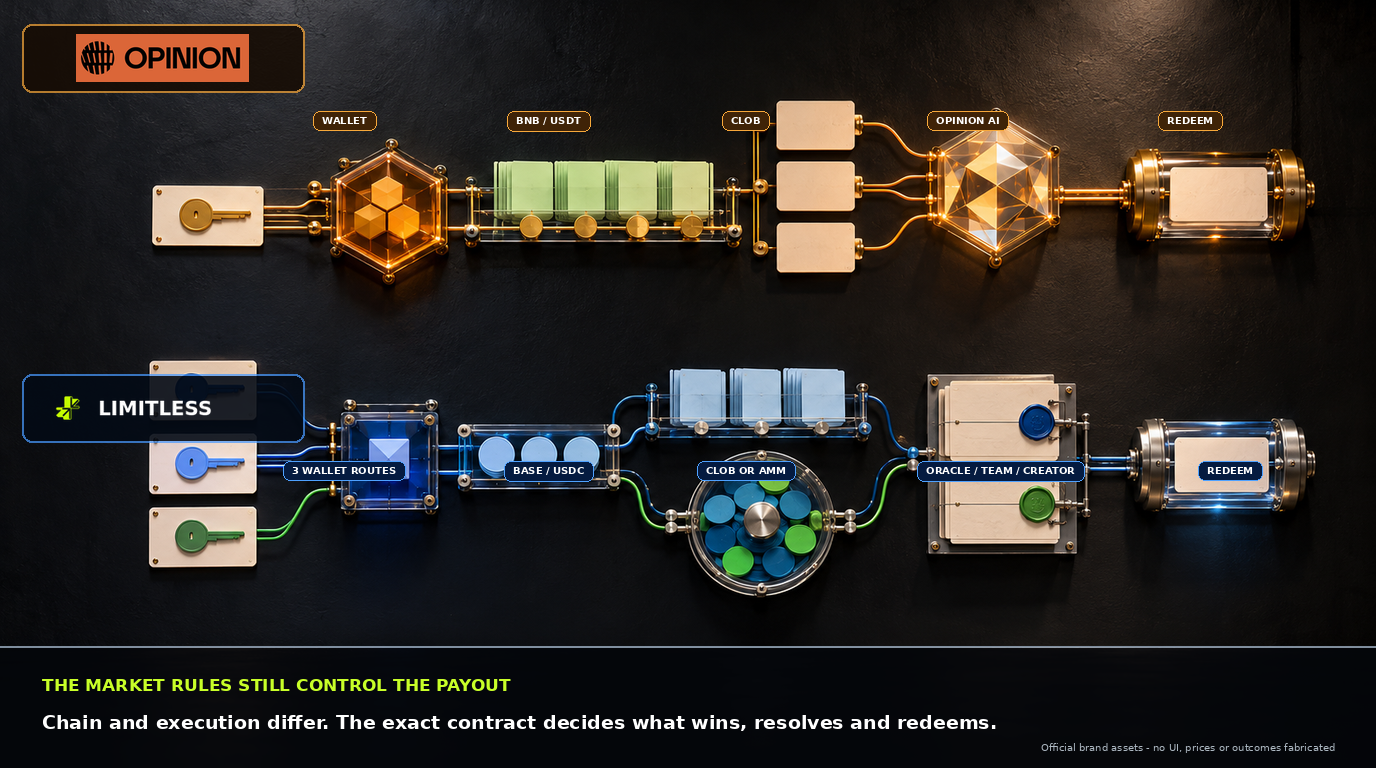
- Opinion: compatible wallet -> BNB Chain -> supported settlement asset such as USDT -> CLOB trade -> resolution -> withdrawal.
- Limitless: external, embedded or smart wallet -> Base -> USDC -> CLOB or AMM trade -> resolution -> redemption or transfer.
Limitless warns that sending USDC from another chain without bridging first will not credit the expected Base balance. The same general wrong-network risk applies to any crypto workflow: a token name alone is insufficient. Verify chain ID, token contract and destination address.
Opinion says it covers on-chain match and settlement gas for trades, while lower-frequency actions can involve user-paid gas. Limitless assigns gas differently by wallet: an EOA user pays Base gas, while the platform documents sponsored gas for smart-wallet trading and in-product smart-wallet withdrawals.
Funding cost is broader than platform fees. Include exchange withdrawal charges, spread on the collateral conversion, bridge costs, gas, and the later route back to a preferred wallet or exchange.
Fees: Which Is Cheaper?
There is no honest one-line answer because Limitless now has several venue schedules and Opinion has a fee floor.
Opinion's documented fees
Opinion's live fee page currently states:
- makers are not charged;
- only takers pay a trading fee;
- the fee ranges from 0% to 1%;
- the curve rises toward a 50% market probability;
- the minimum order is $5;
- the minimum fee is $0.25; and
- the minimum withdrawal is $5.
The $0.25 floor is decisive for small orders. If it applies to a $5 taker fill, it equals 5% of notional. On $25 it equals 1%. On $100 it equals 0.25%. Because Opinion says fees are assessed per matched fill, execution fragmentation can also matter.
Limitless's documented fees
Limitless's current fee page separates four cases:
- Standard AMM markets: a flat 0.40% per trade, with possible promotional exceptions.
- Custom AMM markets: currently 2% per trade, paid into the creator's pool.
- Legacy CLOB venues: makers pay zero; taker buy fees range from 0.40% to 3.00%, and taker sell fees from 0.42% to 1.50% depending on price.
- New trading venues: makers pay zero; takers pay USDC on buys and sells using the documented standard curve
5% x (1 - price)of the trade's USDC value, subject to profile caps and market configuration.
At a $0.50 price, the new-venue table shows 2.50% of USDC value. At $0.90 it shows 0.50%. That is not interchangeable with the legacy curve, and an old Limitless review can easily quote the wrong schedule for a new market.
Compare all-in cost, not the headline rate
Use this equation:
all-in cost = explicit fee + spread + slippage + funding cost + gas/provider cost + withdrawal cost
A 0.40% AMM fee can still produce a worse fill if the pool is shallow. A zero-fee maker order can be cheap but useless if it never executes. Opinion's lower maximum headline rate can still be more expensive on a small fill because of the $0.25 minimum. Limitless's new-venue fee can exceed Opinion's range at some prices.
Use the prediction market fee calculator to organize the explicit costs and our guide to bid-ask spreads to evaluate the execution gap. Compare average fill price for your intended size, not a midpoint or a single top-of-book quote.
Execution and Liquidity
Opinion documents a central limit order book. A resting limit order adds liquidity and can qualify as a maker; an immediately matching order removes liquidity as a taker. This makes the order state easy to reason about, but it does not guarantee depth or a fill.
Limitless uses a broader venue system. Its security page describes a CTF Exchange for CLOB trading, while its product documentation also covers AMM and custom-market pools. A Limitless market's execution mechanics therefore depend on the venue behind that market.
CLOB checklist
For either platform's order book, inspect:
- best bid and ask;
- depth at several price levels;
- likely average execution price;
- partial-fill behavior;
- maker/taker classification;
- cancellation state; and
- depth available for the exit, not only the entry.
AMM checklist
For a Limitless AMM market, inspect:
- current pool liquidity;
- expected price impact for your size;
- the exact pool fee;
- who supplied the liquidity;
- whether the market is platform-created or custom; and
- who controls resolution.
“Limitless has CLOB and AMM” does not mean every order can dynamically choose the better engine. It means the platform supports different venue types. Fetch or inspect the exact market before assuming its execution path.
Aggregate platform volume is also a weak shortcut. A large venue can have a thin niche contract, while a smaller venue can have good depth on a focused question. Liquidity is market-specific, side-specific, size-specific and time-sensitive.
Market Catalog and User-Created Markets
Opinion positions itself around macroeconomic data, news and global events. Its About page emphasizes direct markets on inflation, interest rates, employment and related macro questions. That focus can make discovery useful for macro traders, but positioning does not guarantee that a specific contract is liquid.
Limitless covers crypto, macro, sports, politics and other events. More importantly, it documents two different user-created products.
Community price markets
Limitless's user-generated-market guide says signed-in users can create price markets subject to limits. These markets carry a green Community badge, trade as standard CLOB markets and pay the creator a share of taker fees. The creator share is set when the market is created and frozen for that market.
Custom link-only markets
Limitless's custom-market guide describes a different product:
- the creator writes a binary question and rules;
- chooses opening odds;
- funds the AMM pool with USDC;
- shares an unlisted link; and
- resolves the market from the creator wallet.
The documented fee is currently 2% per trade, paid into the pool. Limitless says it does not judge the outcome or handle disputes for this product. Only the creator wallet can settle, there is no settlement deadline, and funds can remain locked if the creator never resolves the market.
That is a material risk difference. A custom market can be useful for a private community, but the creator is also liquidity provider and final resolver. Treat the rule text, creator identity and locked-capital risk as part of the contract.
Resolution: Opinion AI vs Multiple Limitless Routes
Resolution is where similar-looking positions can become different products.
Opinion resolution
Opinion's resolution page says each market page specifies its method and that most current markets use Opinion AI as the primary oracle. The Terms say designated oracle sources are shown for the market and that the determined outcome is final and binding.
An AI-centered route may be designed to process several sources, but “AI” is not a guarantee of correctness. Before trading, identify the named evidence source, cutoff, time zone, revision policy and treatment of contradictory reports. If the market page does not answer them, the uncertainty is part of the position.
Limitless resolution
Limitless's market-resolution guide lists several routes:
- Pyth Network for the majority of markets;
- Chainlink TWAP for short-cadence crypto markets;
- sports data providers for named sports and esports markets;
- parity with an external venue for mirrored markets;
- manual team review for admin-created event markets without a feed; and
- the creator wallet for custom markets.
The page says manual markets typically resolve within 24-72 hours after the deadline, depending on complexity and data availability. Winning shares redeem for $1 USDC after settlement; eligible 50-50 resolutions redeem each share for $0.50. It also distinguishes a misresolution refund of the bet amount from a winning $1 payout.
Which resolution model is better?
Neither label settles the question. A Pyth price feed can be highly objective but irrelevant to a political event. Team review can handle context but introduces discretion. A creator-final custom market is flexible but has no platform appeal. Opinion AI can process complex evidence, yet traders still need inspectable rules and authority.
Our practical rule is simple: do not trade a market whose resolution source, edge cases and final authority you cannot explain in one paragraph. Save a copy of the market rules before taking a meaningful position.
APIs, SDKs and Automation
Both venues support developers, but their paths differ.
Opinion's OpenAPI documentation exposes public market data and authenticated endpoints for markets, prices, history and order books. It directs order placement, cancellation, position management and blockchain operations to the Opinion CLOB Python SDK. Opinion also documents WebSocket channels and a TypeScript SDK.
Limitless's developer introduction documents REST and WebSocket APIs, scoped tokens and official Python, TypeScript, Go and Rust SDKs. It warns that there is no sandbox or testnet: integrations run against Base mainnet with real USDC. Individual traders can use a scoped token, while partner subaccounts and delegated signing require an application.
For either venue:
- use a dedicated low-balance wallet;
- keep signing secrets out of client code and logs;
- verify chain ID and venue contract before signing;
- reconcile submitted, matched, confirmed and redeemed states;
- stop on stale market data or uncertain order state;
- make cancellation idempotent; and
- enforce account and location permissions in your own system.
Developer documentation proves that an interface is described. It does not prove latency, uptime, fill quality or suitability for unattended capital.
Security and Risk Evidence
Opinion publishes an audit index with named reports for conditional tokens, the exchange engine, fee manager and OPN token. Those reports provide component-specific evidence. They do not establish that every deployed contract, front end, dependency or future upgrade is covered.
Limitless says its core uses Gnosis Conditional Tokens, a CTF Exchange and NegRisk contracts on Base. Its security documentation links audits of upstream Polymarket contracts and explicitly says Limitless modifications, including its safe-signature type and Base-specific configuration, are not covered by the upstream ChainSecurity audit.
That disclosure matters. “Forked from audited code” is weaker than “the deployed modified code was audited.” It is still useful evidence, but the uncovered delta remains risk.
Both products also expose non-contract risks:
- stolen keys or compromised social accounts;
- phishing and malicious approvals;
- front-end or API compromise;
- wrong-chain transfers;
- oracle or source failure;
- thin liquidity and forced exits;
- ambiguous market language;
- account or regional restrictions; and
- stablecoin and chain risk.
No audit eliminates those risks. Keep position size below the amount you can afford to lose and separate trading wallets from long-term holdings.
Where Macro Markets Fits as an Alternative
Macro Markets is a third route for readers who want a crypto-oriented prediction-market product but prefer a platform account rather than starting with a self-hosted wallet. Macro describes CLOB-primary execution with a liquidity-support mechanism and emphasizes macro, crypto and event markets.
The tradeoff is different from both products in this article. Macro should not be described as non-custodial or CFTC-regulated. Users should review its Terms, market help, collateral route and withdrawal rules before using it. Our prediction-market comparison methodology explains the documentation-first framework used here.
Macro may be worth evaluating when:
- you want a platform-account workflow;
- crypto and macro markets are your primary interest;
- you prefer not to manage a Base or BNB Chain trading wallet for each order; or
- its live market has the rules and executable quote you need.
It is not automatically better. Compare eligibility, funding, rules, depth, fees and withdrawal conditions just as strictly.
A Five-Minute Decision Checklist
Use this sequence before choosing Opinion or Limitless:
- Eligibility: Does the current Terms document permit trading from your location?
- Contract equivalence: Do both markets use the same event definition, deadline, time zone and source?
- Wallet route: Can you recover the wallet and identify which key signs and withdraws?
- Collateral: Is your USDT on BNB Chain or USDC on Base, with the verified token contract?
- Venue: Is the Limitless market a legacy CLOB, new venue, AMM, Community market or custom market?
- Executable cost: What is the average fill after taker fee, minimum, spread and slippage?
- Exit: Is there enough bid depth or pool liquidity to exit your intended size?
- Resolution: Who or what decides, and can the outcome be disputed?
- Redemption: When and how does collateral return to your wallet?
- Failure plan: What will you do if the UI, API, chain, oracle or account becomes unavailable?
Our guide to how to trade on prediction markets expands the pre-trade workflow. The pages on Opinion alternatives and Limitless alternatives cover other routes if either product fails the checklist.
Frequently Asked Questions
Is Opinion or Limitless better?
Opinion is the better fit for eligible users who prefer BNB Chain, USDT, a conventional CLOB and Opinion's macro-oriented product. Limitless is the better fit for eligible users who prefer Base, USDC, wallet choice, mixed CLOB/AMM venues or documented user-created markets. The exact contract and live executable cost can reverse the choice.
Is Opinion cheaper than Limitless?
Not universally. Opinion documents a 0-1% taker range with a $0.25 minimum fee. Limitless documents a 0.40% standard AMM fee, 2% custom-market fee and several CLOB schedules that can be above or below Opinion depending on price and venue. Add spread, slippage, gas and funding cost.
Does Limitless charge maker fees?
Limitless currently says CLOB makers pay no trading fee. A resting limit order must actually remain in the book to be a maker, and it may never fill. AMM trades are not maker orders in that sense.
Which network does each platform use?
Opinion's developer documentation lists BNB Chain mainnet. Limitless documents Base mainnet. Opinion uses settlement assets such as USDT; Limitless documents USDC on Base.
Can US residents use Opinion or Limitless?
Both current Terms prohibit US trading. Do not use a VPN or another person's wallet to bypass the restriction. Check current Terms because lists can change.
Are both products non-custodial?
Opinion's Terms describe a self-hosted-wallet product in which the company does not take custody of cryptoassets. Limitless says USDC remains in the user's wallet on Base and offers EOA, embedded and smart-wallet modes. The recovery and provider dependencies differ, so “non-custodial” should not replace a wallet-specific review.
Who resolves Opinion markets?
Opinion says each market specifies its method and most current markets use Opinion AI as the primary oracle. Read the exact market page for the controlling source and edge cases.
Who resolves Limitless markets?
It depends on the market. Limitless documents Pyth, Chainlink TWAP, sports feeds, external-venue parity, manual team review and creator-controlled custom markets. The market page should state the route.
Can users create markets on Limitless?
Yes, under two documented models. Community price markets trade on the CLOB and can pay a creator share of taker fees. Custom markets are unlisted creator-funded AMMs that the creator wallet resolves without a Limitless appeal process.
Does either platform have an API?
Yes. Opinion publishes OpenAPI, WebSocket and CLOB SDK documentation. Limitless publishes REST, WebSocket and official SDKs in several languages. Limitless says its integrations use production Base mainnet rather than a sandbox.
Final Verdict
Choose Opinion if eligibility is clear, BNB Chain and USDT fit your existing workflow, you want a focused CLOB experience, and the specific Opinion market has better rules and executable depth. Choose Limitless if eligibility is clear, Base and USDC fit your workflow, you value wallet choice or its CLOB/AMM and user-created-market options, and the specific venue's fee and resolution route are acceptable.
If both list the event, compare the written contracts before comparing prices. Then compare the average executable fill and realistic exit. A cheaper headline fee cannot repair ambiguous rules, and a strong platform brand cannot create liquidity in a thin order book.
The durable winner is the venue that passes five tests on the exact trade: legal access, recoverable wallet, unambiguous rules, executable liquidity and a verified exit path.
