


Prediction Markets vs Sports Betting: Fees, Odds, and Legal Differences
Prediction markets and sportsbooks can show a price on the same game, but they are not the same product. A sportsbook accepts a wager at odds it offers. A prediction exchange lets customers trade event contracts against other market participants through an order book.
That structural difference changes how prices form, where the operator earns money, whether a position can be sold, which regulator oversees the product, and what costs appear before settlement.
The short answer in the prediction markets vs sports betting comparison is:
- Choose a licensed sportsbook when you want familiar bet types, state gaming protections, and fixed odds at acceptance.
- Consider a regulated prediction exchange when you value an order book, transparent bids and asks, and the ability to place limit orders or trade out before settlement.
- Do not assume either format is available everywhere. Sportsbooks need state authorization, while sports event contracts face active federal, state, and tribal disputes.
Last reviewed and fact-checked: October 24, 2026.
Risk warning: Both products can produce a total loss. This comparison is educational, not financial, tax, or legal advice. Check current fees, rules, licenses, and location restrictions before risking money.
Prediction Markets vs Sports Betting at a Glance
| Feature | Prediction exchange | Sportsbook |
|---|---|---|
| What you buy | A contract tied to an event outcome | A wager at quoted odds |
| Who takes the other side | Another market participant, commonly through an order book | The sportsbook |
| Price format | Often cents from $0 to $1, read as market-implied probability | American, decimal, or fractional odds |
| Main visible costs | Trading fee, bid-ask spread, slippage, and possible withdrawal or funding costs | Operator margin in the odds, plus any disclosed fees or funding costs |
| Price control | Limit orders may set the worst acceptable price | The bettor accepts or rejects the offered odds |
| Early exit | May sell to another trader if the market is open and liquid | Cash-out may be offered at the sportsbook’s discretion and quoted value |
| US regulator | CFTC for registered derivatives exchanges; product-specific disputes remain | State gaming regulator for licensed sportsbooks |
| Availability | Depends on venue, contract category, location, and current orders | Depends on state legalization, operator license, event rules, and location |
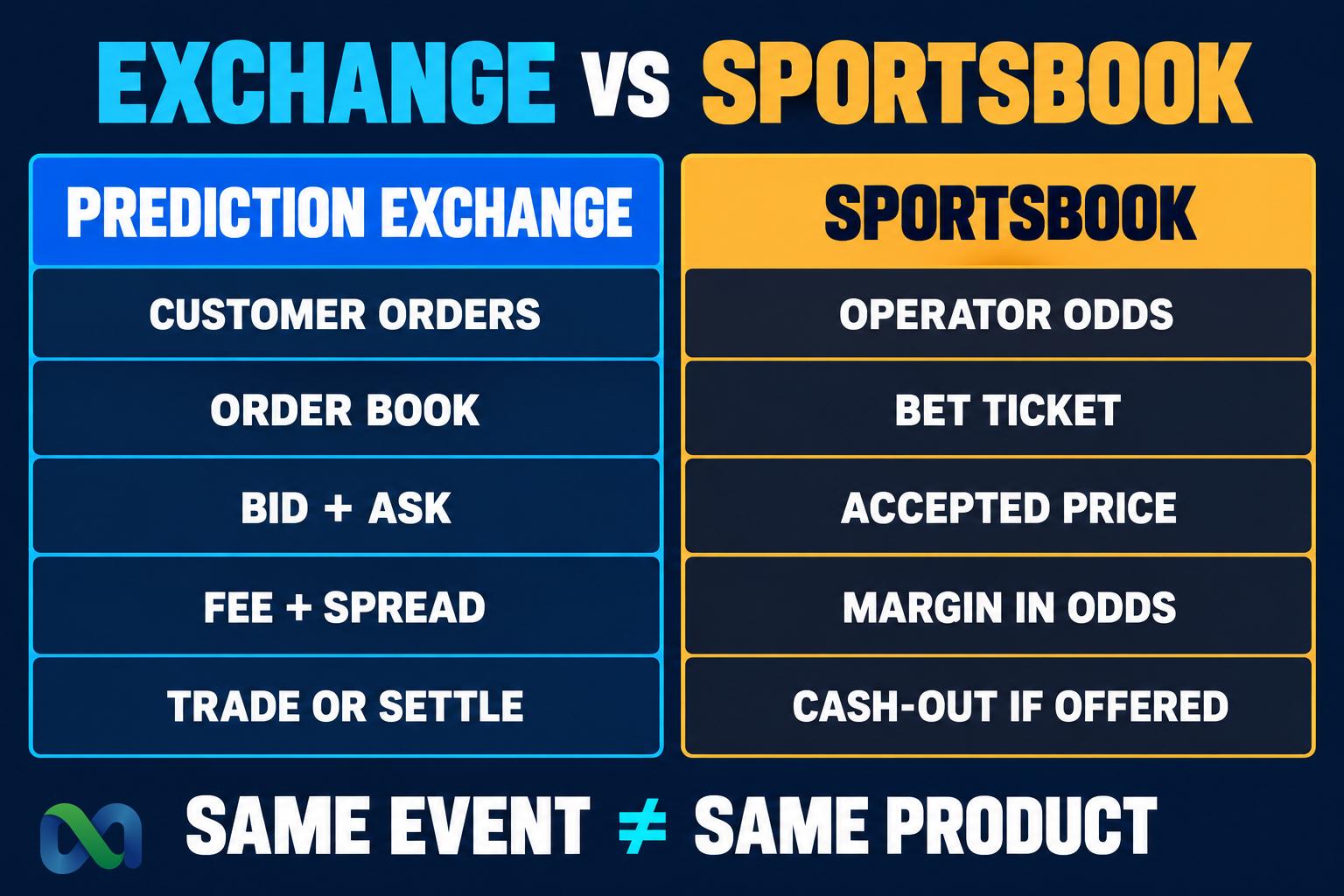
This table describes common retail structures, not every product. Some exchanges use different contract designs, and sportsbook rules vary by jurisdiction and wager type.
How Prices and Odds Work
Prediction-market prices
A binary event contract commonly settles at $1 if the selected outcome wins and $0 if it loses. The CFTC’s prediction-market guide explains that a contract price reflects the market’s perceived likelihood of the outcome.
If a Yes contract is available at 55¢, traders often interpret that as roughly a 55% market-implied probability. A winning contract would produce 45¢ of gross profit before fees:
$1.00 settlement − $0.55 purchase price = $0.45 gross profit
That price is not an objective forecast. It reflects the orders and liquidity available at that moment. The last trade may differ from the current best ask.
Sportsbook odds
A sportsbook quotes odds and becomes the counterparty to an accepted wager. In American odds:
- positive odds show the gross profit on a $100 stake;
- negative odds show the stake needed for $100 of gross profit.
For example, odds of −122 imply about 54.95% before adjusting for the operator’s margin:
122 ÷ (122 + 100) = 54.95%
A $122 winning stake at −122 returns $222: the original $122 plus $100 of gross profit.
The comparison is close to a 55¢ prediction contract, but the cash flow is expressed differently. A 55¢ contract risks 55¢ to make 45¢, while −122 odds risk $1.22 to make $1.00. Scale either amount and the gross risk-return relationship is almost the same before fees, spread, and bookmaker margin.
Fees, Vig, Spread, and Slippage
Costs are where prediction markets vs sports betting comparisons often become misleading. A sportsbook may advertise “no commission,” yet earn through the price. An exchange may show a fee separately while also having a spread between buyers and sellers.
Sportsbook margin or vig
Consider a two-outcome market priced at −110 on each side. Each side has an implied probability of:
110 ÷ (110 + 100) = 52.38%
Together, the two sides sum to 104.76%, not 100%. The extra 4.76 percentage points are the overround, a simple way to describe the bookmaker’s built-in margin before market movement, promotions, or limits.
The overround is not the same as the expected loss on every bet. The sportsbook can move odds, manage exposure, limit accounts, void wagers under its rules, and offer promotions that change the effective price.
Exchange trading fees
Prediction exchanges may charge transaction fees based on contract price, number of contracts, order type, or market. Kalshi’s current fee documentation says fees can differ by market and that maker fees can apply in some markets.
Always use the fee shown in the live order preview. An old fee formula or screenshot may no longer apply.
Bid-ask spread
The best bid is what a buyer offers; the best ask is what a seller accepts. If the Yes bid is 53¢ and the Yes ask is 57¢, the spread is 4¢. Buying at 57¢ and immediately selling at 53¢ creates a 4¢ loss per contract before fees, assuming enough quantity exists at both prices.
Our guide to the bid-ask spread in prediction markets explains why a mid-price is not always executable.
Slippage
A large immediate order can consume several price levels. If only part of the requested quantity is available at the best ask, the remaining contracts may fill at worse prices. That difference between the expected price and average execution is slippage.
Learn how to calculate it in our guide to prediction-market slippage.
Worked Cost Comparison
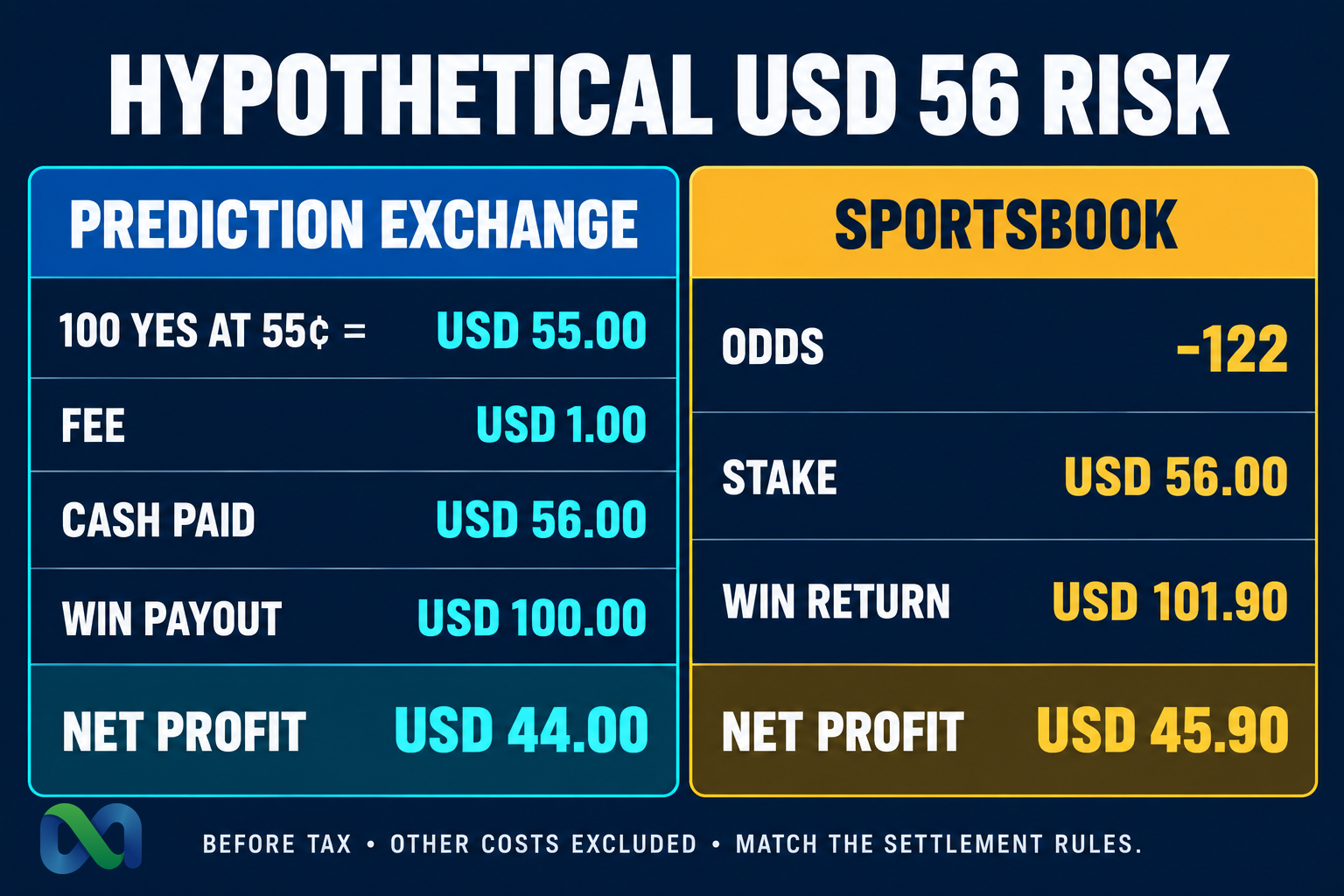
The following example is hypothetical. It compares gross outcomes before tax and excludes funding or withdrawal charges.
Prediction exchange
Assume 100 Yes contracts are available at 55¢ and the displayed transaction fee is $1.00.
- Contract cost:
100 × $0.55 = $55.00 - Trading fee:
$1.00 - Total cash paid:
$56.00 - Winning settlement value:
100 × $1.00 = $100.00 - Gross profit after the displayed trading fee:
$100.00 − $56.00 = $44.00 - Maximum loss if Yes settles at $0:
$56.00
Sportsbook
Assume a sportsbook offers −122 and the bettor risks $56.00.
- Gross profit if the wager wins:
$56.00 ÷ 1.22 = $45.90 - Total return:
$101.90 - Loss if the wager loses:
$56.00
The sportsbook produces $1.90 more gross profit in this narrow example. That does not prove it is always cheaper. A different exchange fee, order-book price, sportsbook line, promotion, or exit plan can reverse the result.
Compare executable prices at the same moment and for the same settlement condition. A contract on “Team A wins the championship” is not equivalent to a sportsbook wager if deadlines, overtime rules, cancellation treatment, or grading sources differ.
Trading, Liquidity, and Early Exit
An exchange position is tradable inventory. If the market remains open and another participant is willing to trade, the holder may sell before the event settles. A limit order can seek a chosen price, but it may fill partly or not at all.
A sportsbook ticket is a contract with the operator at the accepted odds. Some books offer cash-out, but it is not the same as posting an order to a public book. The sportsbook decides whether cash-out is available and what value to quote under its rules.
This creates different risks:
- Exchange liquidity risk: You may not find enough buyers at an acceptable exit price.
- Sportsbook cash-out risk: The feature may be unavailable, suspended, or unattractive when you want it.
- Rule risk: Similar-looking products may use different settlement or grading terms.
- Execution risk: An exchange order may fill at several levels; sportsbook odds may move before acceptance.
Prediction exchanges also expose more market detail. The order book can show bid, ask, and depth. That transparency is useful, but it requires the user to understand order mechanics.
Legal and Regulatory Differences in the US
Licensed sportsbooks are regulated state by state. The Massachusetts Gaming Commission, for example, says only its listed licensees may accept sports wagers in the Commonwealth and describes consumer-protection and responsible-gaming duties for those operators.
Prediction exchanges that list derivatives for the public generally operate as CFTC-regulated designated contract markets. The CFTC says regulated exchanges provide market surveillance, rules, customer rights, and accountability. The exchange model does not make every sports contract legal everywhere.
In KalshiEX LLC v. Assad, the Ninth Circuit held in August 2026 that Kalshi had not shown a likelihood that federal commodities law preempted Nevada gaming regulation for its sports contracts. A September 2026 decision in Blue Lake Rancheria v. Kalshi also recognized likely tribal-law claims involving sports contracts entered from Indian lands.
The practical distinction is:
- a sportsbook should hold the license required by the state where it accepts the wager;
- a prediction exchange should be verified in the CFTC’s registry;
- the exact sports contract may still face state, federal, court, or tribal restrictions; and
- availability in an app is not proof of legality at the user’s physical location.
Our guide to whether Kalshi is gambling explains this legal conflict in more detail. The best prediction market apps in the US guide compares venue registration and access.
Consumer Protections and Account Rules
Both regulated formats require identity and location controls, but the details differ.
A state sportsbook may need to follow rules on minimum age, geolocation, approved wagers, advertising, responsible gaming, self-exclusion, account controls, and dispute handling. Requirements vary by state.
A CFTC-regulated exchange must follow federal market rules, surveillance duties, recordkeeping standards, and applicable customer protections. Its account provider or intermediary may add separate funding, custody, or eligibility terms.
Before using either product, check:
- the legal operator behind the app;
- the relevant regulator and license or registration;
- your minimum-age and location eligibility;
- deposit, withdrawal, and account-hold terms;
- the event definition and settlement source;
- fees, odds, spread, and possible slippage;
- self-exclusion and responsible-gaming tools; and
- the complaint and dispute process.
Regulation reduces some risks; it does not guarantee a winning forecast, continuous liquidity, or instant withdrawals. Our Is Kalshi legit? review separates exchange oversight from trading risk.
Taxes and Recordkeeping
Tax treatment can differ by product and taxpayer, so do not assume a prediction-contract gain is reported exactly like sportsbook winnings.
The IRS says sports-betting winnings are taxable and must be reported even when no Form W-2G is issued. The IRS’s 2026 W-2G instructions include specific reporting and withholding rules for sports wagering.
Prediction-exchange reporting can depend on the instrument, platform, account structure, and current tax guidance. Review the tax form supplied by the operator and consult a qualified tax professional for your circumstances.
Keep records of stakes or contract costs, fees, fills, settlements, payouts, withdrawals, and tax forms. Screenshots alone are not a reliable accounting system.
Which One Is Better for You?
Neither format is automatically better. Choose based on the product, legal access, and the all-in price.
A prediction exchange may fit better if you want:
- visible bids, asks, and market depth;
- limit-order price control;
- a chance to trade out before settlement; or
- non-sports event categories such as economics, weather, or politics.
A licensed sportsbook may fit better if you want:
- familiar moneyline, spread, total, prop, or parlay formats;
- state-specific responsible-gaming systems;
- fixed odds once the bet is accepted; or
- operator promotions that you understand and can value.
Do not choose only from the displayed payout. Compare the exact rules and calculate:
expected value before tax = (your win probability × net win) − (loss probability × amount lost)
Then subtract every cost you can identify. A small apparent edge may disappear after vig, fees, spread, slippage, or a poor cash-out price.
Frequently Asked Questions
Are prediction markets gambling?
They can be regulated as derivatives at the federal level, but sports contracts have also been treated as wagers by state authorities and courts. The legal label depends on the instrument, venue, jurisdiction, and current rulings.
Are prediction markets cheaper than sportsbooks?
Not always. Compare the exchange ask, transaction fee, spread, expected slippage, and possible exit cost with the sportsbook’s offered odds. The cheaper choice can change from one market and moment to another.
Is a 60¢ contract the same as −150 odds?
They represent the same simple implied probability before costs: 60%. A 60¢ winning contract earns 40¢, while −150 risks $1.50 to earn $1.00. Fees, margin, spread, and settlement rules can still make the products economically different.
Can I sell a prediction contract before the game ends?
Often, if the exchange keeps the market open and sufficient liquidity exists. The exit price may be worse than expected. A sportsbook cash-out is a separate operator-controlled feature.
Which is safer: a prediction market or sportsbook?
Use only a verified, regulated operator available in your location. A state license and a CFTC designation create different oversight systems; neither removes the risk of losing the full amount staked.
Do both products use the same event rules?
No. Read the exact contract or house rules, including overtime, postponement, cancellation, corrections, dead heats, and settlement sources. Similar labels can resolve differently.
Prediction Markets vs Sports Betting: Bottom Line
The practical difference between prediction markets vs sports betting is not the subject of the bet. It is the market structure around it.
Prediction exchanges use tradable event contracts, participant orders, spreads, and explicit fees. Sportsbooks quote odds, act as the counterparty, and usually embed their margin in those odds. Both can impose other costs and both can lose.
Compare the exact outcome, executable price, all-in cost, exit method, regulator, and location rules. That is more useful than deciding that one format is always cheaper, safer, or more legal than the other.
