


2030 World Cup Host Countries: Venues and Opening Games
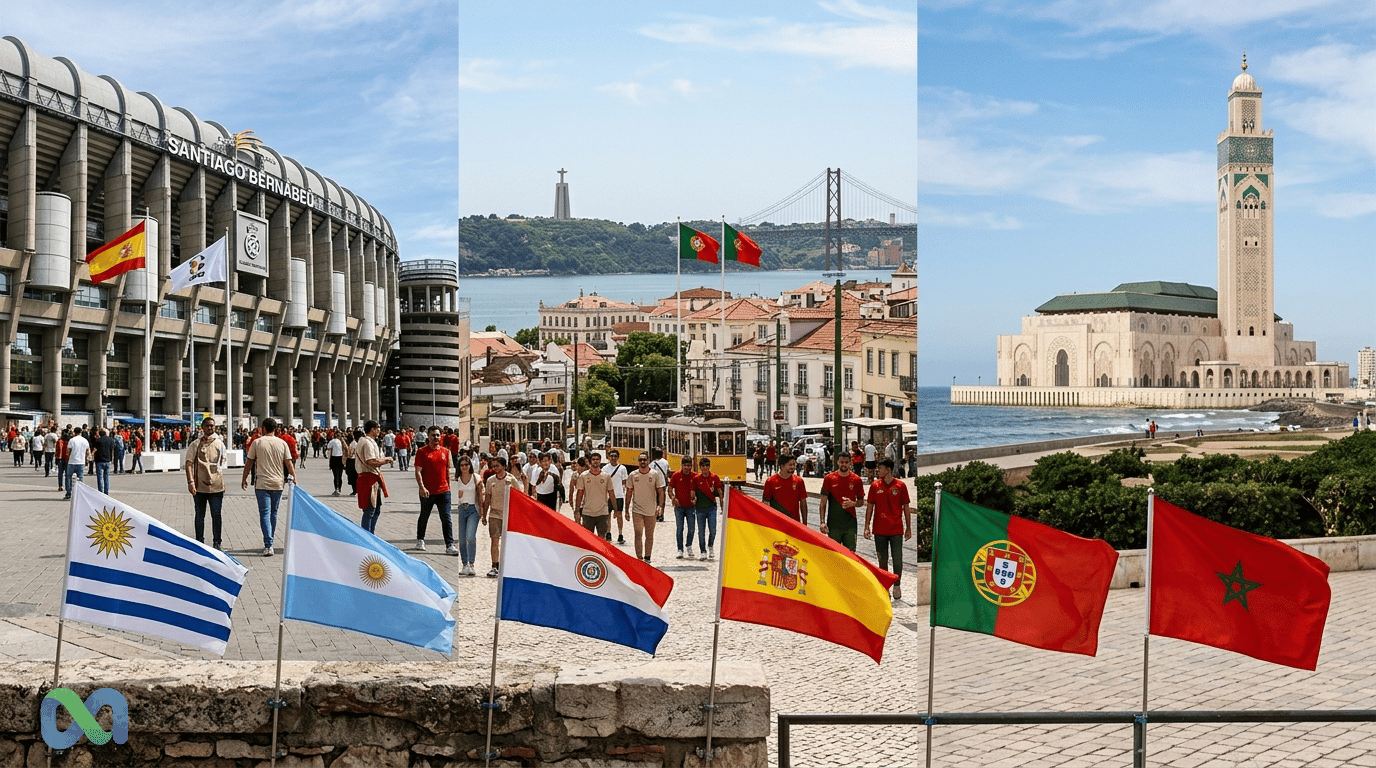
The 2030 World Cup host countries are Spain, Portugal, and Morocco as the main hosts. Uruguay, Argentina, and Paraguay will also stage special opening matches tied to the tournament's centenary. The format marks 100 years since the first World Cup, which was played in Uruguay in 1930.
That answer sounds simple, but the model is unusual. For the first time, the men's World Cup will include official matches in six countries and on three continents. The main phase will sit mostly in Europe and Africa. South America enters as the historical symbol of the centenary.
For football fans, sports calendars, and prediction markets, the host map matters. It affects travel, climate, time zones, team logistics, and how supporters watch each match. Therefore, understanding the 2030 World Cup host countries helps readers analyze the tournament before the ball is kicked.
This guide explains where the 2030 World Cup will be played, which countries will host matches, why FIFA chose this format, and what still needs confirmation before the tournament starts.
Where Is the 2030 World Cup?
The 2030 World Cup will be played mainly in Spain, Portugal, and Morocco. It will also include opening celebration matches in Uruguay, Argentina, and Paraguay. That makes the 2030 edition a multi-continent World Cup, with matches in Europe, Africa, and South America.
The question "where is the 2030 World Cup" has two layers. The first layer is the main host structure. Spain, Portugal, and Morocco will carry most of the tournament. The second layer is the centenary celebration. Uruguay, Argentina, and Paraguay will each host an early match linked to the tournament's origin story.
In short:
- Main hosts: Spain, Portugal, and Morocco.
- Celebration matches: Uruguay, Argentina, and Paraguay.
- Special reason: 100 years since the first World Cup, held in Uruguay in 1930.
- Format: one tournament across six countries and three continents.
FIFA confirmed this structure as part of the same cycle that also confirmed Saudi Arabia as the 2034 World Cup host. The key is not to treat every country as having the same role. Three countries are the operating base. Three countries are part of the centenary opening.
Which Countries Will Host the 2030 World Cup?
The 2030 World Cup has six countries involved, but they do not share the same job. This distinction prevents confusion. Spain, Portugal, and Morocco are the main hosts. Uruguay, Argentina, and Paraguay will stage matches connected to the historic celebration.
| Country | Role in the tournament | Continent | What to expect |
|---|---|---|---|
| Spain | Main host | Europe | Many matches and core tournament infrastructure |
| Portugal | Main host | Europe | Main-phase matches and European logistics support |
| Morocco | Main host | Africa | Main-phase matches and African presence in the event |
| Uruguay | Celebration match | South America | Tribute to the 1930 World Cup in Montevideo |
| Argentina | Celebration match | South America | Symbolic early match tied to the centenary |
| Paraguay | Celebration match | South America | Match connected to CONMEBOL's history |
The table shows the central point. It is not accurate to say the World Cup will simply be in South America. It is also incomplete to say it will only be in Spain, Portugal, and Morocco. The format combines a main host group with a historical opening celebration.
Spain, Portugal, and Morocco as Main Hosts
Spain, Portugal, and Morocco form the main bid for the 2030 World Cup. These three countries should stage most matches, including knockout rounds and the central tournament operation. FIFA can still release more detail on cities, stadiums, and the final calendar in later stages.
The choice has a clear geographic logic. Spain and Portugal share the Iberian Peninsula. Morocco sits just across the Strait of Gibraltar. That reduces part of the complexity between Europe and Africa, even though international borders are still involved.
The three countries also have strong football identities. Spain and Portugal have leagues with global visibility. Morocco has grown as a competitive power, especially after its historic 2022 World Cup run. The bid therefore combines infrastructure, sporting appeal, and regional symbolism.
Uruguay, Argentina, and Paraguay in the Opening Games
Uruguay, Argentina, and Paraguay will host matches at the start of the World Cup. The goal is to celebrate the tournament's 100th anniversary. The first World Cup took place in Uruguay in 1930, and Uruguay won that tournament.
This decision gives South America a historical role. It recognizes the origin of the competition without moving the full operation to the continent. The South American games should work as a symbolic opening before the main phase moves to Europe and Africa.
For fans, this means a World Cup with a distributed start. After those matches, the tournament should continue in the main host structure. FIFA will need to build the calendar carefully, because the format creates real travel and time-zone challenges.
Why Will the 2030 World Cup Have Games in Six Countries?
The 2030 World Cup will have games in six countries because FIFA wanted to mark the tournament's centenary. It paired a strong operating base with a tribute to the first World Cup. Spain, Portugal, and Morocco host the main phase, while Uruguay, Argentina, and Paraguay participate in the symbolic opening.
The 1930 World Cup is the center of this explanation. Uruguay organized the first edition. That tournament had a different size, a different structure, and a very different travel reality. Even so, it created football's most important global event.
One century later, FIFA chose to mark the date with matches in South America. The choice also connects to CONMEBOL's history. Uruguay, Argentina, and Paraguay represent a major part of South American football's institutional and cultural base.
The Symbolism of Uruguay 1930
Uruguay has special weight in this story. The country hosted the first World Cup and beat Argentina in the final. Montevideo became a core marker in football's global memory.
By including Uruguay in 2030, FIFA strengthens the link between past and present. This is not only a logistics decision. It is also a narrative decision. The modern tournament returns to its starting point before moving into the main host structure.
That symbolism also helps explain Argentina and Paraguay. Argentina was the first World Cup runner-up and has one of football's strongest national histories. Paraguay hosts CONMEBOL's headquarters, which ties the celebration to the organization of South American football. Together, the three countries form a regional tribute.
FIFA's Decision and the Multi-Continent Format
FIFA confirmed the model as part of the selection process for the 2030 and 2034 World Cups. According to FIFA's tournament material, the 2030 edition uses this structure to celebrate the centenary in a global way.
In practice, this creates an unprecedented World Cup scale. The tournament touches South America, Africa, and Europe. It also reinforces a recent trend: larger World Cups, more host countries, more teams, and more complex calendars.
The 2026 World Cup will already be staged in three countries: the United States, Mexico, and Canada. The 2030 edition goes further. It blends a shared main host with celebration matches on another continent. As a result, the single-host model is becoming less dominant.
How 2030 World Cup Logistics Could Work
The 2030 World Cup logistics should work in two broad phases. First, the celebration games take place in South America. Then the competition concentrates in Spain, Portugal, and Morocco. FIFA still needs to publish the detailed calendar before anyone can confirm exact dates, cities, and travel paths.
This structure tries to balance symbolism and efficiency. If all matches were spread evenly across six countries, the burden would be huge. With only early matches in South America, most teams should remain focused around the Europe-Africa axis.
Even so, several issues matter:
- Time zones: matches in South America and Europe will create different global TV windows.
- Travel: teams in the opening games may face long flights soon after playing.
- Preparation: squads need to plan rest, acclimatization, and logistics early.
- Supporters: following games across multiple countries can become expensive.
- Calendar fairness: FIFA must protect competitive balance and avoid unfair rest gaps.
Logistics will be one of the most watched topics before 2030. The more detailed the schedule becomes, the easier it will be to assess the sporting and commercial impact.
Opening Matches in South America
The opening matches in South America serve a symbolic purpose. They should start the World Cup with a focus on the centenary. Uruguay is the most important part of that tribute because of the 1930 tournament.
Argentina and Paraguay also matter. Argentina links the tournament to the first runner-up and to one of the world's most popular national teams. Paraguay connects the tribute to CONMEBOL and the organization of South American football.
After those games, the tournament should move into the main phase. That transition requires careful planning. A team that plays in South America may need to travel to Europe or Africa within a short window.
Main Phase Across Europe and Africa
The main phase should take place in Spain, Portugal, and Morocco. This area will carry the operational core of the tournament, including stadiums, training bases, media facilities, and fan travel.
The proximity between the three countries helps. Spain and Portugal have strong land and air connections. Morocco is close to southern Spain, with short flights and sea routes. Still, the World Cup will involve borders, controls, and different climates.
For teams and coaching staffs, the group draw will be important. A group with shorter trips could have an operational edge. A group with frequent country changes could face more fatigue. Therefore, analysts will watch the match distribution closely.
When Did FIFA Confirm the 2030 World Cup Hosts?
FIFA confirmed the 2030 and 2034 World Cup host decisions during its selection cycle. The decision confirmed Spain, Portugal, and Morocco as the main base for 2030, plus celebration matches in Uruguay, Argentina, and Paraguay.
That confirmation answered the main question about who will host the 2030 World Cup. However, it did not settle every detail. Important steps remain before the tournament. These include the final stadium map, the full match schedule, kickoff times, and possible operating adjustments.
Short Timeline
- 1930: Uruguay hosts the first World Cup and wins the title.
- 2023: FIFA announces the joint-host plan for 2030, including the South American tribute.
- 2024: FIFA formalizes decisions connected to the 2030 and 2034 hosts.
- Before 2030: FIFA must detail cities, stadiums, schedule, and tournament operations.
This timeline explains why the topic will keep changing. The host structure is set. The final World Cup experience still depends on decisions that have not been published.
What Still Needs Confirmation
The main pending item is the final map of cities and stadiums. Many outlets discuss likely venues, but readers should treat those lists carefully until FIFA confirms them.
The exact order of matches is also pending. That includes the opening sequence, host debuts, group-stage order, and possible semifinal and final venues. Each detail can affect tourism, broadcasting, team preparation, and the way sports markets read the tournament.
For that reason, this article should be updated when FIFA releases new information. For now, the central answer is clear: the 2030 World Cup will be hosted mainly by Spain, Portugal, and Morocco, with celebration matches in Uruguay, Argentina, and Paraguay.
What the 2030 Host Map Changes for Fans and Analysts
The host map changes how fans plan trips, how teams organize preparation, and how analysts evaluate scenarios. In a normal World Cup, the host country already creates strong effects. In 2030, the impact may be larger because the tournament crosses continents.
For supporters, the first effect is financial. Watching matches in Spain, Portugal, and Morocco may be easier for fans based in Europe. Following the South American opening matches as well requires a very different budget. Many fans may therefore choose one segment of the tournament.
For teams, logistics can influence performance. Long travel, climate, and training routines affect preparation. The difference does not decide everything, but it matters in short tournaments. A team that adapts well to the calendar can gain small advantages.
For analysts, the 2030 World Cup will be a useful case study. The format adds new variables to probability models. Distance between venues, altitude, climate, rest, and local support can all shape expectations.
At Macro Markets, that kind of analysis matters because prediction markets turn expectations into observable prices. When the final calendar is released, traders can compare football strength with real logistical factors. The host map stops being trivia and becomes an analytical input.
Why Host Details Matter for Sports Markets
Host details matter because tournament prices do not move only on team quality. They also react to information about travel, rest, weather, and crowd support. A favorite with a difficult route can look different from the same favorite in a compact group. A smaller team with short trips and strong local support can also become more interesting once the schedule is known.
The 2030 World Cup makes that analysis more complex than usual. The opening celebration matches create one set of conditions. The main phase in Spain, Portugal, and Morocco creates another. Analysts will need to separate symbolic matches from the operational core of the tournament.
That distinction is useful for fans, too. It helps them avoid overreading headlines about six host countries. The practical tournament experience will depend on which teams play where, how much rest they get, and whether the final calendar keeps travel balanced. Until FIFA publishes those details, the safest view is clear: the host countries are confirmed, but the market-relevant schedule is still incomplete.
For now, that uncertainty is the point. The confirmed map answers the location question, but it does not yet answer every performance question. That is why updates on venues, kickoff windows, and group routing will matter as much as the host announcement itself.
FAQ: Quick Questions About the 2030 World Cup
Where Will the 2030 World Cup Opening Be?
The opening will be connected to the celebration matches in South America. Uruguay should have a central role because of the 1930 centenary. However, FIFA still needs to publish the full official calendar.
Will Brazil Host Any 2030 World Cup Match?
No. Based on the current confirmation, Brazil is not among the countries scheduled to host matches at the 2030 World Cup. The countries involved are Spain, Portugal, Morocco, Uruguay, Argentina, and Paraguay.
Which Country Gets Most of the Tournament?
Most of the tournament will sit with the main hosts: Spain, Portugal, and Morocco. The exact split by city and stadium still depends on official confirmation.
Is the 2030 World Cup in Europe, Africa, or South America?
The correct answer is all three. The main phase will be in Europe and Africa, with Spain, Portugal, and Morocco. South America will host celebration matches in Uruguay, Argentina, and Paraguay.
Where Is the 2034 World Cup?
The 2034 World Cup will be in Saudi Arabia, according to FIFA's confirmation in the same decision cycle. It is a separate tournament and does not change the 2030 World Cup host structure.
Where Is the 2038 World Cup?
The host of the 2038 World Cup has not been officially decided. Any list of possible candidates should be treated as speculation until FIFA makes a formal announcement.
Is There a Men's FIFA World Cup in 2035?
No. There is no men's FIFA World Cup scheduled for 2035. The tournament is held every four years. After 2030, the next men's edition will be 2034.
Official Sources and References
The information in this article is based on official announcements and recognized coverage. The main reference is FIFA, which organizes the tournament and confirms the host model. Independent reporting from major outlets also helps explain the logistics and format.
- FIFA: 2030 World Cup hosts and qualified teams
- BBC: 2030 World Cup stadiums, hosts, and format
- AP: 2030 World Cup set for Spain, Portugal, Morocco and South America
Conclusion: 2030 World Cup Host Countries
The final answer is that the 2030 World Cup host countries are Spain, Portugal, and Morocco for the main tournament, with celebration matches in Uruguay, Argentina, and Paraguay. The edition will be historic because it marks 100 years since the first World Cup and takes official matches to three continents.
The most important point is to separate main hosts from celebration matches. Spain, Portugal, and Morocco carry the core operation. Uruguay, Argentina, and Paraguay represent the tribute to the tournament's birth.
Before 2030, FIFA still needs to publish details on cities, stadiums, and the calendar. Those updates matter. For anyone analyzing football with data, each new detail can change expectations around travel, preparation, and team performance.
At Macro Markets, global events like the World Cup show how information becomes probability. Once the calendar is complete, the host map will not be just a geography detail. It will be part of the risk, edge, and opportunity profile in sports markets.
