


Prediction Market Calculators: Find the Right Free Tool

Find the right prediction market calculators for the question you are trying to answer. Macro Markets offers 11 free calculators covering odds, parlays, hedging, no-vig prices, transaction costs, arbitrage, expected value and Kelly position sizing. Each link below opens the working calculator, with its inputs, results and model explained on the destination page.
A payout, a profit and an expected value answer different questions. Start with the task you have, then use the calculator built for that task. The examples in this guide are hypothetical arithmetic, not live prices or suggested trades.
Directory checked November 7, 2026. All 11 tools listed here were accessible without signing in. They calculate from the values you enter; they do not submit bets or trading orders.
Choose a Calculator for Your Question
Use this directory to open the relevant tool directly:
| Your task | Calculator |
|---|---|
| Format only | Converter |
| Price and payout | Odds |
| Independent legs | Parlay |
| Opposing outcomes | Hedge |
| Remove margin | No-vig |
| Binary trade costs | Fees |
| Binary pair | Binary arbitrage |
| Odds allocation | Odds arbitrage |
| Binary EV scenarios | Binary EV |
| Standard odds EV | Odds EV |
| Bankroll sizing | Kelly |
Eight tools have standalone pages under /tools. Three binary-contract calculators are embedded in their explanatory articles. Choose by the cash-flow model, not just the tool's name. Standard back bets and fully paid binary contracts are not interchangeable.
The 11 Calculators Explained
Odds Converter: Change Formats Without Entering a Stake
The odds converter converts a supported American, decimal or fractional price into the other formats and its implied probability. Use it when you only need a format conversion, without a payout calculation.
Its hypothetical starting price of -110 is equivalent to about 1.909091 decimal odds, 10/11 fractional odds and 52.381% implied probability. It does not remove margin, estimate the true chance or include fees.
Odds Calculator: Convert a Price and Calculate a Single Payout
Open the odds calculator when you have one offered price and want to understand its equivalent formats, payout and potential profit.
Enter American, decimal or fractional odds and a stake in US dollars. The outputs include all three odds formats, the total payout if correct, profit, stake at risk and the probability implied by the offered price.
For example, +150 American, 2.5 decimal and 3/2 fractional describe the same standard return. A hypothetical $100 stake pays $250 if it wins, including the original $100 and $150 profit, before added costs. The tool's initial -110 example uses a different price and shows approximately $190.91 payout on $100.
Use this tool for a single selection or a format conversion. It does not remove margin from a complete market, estimate the event's true probability or automatically add fees and taxes. When you change the input format, enter the price again in the new units.
Parlay Calculator: Model Several Independent Selections
The parlay calculator models one combined wager whose required selections must all win. It accepts two to twenty selections, mixed odds formats and one total USD stake.
The tool converts the entered prices to decimal odds, multiplies them and shows combined odds, payout, profit and the price-implied break-even threshold. Two hypothetical selections at -110 each produce combined decimal odds of about 3.6446. At a $10 stake, the rounded payout is $36.45, including approximately $26.45 profit, before fees and taxes.
That multiplication models independent selections. A same-game or otherwise correlated parlay needs the bookmaker's actual combined quote; multiplying individual prices does not establish a fair combined price.
Several separately purchased prediction-market contracts also settle separately. Buying them does not create the combined wager modeled here. Use the parlay calculator when the product itself is a parlay, and use the binary-contract tools for separately settled positions.
Hedge Calculator: Compare Two Opposing Results
Use the hedge calculator when you already have a standard back bet and want to model an additional bet on the opposite outcome.
Enter the original stake, original odds and opposing odds. The tool calculates an additional hedge stake and shows both net outcomes, total cash staked and the lower net result. Each set of odds can use a different supported format.
Its hypothetical starting example is $100 at +300, with the opposite outcome offered at -150. The modeled hedge is $240. Either winning bet returns $400 against $340 combined stakes, leaving $60 net before costs, provided exactly one bet wins and both settle on matching terms.
Other prices can balance the outcomes at a loss. The hedge stake is rounded to cents, and the two net results use that displayed amount. This model excludes fees, draws, voids, cash-outs and exchange lay liability. A parlay fits only after its other legs have already won and the remaining exposure has exactly two opposite outcomes.
No-Vig Calculator: Separate Offered Prices from a Margin-Free Reference
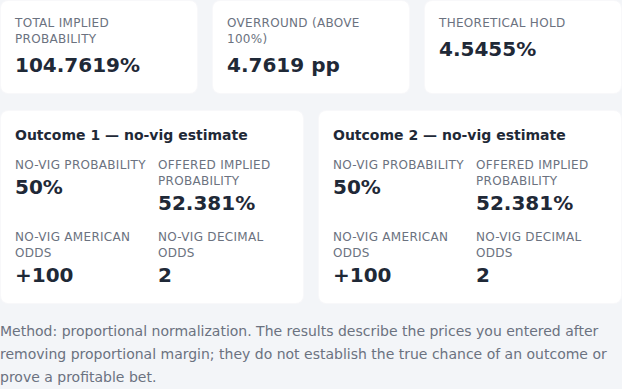
The no-vig calculator accepts the prices for every outcome in a two-way or three-way market. It converts the odds into implied probabilities and normalizes them proportionally to a total of 100%.
It shows the original probability sum, overround, theoretical hold, normalized probabilities and corresponding reference American and decimal odds. For hypothetical -110 / -110 prices, the offered probabilities total approximately 104.76%. Proportional normalization gives 50% per outcome, equivalent to +100 American or 2.0 decimal odds.
Here, overround is approximately 4.76 percentage points; theoretical hold is approximately 4.55%. They have different denominators and should not be presented as the same measure.
The normalized probabilities are price-based estimates under the selected method. They are not verified event forecasts or evidence of a profitable position. Include every mutually exclusive outcome covering the market, including a draw when applicable, and use matching event and settlement definitions.
Fee Calculator: Find the Cost and Winning Result of One Binary Position
The prediction market fee calculator models one fully paid binary position held through a $1 winning or $0 losing settlement.
Enter the executable contract price in cents, quantity, total trading fee and other included dollar costs. It shows committed cash, winning settlement payout, net profit if correct, return on cost and the break-even probability.
For the hypothetical 100 contracts at 55 cents with a $1 total fee, total cost is $56. A normal win pays $100 and leaves $44 net profit; a normal losing settlement returns $0 and loses the entered cost. The break-even probability is 56%, while return on cost if correct is approximately 78.57%.
This is the right starting point when you need the cost ledger. It does not supply the probability that the position wins. Use the expected value calculator for that separate calculation, entering your own probability assumption.
Contract Arbitrage Calculator: Check a Complementary Binary Pair
The prediction market arbitrage calculator models two complementary positions, with executable prices, quantities, per-leg total fees and other included costs.
The tool shows committed cash and the net result under each modeled normal outcome. It requires confirmation of matching contract rules and completed fills before treating the minimum result as verified under its assumptions. Unequal quantities can leave directional exposure.
Its initial hypothetical prices are 48 cents for Yes and 49 cents for No, with 100 contracts on each side and $2 assumed fees per order. The $97 premium becomes $101 total cost. A $100 conditional settlement leaves a $1 loss, even though the headline prices sum to less than $1.
Use it to examine the full pair rather than infer profit from a quoted gap. Different definitions, deadlines, cancellation rules, unfilled orders or unequal quantities can change the result. The calculator does not confirm those conditions for you. Our prediction market arbitrage guide explains them in more detail.
Contract Expected Value Calculator: Compare Probability Scenarios
The prediction market expected value calculator combines one binary position's cost with your own estimated probability that the purchased side pays its winning amount.
Inputs include executable price, whole-contract quantity, winning payout, total fees, other included costs and three ordered probability assumptions. Outputs separate expected net, expected return, break-even probability and actual modeled win/loss results.
Using the $56 cost example with an assumed 60% chance of a $100 winning payout, EV is +$4. A single normal settlement still produces +$44 or −$56, rather than a $4 payment. At assumed probabilities of 50% and 70%, EV becomes −$6 and +$14 while the two cash outcomes stay the same.
The lower and higher scenarios are assumptions you enter, not confidence intervals. OpenStax's expected value explanation describes the underlying probability-weighted average. The tool checks arithmetic; it does not validate your forecast or determine position size.
Odds Arbitrage Calculator: Allocate Across Two or Three Outcomes
The standard-odds arbitrage calculator splits a USD budget across two or three mutually exclusive outcomes. Enter a complete market and compare whole-cent stakes, payouts and the net result for each winner.
Its hypothetical $100 example uses +110 for each of two outcomes. Allocating $50 to each produces a $105 winning payout and a $5 net result in either modeled state, before costs. This requires matching settlement rules, complete coverage and accepted stakes at the entered prices. Fees, changing odds, rejected stakes or voids can change the result. For a complementary binary-contract pair with per-leg fees, use the contract arbitrage tool instead.
Odds Expected Value Calculator: Evaluate a Standard Back Bet
Use the standard-odds EV calculator for a single back bet with an entered stake, odds and your estimated winning probability. It shows expected net, expected ROI, break-even probability, probability edge and both cash outcomes, before fees and taxes.
The hypothetical +100 odds, $100 stake and 55% probability give +$10 expected net and 10% expected ROI. The actual modeled outcomes are +$100 or -$100; a win returns $200 including the stake. Use the contract EV tool when you need a binary purchase price, contract quantity and explicit costs.
Kelly Calculator: Model Full, Half or Quarter Kelly
The Kelly calculator adds bankroll allocation to your price and probability assumptions. It supports one fully paid $1-or-$0 binary position with an entered linear fee per contract, or standard odds without fees. It does not estimate the probability for you.
Its hypothetical $1,000 bankroll, 60% probability, 55-cent price and assumed 1-cent fee per contract produce a full Kelly fraction of about 9.09%. Quarter Kelly gives a model budget displayed as $22.73. Rounding down buys 40 contracts for $22.40, with a winning net of $17.60, a losing net of -$22.40 and $1.60 expected net under that probability assumption.
Half and quarter Kelly scale the full fraction, not the whole bankroll. The tool models one long position, not a portfolio or existing correlated exposures. A wrong probability can turn a modeled advantage into a loss; a smaller multiplier does not verify the estimate.
How to Use the Tools Together
Start by identifying the product and the decision you are modeling. Then choose the shortest useful sequence:
- Decode an offered price. Use odds for a single selection; use no-vig when you have a complete market and want a proportional margin-free reference.
- Model the relevant payoff. Use parlay for an independent combined wager, fees for one supported binary contract, or arbitrage for a supported complementary pair.
- Add the assumption that changes the question. EV needs your probability estimate. Hedge needs an existing position and a valid opposing outcome.
- Model bankroll allocation separately. Kelly adds an entered bankroll and full, half or quarter scaling. Check total exposure outside this one-position model.
Keep payout and profit separate throughout. A $250 payout on a $100 standard bet includes $150 profit. A $100 binary-contract payout against $56 cost includes $44 profit. A $4 EV describes a weighted estimate under a probability assumption. These are three different quantities.
Keep price-derived probabilities separate from forecasts as well. Removing proportional margin changes a reference calculation; it does not reveal a verified true probability. Typing a larger probability into the EV tool changes its weighting, not the event or your evidence.
Enter Actual Costs and Read the Relevant Rules
Calculator examples are not fee schedules. Kalshi's fee guidance explains that some markets have different fees and some resting orders incur maker charges when executed. Polymarket US publishes a product-specific schedule; it should not be applied automatically to international Polymarket or another venue.
Use the actual product's order preview and fee information. Reflect spread and slippage in the executable or average fill price when the model calls for it, and avoid adding the same cost twice. A hypothetical fee of $1 in an example is simply an input.
Using the Calculators Alongside Macro Markets
Macro Markets publishes these tools and operates our own crypto-native prediction-market alternative. You can use the calculators to understand an entered price, compare modeled outcomes or check assumptions before reviewing a particular market.
The calculators are separate from order execution. Opening a sports-market link does not place the hypothetical parlay or hedge shown in a tool. Review the actual market's payout, available quantity, funding route, settlement rules and access requirements before treating its numbers as applicable.
For the mechanics of buying and settling individual contracts, start with how to trade on prediction markets. To understand how we compare platforms and distinguish product facts from judgments, read our comparison methodology.
Frequently Asked Questions
Are all 11 calculators free to use?
Yes. The 11 linked tools were accessible without signing in when this directory was checked. They calculate from entered values in the browser. Platform account requirements for an actual trade are a separate matter.
Which calculator should I use for Kalshi or Polymarket?
Choose by the position and contract model. The fee and EV calculators can analyze an entered position that matches their binary settlement assumptions. The arbitrage calculator needs a valid complementary pair. None supplies a universal platform fee preset or verifies your contract rules.
How do the odds calculator and odds converter differ?
Both convert supported price formats. The dedicated converter works without a stake. The odds calculator also models payout and profit for an entered stake. The no-vig tool needs every outcome in a complete market to normalize implied probabilities.
Does Kelly predict the winning outcome?
No. You supply the probability. Kelly calculates an allocation under that assumption. It does not validate your forecast or account for a portfolio of existing exposures.
Can a positive modeled result still lose money?
Yes. Positive EV can coexist with a losing individual settlement. A conditional arbitrage or hedge result can also fail to describe an actual trade if prices, quantities, fills, costs or settlement assumptions differ from the model. Read both outcome results and the assumptions on the tool page.
Do these calculators predict outcomes or place orders?
No. They perform the calculations described on their pages. A price-implied probability, a no-vig estimate and a probability you supply are different inputs or outputs; none is an automatic verified forecast. No bet or trading order is submitted by these tools.
