


Kalshi vs DraftKings Predictions: Fees, Markets and Availability
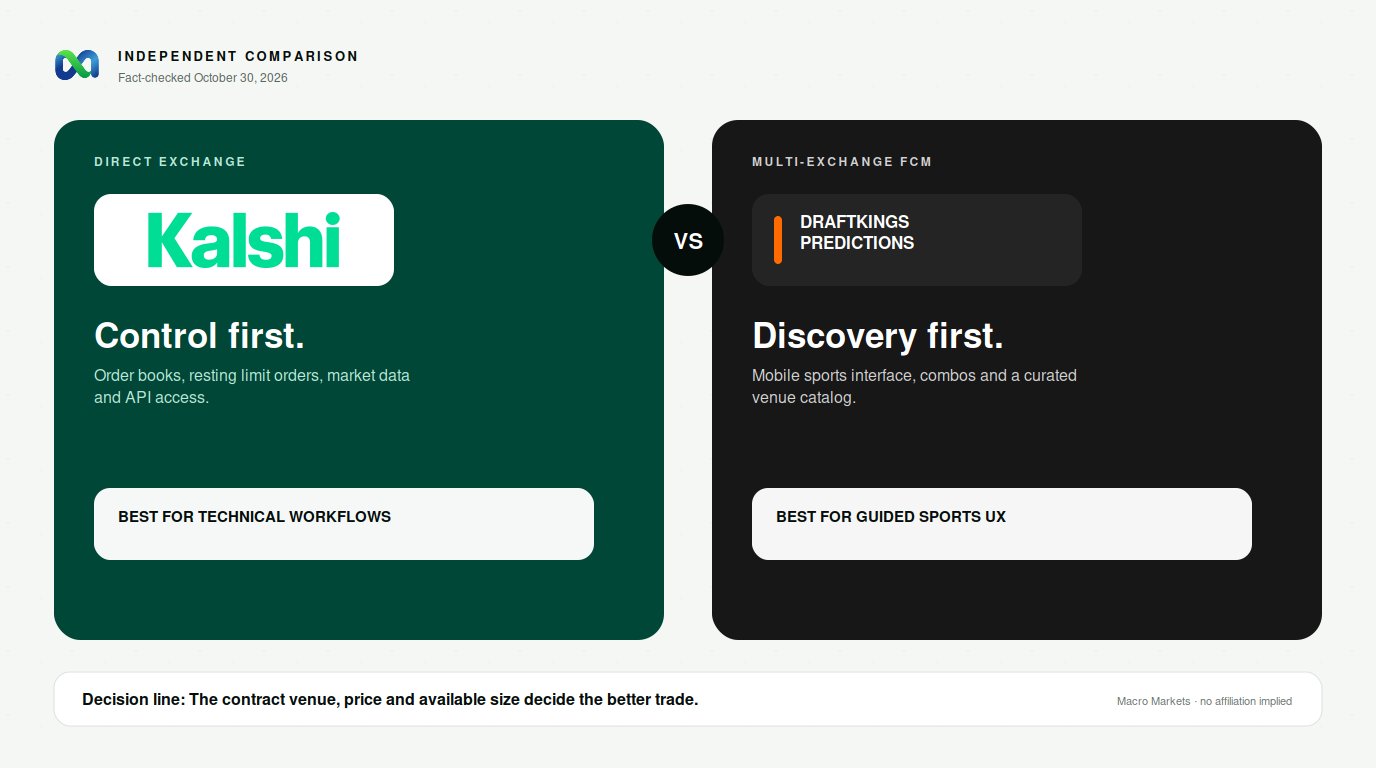
Kalshi and DraftKings Predictions both let eligible customers trade event contracts, but they are not the same kind of product. Kalshi gives retail users direct access to its designated contract market, visible order books and developer API. DraftKings Predictions presents a familiar sports-brand interface and can offer contracts from multiple exchanges, including its affiliated DKEx/Railbird venue, CDNA and CME.
Our verdict: Kalshi is the stronger default for traders who want a direct exchange relationship, limit-order control, transparent order-book data and API access. DraftKings Predictions is the stronger default for eligible users who prefer a mobile-first sports interface, combo discovery and a curated multi-exchange catalog. Neither wins every fee or liquidity comparison. The exact contract, venue, price, available size, fee schedule and exit plan determine the better trade.
Last reviewed and fact-checked: October 30, 2026.
Editorial disclosure: Macro Markets publishes this comparison and operates a prediction-market platform. We include Macro Markets as a disclosed crypto-native alternative, apply the same comparison criteria and do not present it as a CFTC-designated US exchange. This is a documentation-based review; we did not open, fund and place simultaneous matched orders on both products for this article. Event contracts are speculative and can lose the full amount committed. This page is educational, not financial, tax or legal advice.
Kalshi vs DraftKings Predictions: Quick Verdict
Choose Kalshi if you want to interact with a prediction exchange directly. Its central limit order book, resting limit orders, public market data and REST API make it the better fit for price-sensitive or technical traders. Kalshi's catalog also reaches well beyond sports into politics, economics, weather, crypto, technology, culture and other current events.
Choose DraftKings Predictions if you want event contracts inside an interface designed around the habits of mainstream sports customers. The current product emphasizes easy Yes/No discovery, major sports, combos and a separate Predictions wallet. DraftKings also aggregates markets from multiple exchanges, which can widen the visible catalog but makes the venue and fee check more important on every order.
The clearest difference is structural:
- Kalshi: the customer trades on the Kalshi exchange under Kalshi's market rules.
- DraftKings Predictions: the customer uses a DraftKings intermediary and interface, while the individual contract can be listed on DKEx/Railbird or another supported exchange.
That difference affects fees, order controls and settlement. It does not automatically make one product safer, cheaper or more liquid. Our prediction-market comparison methodology explains why the executable order and contract rule matter more than the logo.
Winner by use case
- Direct exchange access: Kalshi.
- Public order books, limit orders and API workflows: Kalshi.
- Sports-brand familiarity and guided mobile discovery: DraftKings Predictions.
- Currently visible combo experience: DraftKings Predictions.
- Broader international account availability: Kalshi, subject to the current Member Agreement and restricted jurisdictions.
- US product with a separate familiar-brand wallet: DraftKings Predictions.
- Lowest total cost: no universal winner; compare the exact ticket and executable spread.
- Best liquidity: no universal winner without simultaneous matched-contract evidence.
- Crypto-native alternative and global discovery: Macro Markets for eligible users, with a different regulatory, custody and funding profile.
For individual product analysis, read our complete Kalshi review and DraftKings Predictions review.
Kalshi vs DraftKings Predictions at a Glance
| Decision factor | Kalshi | DraftKings Predictions | Practical edge |
|---|---|---|---|
| Core structure | Direct access to KalshiEX, a CFTC-designated contract market | Customer-facing intermediary offering contracts from multiple supported exchanges | Depends on preferred workflow |
| Public baseline age | 18+, subject to identity and jurisdiction checks | 18+, subject to identity, location and product eligibility | Tie |
| Geographic scope | Accessible in the US and many international jurisdictions; restrictions apply | Must be physically located in a supported US state, territory or DC; market access varies | Kalshi for international reach |
| Market menu | Sports, politics, economics, weather, crypto, culture and more | Sports, politics, crypto, financials, economics, culture and climate | Contract-specific |
| Order controls | Central limit order book, resting orders, public data and REST API | Consumer trade slip, buy/sell workflow and combos; controls vary by venue and product | Kalshi for advanced control |
| General trading fee snapshot | Probability-weighted formula; special series can differ | Current public terms state $0.01 per contract bought or sold plus a separate exchange fee | Compare the complete ticket |
| Funding | ACH, debit, wire, PayPal, Venmo, Cash App and crypto availability varies by region | Separate Predictions wallet; supported methods and withdrawal path depend on account | Kalshi for published rail breadth |
| Early exit | Place a sell order against available market liquidity | Sell before close when a market and executable price are available | Tie in principle |
| Settlement | Kalshi contract rule and named source | Rule of the exchange listing that DraftKings contract | Read the exact rule |
| Liquidity | Varies by Kalshi contract and time | Varies by contract, exchange and time | No universal winner |
What this table does not prove
It does not prove that two similarly worded contracts are interchangeable. One may observe a different source, time, threshold or correction window. It also does not prove that the lower visible fee creates the lower all-in cost. A two-cent difference in the executable price is worth $2 across 100 one-dollar contracts before any explicit charge.
Use the table to select a workflow, then compare the live market. Record the full question, venue, settlement source, close time, bid, ask, available quantity and every fee before choosing. A midpoint or probability display is not necessarily the price available for the desired size.
The most important buying question
Ask: Am I choosing a platform, or am I choosing a specific contract?
The platform controls onboarding, funding, interface and support. The contract controls the legal payoff, close time and resolution. The exchange order book controls the fill. A good platform fit cannot rescue a badly priced or ambiguously written contract.
Regulation, Exchanges and Account Structure
Kalshi and DraftKings Predictions both participate in US federally regulated event-contract infrastructure, but their customer routes are different. Calling both of them simply “exchanges” hides the most useful part of the comparison.
Kalshi's direct exchange model
The CFTC's Kalshi record identifies Kalshi as a designated contract market since November 3, 2020. The record also says the CFTC modified its designation in January 2025 to permit intermediated futures trading.
For a typical retail prediction-market user, Kalshi is still presented as the destination exchange. Orders enter Kalshi's central limit order book, and Kalshi's contract rules determine trading and settlement. Kalshi's current materials also describe affiliated clearing through Kalshi Klear. That makes the exchange and clearing layers easier to identify, although users must still read the exact market rule.
A direct relationship does not guarantee a fill. A limit order can rest without execution, a market can be halted, and the available quantity can disappear before submission. It does, however, give users a clearer view of the book and more control over the maximum price they accept.
DraftKings' intermediary and multi-exchange model
DraftKings Predictions is the customer-facing product and intermediary, not necessarily the listing exchange. Its current footer, accessed October 30, 2026, describes the product as a CFTC-registered futures commission merchant and NFA member. Some recently indexed DraftKings pages and promotional terms still use the older “introducing broker” description. Those roles are legally distinct, so the current signed customer agreement and account statement should control over cached marketing copy.
DraftKings' rules and settlements page at predictions.draftkings.com/en/rules-and-settlements says the product offers markets from multiple exchanges. It currently points users to rules for DKEx, CDNA and CME. The same page tells customers to use “View Rules” in the trade slip for the exchange rules governing a specific market.
DKEx is associated with Railbird Exchange. The CFTC's Railbird record shows designated-contract-market status from June 13, 2025. An amended 2026 order addressed intermediated trading through futures commission merchants. DraftKings' ownership or affiliation with the venue can support close product integration, but it does not mean every DraftKings Predictions contract is a DKEx contract.
Why the listing venue matters
The listing exchange determines the contract specification, order-book rules, trading hours, fee layer and settlement process. DraftKings can present several venues through one interface. That is convenient, but two contracts inside the same app may have different exchange economics.
Before submitting an order on DraftKings Predictions, identify:
- the customer-account entity in the current agreement;
- the exchange named on the trade slip;
- the exchange and DraftKings fees shown for that order;
- the rulebook and settlement source;
- the available price and quantity for the intended size.
On Kalshi, the venue mapping is simpler, but steps three through five still apply. The user must inspect whether the order takes existing liquidity or rests, whether the series has a special fee multiplier, and whether the settlement rule fits the intended forecast.

What regulation does and does not mean
CFTC designation and NFA registration are meaningful evidence about oversight, reporting, market rules and customer-facing responsibilities. They are not guarantees of profit, uninterrupted access or immediate liquidity. They also do not settle every federal-versus-state dispute involving sports event contracts.
Both routes still expose users to:
- market risk: the selected side can settle at zero;
- liquidity risk: a position may be expensive or impossible to exit early;
- rule risk: an ambiguous headline can conceal a precise or unexpected settlement condition;
- operational risk: a venue, app, data source or geolocation service can fail;
- legal and eligibility risk: contract availability can change by location or policy;
- security risk: compromised credentials or payment methods can expose funds.
Our guide to whether prediction markets are legal separates exchange registration, state challenges and individual eligibility.
Fees, Spreads and a 100-Contract Cost Example
Fee comparisons are useful only when the same economic contract, side, price, quantity and execution type are matched. Kalshi publishes a probability-weighted exchange formula with series exceptions. DraftKings publishes a customer-level transaction fee and adds the fee of the exchange that lists the contract. These are different layers.
Kalshi fee snapshot
Kalshi's fee schedule effective July 7, 2026 states that its general immediately matched order fee is:
fee = round up(M × 0.07 × C × P × (1 − P))
Here, P is the contract price in dollars, C is the number of contracts and M is the series multiplier. The same schedule says the default multiplier is one for general immediately matched trading, while maker treatment and non-standard series can differ. Kalshi says the fee is shown by the information icon beside the purchase total.
At a 50-cent price and a multiplier of one, the published table shows a $1.75 fee for 100 contracts. At 25 cents, the table shows $1.32; at 90 cents, $0.63. The curve is highest around 50 cents because expected earnings are most balanced there.
The schedule also says there is no settlement fee, no membership fee and no Kalshi fee for ACH deposits or withdrawals. Debit, crypto, Cash App, alternative payment processors and the customer's bank can introduce separate charges. Special contract series may have different maker or taker multipliers, so the final ticket overrides the general illustration.
DraftKings Predictions fee snapshot
DraftKings' current public prediction terms state that DraftKings Predictions charges $0.01 for each event contract bought or sold, while the exchange offering the contract charges a separate exchange fee. Its fee disclosure is the controlling place to check current schedules.
On that public customer-level rate, buying 100 contracts creates a $1 DraftKings fee, plus the exchange fee. Selling all 100 before settlement can create another $1 DraftKings fee, again plus the applicable exchange charge. The final cost depends on whether the contract is listed by DKEx, CDNA, CME or another supported venue and which fee schedule applies there.
Do not treat $1 as the complete DraftKings number or compare it directly with Kalshi's $1.75. One is the stated DraftKings layer before the separate exchange charge; the other is Kalshi's general exchange fee for a specific 50-cent example.
Neutral 100-contract example
Assume an economically identical Yes contract is executable at $0.50 on both products and the user buys 100 contracts.
| Component | Kalshi illustration | DraftKings Predictions illustration |
|---|---|---|
| Contract premium | $50.00 | $50.00 |
| Published fee layer | $1.75 general immediately matched fee | $1.00 DraftKings buy fee |
| Additional exchange fee | Included in the Kalshi exchange example | Must be added from the listing exchange schedule |
| Gross entry before funding costs | $51.75 | $51.00 plus exchange fee |
This example still cannot name a winner. If Kalshi's best ask is $0.49 and the comparable DraftKings contract is $0.52, the $3 price difference across 100 contracts can outweigh the explicit fee difference. If one order moves through several price levels, slippage matters too. If settlement rules differ, the two instruments are not true substitutes at any price.
Use a complete calculation:
All-in cost = premium + intermediary fees + exchange fees + spread + slippage + funding costs + exit costs + applicable taxes
Our prediction-market fee calculator can model the components. The guide to the bid-ask spread explains why the visible midpoint can be a poor estimate of execution.
Maker orders, marketable orders and exit cost
Kalshi lets a user place an order that rests on the book until matched or canceled. Its general schedule distinguishes immediately matched orders from maker treatment, and some named series have special multipliers. Resting can improve price control but introduces non-execution risk.
DraftKings simplifies the consumer trade slip, but the underlying venue still controls whether a trade can execute and at what price. Before confirming, check the full cost rather than assuming the app's percentage display includes every layer.
Early exit is another sale, not a refund. On either route, the user faces the current bid, available size, applicable fees and possible slippage. A product that is cheaper to enter may be more expensive to leave.
Markets, Availability, Wallets and Trading Tools
Both products now cover far more than a single sports category. Kalshi offers sports, politics, economics, weather, crypto, technology, culture and other event markets. DraftKings currently displays football, baseball, basketball, hockey, tennis, motorsports, soccer, crypto, politics, financials, economics, culture and climate categories.
Catalog breadth changes daily. Count useful contracts, not category labels. A large menu can contain shallow markets or several versions of one question. A smaller catalog can be better if the desired contract has clear rules, a narrow spread and enough executable size.
Sports and combos
DraftKings has the stronger default presentation for users arriving from sports products. Its interface emphasizes league navigation and allows eligible users to discover combo contracts. That familiarity reduces discovery friction, but a combo is still an exchange-listed instrument with its own price and rules. It should not be treated as an ordinary sportsbook parlay.
Kalshi also lists a broad sports catalog and can expose more exchange-style detail. Its advantage is control rather than brand familiarity: users can inspect the order book and choose a limit. Sports availability remains legally and operationally fluid on both products, and a contract visible today may not be offered in every location tomorrow.
Politics, economics, crypto and culture
Kalshi has a long-established discovery experience for macroeconomic releases, elections, government decisions, weather and culture. DraftKings' current public menu also includes politics, crypto, financials, economics and culture. For a particular forecast, compare resolution sources before assuming the similarly named questions are equivalent.
For example, a Bitcoin price contract can differ by index, timestamp, observation window and treatment of an unavailable source. An inflation market can reference a particular release, vintage or rounding rule. The shorter headline is not the complete bet.
Availability and account eligibility
Kalshi's current signup guidance says an individual must be at least 18 and pass identity verification when requested. It now says the platform is accessible internationally, subject to restricted jurisdictions and the Member Agreement. Payment rails vary: international customers do not receive every US funding method.
DraftKings Predictions uses an 18+ baseline and requires the customer to be physically located in a supported US state, Washington DC or US territory. Its availability page distinguishes all-market, financial-only, sports-restricted and unavailable locations, and says access is unavailable on tribal land. The product footer accurately summarizes the key limitation: market availability varies.
Account availability is not contract availability. A customer may be allowed to log in and trade financial markets while a sports contract is hidden. Location can also matter after entry; travelers should understand whether an open position can be sold from the destination jurisdiction.
Funding and wallets
Kalshi publishes support for bank transfer, debit, wire, PayPal, Venmo, Cash App and crypto, with eligibility and charges varying by country, state, provider and direction. Its July 2026 fee schedule says ACH deposits and withdrawals carry no Kalshi fee, debit deposits can cost up to 2%, and crypto processor fees are disclosed before the transaction. Security holds can delay withdrawal of recently deposited funds.
DraftKings Predictions uses a wallet separate from DraftKings Sportsbook and other products. Existing brand access should not be confused with shared cash. Confirm which deposit methods are available to the Predictions account, whether funds can be withdrawn to the original rail, and whether a hold applies.
Kalshi's longer funding menu is an advantage for flexibility, but more rails create more fee and error paths. Crypto deposits on Kalshi are converted through payment-provider infrastructure; that is not the same product model as holding a crypto-denominated position on a crypto-native market.
Order books, API and automation
Kalshi is the clear choice for documented developer access. Its REST API exposes public market data and order books, plus authenticated orders, trades, portfolio and history. That supports research tools, alerts, systematic order entry and recordkeeping, subject to API rules and rate limits.
DraftKings Predictions is designed primarily as a consumer product. The public experience prioritizes browsing, a trade slip, position management and combos rather than a retail trading API. That can be the better fit for occasional users but is a constraint for anyone who needs programmatic data or execution.
Automation does not remove judgment. An API user must still map equivalent contracts, protect credentials, enforce order limits and monitor rule or status changes. Faster execution can amplify a bad assumption.
Early exit and liquidity
Kalshi users can submit sell orders against the current order book. DraftKings says customers can buy more, sell or hold until resolution, subject to the market and executable price. Neither path guarantees an early exit.
We do not award a permanent liquidity winner. A valid test would require the same economic event, matched rules, identical observation time, same side and size, and executable bid and ask data. User counts, brand recognition and total volume are useful context but cannot prove that a specific 100-contract order can fill well now.
Before any material position, use the checklist in how to trade on prediction markets: read the rule, use a limit where possible, inspect available size and plan the exit before entry.
What if neither product fits?
Macro Markets is a crypto-native alternative for eligible users who prioritize crypto funding and global market discovery. It occupies a different category from a US CFTC-designated exchange or FCM route. Macro Markets is not presented here as a CFTC-designated US exchange.
That difference brings a separate diligence checklist: jurisdiction, custody, collateral asset, smart-contract or platform risk, network fees, withdrawal mechanics, liquidity and resolution process. Crypto-native access may be a benefit for a user who deliberately wants it, but it is not a substitute for US regulatory registration.
Because Macro Markets publishes this article, treat this section as a disclosed first-party description. Independently verify its current terms and compare the same executable economics. See the broader best prediction market apps, Kalshi alternatives and DraftKings Predictions alternatives.
Frequently Asked Questions
Is Kalshi better than DraftKings Predictions?
Kalshi is better for users who value direct exchange access, visible order books, limit orders and an API. DraftKings Predictions is better for eligible users who prefer a familiar sports-brand interface, combo discovery and a curated multi-exchange catalog. The better contract can differ from the better default platform.
Which platform has lower fees?
There is no universal winner. Kalshi's general fee is probability-weighted and changes by price, execution type and series multiplier. DraftKings' current public terms state a one-cent customer fee per contract bought or sold, plus the separate fee of the listing exchange. Compare the full ticket, spread, depth and exit cost.
Is DraftKings Predictions an exchange?
DraftKings Predictions is the customer-facing intermediary and interface. It offers contracts from multiple exchanges. Its rules page currently identifies DKEx, CDNA and CME routes. DKEx is associated with Railbird, a CFTC-designated contract market affiliated with DraftKings.
Is Kalshi legal and regulated?
KalshiEX is a CFTC-designated contract market. That registration is meaningful, but it does not guarantee profit or universal access. Users must still meet identity and jurisdiction requirements, and sports event contracts continue to face legal disputes in some states.
Can I use DraftKings Sportsbook money in Predictions?
Do not assume so. DraftKings Predictions maintains a separate wallet from Sportsbook and other DraftKings products. Deposit, withdrawal and promotion rules for the Predictions balance control.
Does Kalshi accept crypto?
Kalshi supports crypto deposits and withdrawals for eligible users through payment providers, with supported assets, networks and fees shown in the transfer flow. For US users, its help center says Zero Hash converts transfers between crypto and fiat. That differs from a crypto-native prediction market's custody and collateral model.
Which platform has better sports markets?
DraftKings has the stronger sports-brand navigation and combo presentation. Kalshi offers sports markets with more visible exchange controls. The actual winner depends on whether the desired contract is available, how it is written, and the executable price and depth.
Which platform has better liquidity?
Neither can be named the universal winner without simultaneous matched-contract evidence. Liquidity belongs to a specific contract at a specific moment. Compare the executable bid, ask and quantity for the same rule and expiry.
Can I sell before settlement?
Potentially. Kalshi lets users place a sell order, while DraftKings says users can sell before close when available. Both depend on current liquidity and price. An exit is a new trade, not a guaranteed refund.
Which platform is available outside the United States?
Kalshi currently says it is accessible in many international jurisdictions, subject to restricted countries and its Member Agreement. DraftKings Predictions is a US-location product whose market access varies by state, territory and physical location.
What is the best crypto-native alternative?
Macro Markets is the disclosed crypto-native option in this comparison for eligible users seeking crypto funding and global discovery. It has a different jurisdiction, custody and regulatory profile and is not presented as a CFTC-designated US exchange.
Final Verdict
Kalshi wins for exchange control. Its direct venue relationship, visible order books, resting limit orders and REST API give price-sensitive and technical users more information and flexibility. It is also the more natural starting point for users outside the United States who qualify under the current Member Agreement.
DraftKings Predictions wins for guided sports discovery. Its familiar interface, league navigation, combos and multi-exchange catalog can make event contracts easier to browse for eligible US users. The trade-off is one more layer to inspect: the listing venue and its fee and settlement rules can change from contract to contract.
Neither wins automatically on cost or liquidity. At 50 cents, Kalshi's July 2026 general table shows a $1.75 fee for 100 immediately matched contracts. DraftKings' public customer fee would be $1 for 100 contracts, but the listing exchange fee must still be added. Price, spread and available size can outweigh that difference.
Make the final Kalshi vs DraftKings Predictions choice at the contract level:
- Match the event, side, source, threshold, expiry and correction rules.
- Identify the exchange and current fee schedule.
- Compare executable bids, asks and quantity at the same moment.
- Include entry, funding and possible exit costs.
- Choose the interface and account structure that support the intended workflow.
For most active or technical traders, Kalshi is the stronger default. For occasional sports-focused users who value familiar discovery, DraftKings Predictions is the stronger default. For eligible users intentionally seeking crypto rails and global discovery, Macro Markets is the disclosed alternative—with a distinct risk and regulatory profile that must be evaluated on its own terms.
