


Kalshi vs FanDuel Predicts: Fees, Markets and Availability
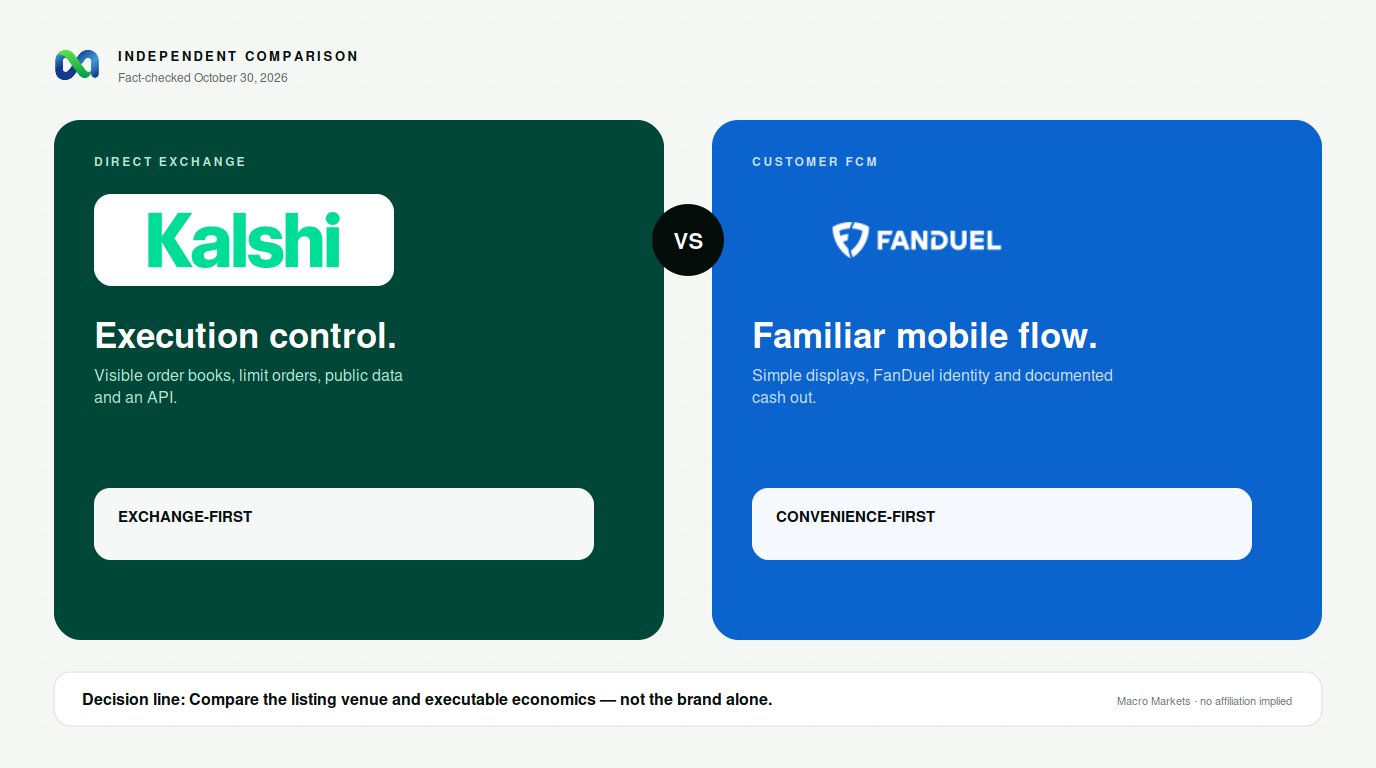
Kalshi and FanDuel Predicts both offer event contracts, but they give customers different routes into the market. Kalshi is the listing exchange and exposes its order book directly. FanDuel Predicts is a futures commission merchant, or FCM, that provides a familiar consumer interface for contracts listed on supported exchanges.
Our verdict: Kalshi is the stronger default for users who want direct exchange access, visible order books, limit-order control and an API. FanDuel Predicts is the stronger default for eligible US customers who value a familiar FanDuel account, simple price displays and a documented cash-out flow. Neither platform wins every cost or liquidity comparison. The exact contract, listing venue, executable price, available size and exit path matter more than the brand.
Last reviewed and fact-checked: October 30, 2026.
Editorial disclosure: Macro Markets publishes this comparison and operates a prediction-market platform. We include Macro Markets as a disclosed crypto-native alternative, apply the same decision criteria and do not present it as a CFTC-designated US exchange. This is a documentation-based comparison; we did not open, fund and place simultaneous matched orders on Kalshi and FanDuel Predicts. Event contracts are speculative and can lose the full amount committed. This page is educational, not financial, tax or legal advice.
Kalshi vs FanDuel Predicts: Quick Verdict
Choose Kalshi if you want a dedicated exchange account and more control over execution. Kalshi publishes market data, displays order books, supports resting limit orders and offers a REST API. Those features make it easier to inspect the price and quantity available before entering a position.
Choose FanDuel Predicts if you want an event-contract experience built around the FanDuel account and mobile interface. It uses percentage, multiplier and cents displays, keeps Predicts funds visible beside the separate Sportsbook balance, and documents a cash-out process for eligible open positions.
The legal and operational distinction is central:
- Kalshi is a CFTC-designated contract market where the contract is listed and traded.
- FanDuel Prediction Markets LLC is a CFTC-registered FCM that carries the customer relationship and provides access to supported exchanges.
- CME Group exchanges or CDNA can supply the contract, order rules, clearing route and settlement terms shown through FanDuel.
This does not mean one structure always produces a better price. Kalshi can have a wide spread or shallow book. FanDuel can surface a competitive contract through one of its supported venues. Compare executable economics, not business labels alone.
Winner by use case
- Direct exchange account: Kalshi.
- Order-book visibility and limit orders: Kalshi.
- Public API and technical workflows: Kalshi.
- Familiar FanDuel identity and mobile navigation: FanDuel Predicts.
- Clearly documented cash-out flow: FanDuel Predicts.
- Broader international eligibility: Kalshi, subject to its Member Agreement and restricted jurisdictions.
- US account tied to a familiar sports brand: FanDuel Predicts.
- Lowest total trading cost: no universal winner.
- Best liquidity: no permanent winner without a simultaneous matched-contract test.
- Crypto-native funding and global discovery: Macro Markets for eligible users, with a different custody, jurisdiction and regulatory profile.
Our prediction-market comparison methodology explains why we compare legal entity, venue, rules, price, spread and available size before brand familiarity. For full product analysis, read the Kalshi review and FanDuel Predicts review.
Kalshi vs FanDuel Predicts at a Glance
| Decision factor | Kalshi | FanDuel Predicts | Practical edge |
|---|---|---|---|
| Customer route | Direct account with a designated contract market | Retail FCM account accessing supported exchanges | Depends on workflow |
| Public age baseline | 18+, subject to identity and jurisdiction checks | 18+, subject to identity, location and account approval | Tie |
| Geographic scope | US plus many international jurisdictions; restrictions apply | US retail product; visible product and markets depend on physical location | Kalshi for international reach |
| Listing venue | KalshiEX | CME Group DCMs and CDNA under current disclosure | Kalshi is simpler; FanDuel offers multiple channels |
| Market catalog | Sports, politics, economics, weather, crypto, culture and more | Sports, financials, crypto, economics, culture and other supported events | Contract-specific |
| Trading controls | Order book, resting limit orders, market data and REST API | Consumer order flow, price-display choices and cash out when available | Kalshi for advanced control |
| Fee snapshot | Probability-weighted general schedule; special series can differ | Public cash-out support states up to $0.02 per dollar cashed out | Different bases; compare the ticket |
| Wallet | Dedicated Kalshi balance and multiple funding rails | Predicts and Sportsbook wallets remain separate | Different account model |
| Early exit | Submit a sell order against the book | Cash out when liquidity and product conditions permit | Both depend on liquidity |
| Settlement | Kalshi contract rule and named source | Rule of the exchange listing the FanDuel contract | Read the exact specification |
| Liquidity | Contract- and time-specific | Contract-, exchange- and time-specific | No universal winner |
What the table cannot show
The table cannot prove that two market headlines represent the same instrument. One contract may use a different official source, observation time, postponement rule or correction policy. It also cannot show the live quantity available at the displayed price.
Before choosing, match the complete question and settlement terms. Then record the executable bid, ask, quantity and fee. A percentage on the screen can be useful for orientation, but it is not a guarantee that the desired order will fill at that level.
Platform fit versus contract fit
A platform can be easy to use and still offer an unattractive contract. A complex interface can still expose the best price. Separate these decisions:
- Platform fit: onboarding, funding, wallet, controls and support.
- Contract fit: source, deadline, venue, price, spread, depth and settlement.
The second decision determines the actual risk and payoff. The first determines how easy it is to manage that decision.
Regulation, Exchanges and Account Structure
Both products operate within federally regulated US derivatives infrastructure, but they occupy different layers. Kalshi is the exchange. FanDuel Predicts is the customer FCM, while supported exchanges list the contracts.
Kalshi's direct exchange route
The CFTC's Kalshi record identifies Kalshi as a designated contract market since November 3, 2020. The same record notes that the CFTC modified its designation in January 2025 to permit intermediated futures trading.
Retail customers commonly use Kalshi directly. Their orders enter Kalshi's central limit order book, and Kalshi's rules define the contract and trading process. Current Kalshi materials also describe affiliated clearing through Kalshi Klear.
The direct route makes the venue easy to identify. It does not remove market risk. An order can remain unfilled, the available price can move, and a market can be halted or closed. The value is transparency and control, not guaranteed execution.
FanDuel Predicts as the customer FCM
The FanDuel Predicts risk disclosure identifies FanDuel Prediction Markets LLC as a CFTC-registered FCM and NFA member. The FCM opens and carries the customer account, handles funds and transmits or executes eligible orders.
FanDuel Predicts is jointly owned and operated by FanDuel Group Inc. and CME Group Inc. Its July 30, 2026 FCM disclosure describes two event-contract channels:
- CME Group designated contract markets, accessed through a non-clearing omnibus relationship with Plus500US Financial Services LLC.
- Crypto.com Derivatives North America, or CDNA, accessed through direct membership.
The disclosure also says customer activity is self-directed and fully collateralized. FanDuel does not promise that every customer will see every contract from both channels.
Why the venue and clearing route matter
The exchange writes the contract specification, operates the market and determines the rules for settlement. The clearing route determines how obligations and customer collateral move through regulated infrastructure. FanDuel's interface can make those layers less visible than the consumer brand.
For each FanDuel Predicts order, identify:
- the exact listing exchange;
- the market and contract rule;
- the official settlement source and observation time;
- the executable price and available quantity;
- all entry and potential cash-out costs.
On Kalshi, the first answer is simpler, but the remaining checks still apply. A direct exchange relationship does not make every Kalshi market liquid or every rule obvious.

Regulation is not a trading guarantee
CFTC and NFA oversight is important. It provides evidence about registration, disclosures, customer accounts and market rules. It does not insure a user against a wrong forecast, an unfavorable fill or a missing early exit.
Both products expose users to:
- market risk: a position can settle at zero;
- liquidity risk: an exit can be costly or unavailable;
- rule risk: a short headline can hide decisive conditions;
- operational risk: apps, exchanges, clearing firms or data providers can fail;
- legal risk: sports event contracts remain subject to state and federal disputes;
- security risk: compromised accounts or payment methods can expose funds.
FanDuel's June 2026 risk disclosure specifically warns that litigation or regulatory action could lead to halts, forced close-outs or positions that cannot be offset at the expected price. Our guide to whether prediction markets are legal explains why exchange registration and state access are separate questions.
Fees, Spreads and a 100-Contract Cost Example
Kalshi and FanDuel publish fee information in different forms. Kalshi publishes a general trading formula and a table by contract price. FanDuel's support material publishes a ceiling for the fee included in cash-out value. Those numbers do not describe the same transaction stage.
Kalshi general fee snapshot
Kalshi's schedule effective July 7, 2026 gives this general formula for orders that immediately match resting liquidity:
fee = round up(M × 0.07 × C × P × (1 − P))
P is the price in dollars, C is the contract count and M is the applicable multiplier. Some series have different maker or taker treatment. The current ticket controls.
For 100 contracts at $0.50 with a multiplier of one, Kalshi's published table shows a $1.75 trading fee. At $0.25, the same table shows $1.32. At $0.90, it shows $0.63. The probability-weighted curve is highest near the middle.
The schedule also states no settlement or membership fee and no Kalshi fee for ACH deposits and withdrawals. Debit, crypto and other payment rails can have separate processor or network charges.
What FanDuel's public fee statement covers
FanDuel's cash-out support page at support.fanduel.com/s/article/How-does-cash-out-work-with-FanDuel-Predicts says the displayed cash-out value includes a transaction fee of up to $0.02 per dollar cashed out. It also says cash out depends on market liquidity and may not always be available.
That is an exit-fee ceiling, not proof that every entry costs 2% or two cents per contract. FanDuel's customer agreement says commissions, exchange charges, regulatory fees and service charges can apply at rates disclosed through its websites or electronic communications. The signed-in order flow and current schedule control the opening economics.
A neutral 100-contract entry example
Assume both products show economically identical Yes contracts at $0.50 and the user wants 100 contracts. The premium is $50 before fees.
| Component | Kalshi illustration | FanDuel Predicts illustration |
|---|---|---|
| Contract premium | $50.00 | $50.00 |
| Publicly calculable entry fee | $1.75 under the general immediately matched schedule | Confirm in the live order flow |
| Exchange and intermediary layers | Kalshi exchange fee shown in example | Supported exchange and FCM charges may apply |
| Entry total before funding costs | $51.75 | $50.00 plus disclosed live charges |
The blank FanDuel entry cell is deliberate. A fair comparison does not invent a number when the public cash-out ceiling describes a different transaction.
A separate cash-out example
Assume an open FanDuel position shows a $70 gross cash-out value. The published ceiling of two cents per dollar implies a fee of up to $1.40 included in that value. The actual displayed net amount controls.
For a comparable Kalshi position, the customer submits a sell order. The exit economics depend on the available bid, quantity, series multiplier and fee treatment at that moment. A 100-contract sale around $0.70 would use the applicable Kalshi schedule, but it is not equivalent to FanDuel's cash-out interface unless the contract and gross executable value match.
Spread and slippage can reverse the result
Suppose one platform offers an executable ask of $0.49 and the other offers $0.52. Across 100 contracts, the price difference is $3 before fees. That can exceed the visible difference between the published fee examples.
Use a complete formula:
All-in cost = premium + FCM charges + exchange fees + spread + slippage + funding cost + exit fee + applicable taxes
Our prediction-market fee calculator helps compare the layers. The guide to the bid-ask spread explains why an attractive midpoint may not be executable.
Markets, Availability, Wallets and Trading Tools
Kalshi and FanDuel Predicts both cover sports and non-sports events. The difference is not simply catalog size. It is how the user finds, prices and manages the contracts that are actually available in the current location.
Sports and non-sports markets
Kalshi lists sports alongside politics, economics, weather, crypto, technology and culture. It is built as a general event exchange rather than a sports product with additional categories.
FanDuel Predicts launched with financial benchmarks, commodities, crypto, economic indicators and sports. Its current public materials describe sports, culture, financials, crypto and more. FanDuel's sports-brand experience can make league and event discovery more familiar to existing customers.
Category labels do not establish value. Compare the exact contract's rule, price and depth. A larger menu with thin books can be less useful than a smaller catalog with a clean settlement source and competitive executable quote.
Availability depends on location and contract type
Kalshi currently says individuals must be at least 18, pass identity checks when requested and comply with the Member Agreement. It says the exchange is accessible in many international jurisdictions, subject to restricted countries and local law.
FanDuel Predicts is a US retail product. FanDuel's app support explains that the product shown can change with physical location. Sportsbook may appear in some states and Predicts in others. The same FanDuel account remains, but the available product, promotions and features can change.
FanDuel's launch statement said financial event contracts would be available broadly while sports contracts would be limited by state and tribal-land rules. It also said sports event contracts could be removed as a state legalized online sports betting. Current in-app eligibility is more reliable than a static launch map.
Account availability is not the same as market availability. A user can have a valid FanDuel account and still lack the desired sports contract. A Kalshi user can also face contract-specific restrictions or legal changes.
Separate FanDuel wallets
FanDuel Predicts and FanDuel Sportsbook use separate wallets, histories and promotions. Both balances can appear in the Account Hub, but funds do not transfer directly between them. Each balance has its own withdrawal button and product-specific flow.
This is easy to misunderstand because the identity and visual brand remain FanDuel. A Sportsbook balance should not be assumed to fund a Predicts order. Predicts trades also do not automatically count toward Sportsbook rewards.
Kalshi uses its own dedicated balance and publishes a broader set of transfer rails, including ACH, debit, wire, PayPal, Venmo, Cash App and crypto where supported. Methods, fees and withdrawal holds vary by region and provider.
Order controls and API access
Kalshi is the stronger fit for advanced execution. Users can inspect the order book, place a resting limit and use the REST API for market data, orders, trades and portfolio history. A limit gives price control but does not guarantee execution.
FanDuel Predicts favors a guided consumer order flow. It offers percentage, multiplier and cents displays. Its support material says the system attempts to limit large execution-price changes, but the live confirmation remains decisive. FanDuel does not publicly position the retail product around an open trading API.
Simple presentation is useful for occasional users. It can also hide the venue, book and fee layers. Expand the order details and contract rule before confirming.
Cash out and early exit
Kalshi customers can place a sell order against available book liquidity. FanDuel customers may receive a cash-out value and submit a sale through the product. Both methods depend on a counterparty and an executable market.
Cash out is not a guaranteed refund. FanDuel says availability and value can change until submission. A halted, closed or thin market may offer no usable exit. Kalshi users face the same practical problem when the book has no acceptable bid.
We do not name a universal liquidity winner. A valid test would need:
- the same economic event and settlement rule;
- observations at the same time;
- the same side and quantity;
- executable bids and asks rather than a midpoint;
- repeated samples across sports and non-sports markets.
Without that evidence, customer reach and total platform volume are only proxies. Our guide to how to trade on prediction markets provides a pre-order checklist.
What if neither product fits?
Macro Markets is a crypto-native alternative for eligible users who prioritize crypto funding and global market discovery. It is not presented as a CFTC-designated US exchange or as an FCM route comparable to FanDuel Predicts.
Crypto-native access changes the diligence required. Review jurisdiction, collateral asset, custody, network costs, withdrawal mechanics, liquidity and resolution. A crypto rail can solve a funding preference while adding risks that do not exist in the same form in a US FCM or direct DCM account.
Because Macro Markets publishes this comparison, treat this as a disclosed first-party description. Verify its current terms independently. For more options, see the best prediction market apps, Kalshi alternatives and FanDuel Predicts alternatives.
Frequently Asked Questions
Is Kalshi better than FanDuel Predicts?
Kalshi is better for direct exchange access, order books, limit orders, API workflows and broader international eligibility. FanDuel Predicts is better for eligible US users who value a familiar FanDuel account, simple displays and documented cash out. The better contract can still appear on either product.
Which platform has lower fees?
There is no universal answer from the public numbers. Kalshi publishes a probability-weighted schedule. FanDuel publicly states that cash-out value includes a fee of up to two cents per dollar cashed out, while opening charges must be checked in the live order flow. Include spread and slippage.
Is FanDuel Predicts an exchange?
No. FanDuel Prediction Markets LLC is the customer FCM. Current disclosures say it offers event contracts through CME Group designated contract markets and CDNA. The listing exchange and contract rules determine settlement.
Is Kalshi an exchange?
Yes. KalshiEX is a CFTC-designated contract market. That status is meaningful, but it does not guarantee profit, immediate liquidity or access to every contract in every jurisdiction.
Does FanDuel Predicts use CME or Crypto.com?
Its July 2026 FCM disclosure describes both routes: CME Group DCMs through a non-clearing omnibus relationship and CDNA through direct membership. The exact contract shown in the order flow identifies the relevant venue.
Can I use my FanDuel Sportsbook balance?
Do not assume so. FanDuel documents separate Predicts and Sportsbook wallets. Both can appear in Account Hub, but funds do not transfer directly between them.
Can I cash out before settlement?
Potentially. FanDuel may display cash out when liquidity permits, and the value includes the applicable fee. Kalshi lets a user submit a sell order. Neither guarantees an acceptable early-exit price.
Which platform has better sports markets?
FanDuel has the more familiar sports-brand navigation. Kalshi provides stronger exchange controls and a broad sports catalog. Compare the current contract rule, price and available size rather than awarding a permanent catalog winner.
Which platform has better liquidity?
Neither can be named the universal winner without simultaneous matched-contract evidence. Liquidity varies by venue, contract, time, side and order size.
Is FanDuel Predicts available in every state?
The product and individual markets depend on physical location. FanDuel can show Sportsbook in some states and Predicts in others, and sports event contracts can have additional restrictions. Check the current app after location verification.
Is Kalshi available outside the US?
Kalshi currently says it is accessible in many international jurisdictions. Restricted countries, the Member Agreement, identity checks and local law still apply. Funding methods also differ for international users.
What is the best crypto-native alternative?
Macro Markets is the disclosed crypto-native alternative in this article for eligible users seeking crypto funding and global discovery. It has a different jurisdiction, custody and regulatory profile and is not presented as a CFTC-designated US exchange.
Final Verdict
Kalshi wins on trading control. Its direct exchange structure, visible order book, limit orders and REST API make it the better default for active, price-sensitive or technical users. Its current international availability is another advantage for eligible users outside the United States.
FanDuel Predicts wins on familiar consumer flow. It keeps the FanDuel identity, offers several simple price displays and documents how wallet separation and cash out work. Its CME and CDNA channels can provide a varied catalog, but users must inspect the listing venue and rule on each order.
Neither wins automatically on fees or liquidity. Kalshi's July 2026 general table shows $1.75 for 100 immediately matched contracts at 50 cents. FanDuel's public cash-out ceiling describes an exit value, not a universal entry fee. The live order flow, spread, depth and net exit proceeds decide the result.
Use this final Kalshi vs FanDuel Predicts checklist:
- Match the complete event, source, threshold and expiry.
- Identify the listing exchange and current fee layers.
- Compare executable prices and quantity at the same moment.
- Confirm location, wallet and funding eligibility.
- Plan the exit before entering the position.
For most active traders, Kalshi is the stronger default. For eligible US customers who prefer a familiar sports-brand experience and simple cash-out flow, FanDuel Predicts is the stronger default. For eligible users deliberately seeking crypto rails and global discovery, Macro Markets is the disclosed alternative—with a different risk profile that should be evaluated separately.
